
SALVADOR, EL. - The smallest (34,126 sq. km.) of the Central American Republics and the only one facing solely onto the Pacific.
I. GEOGRAPHY
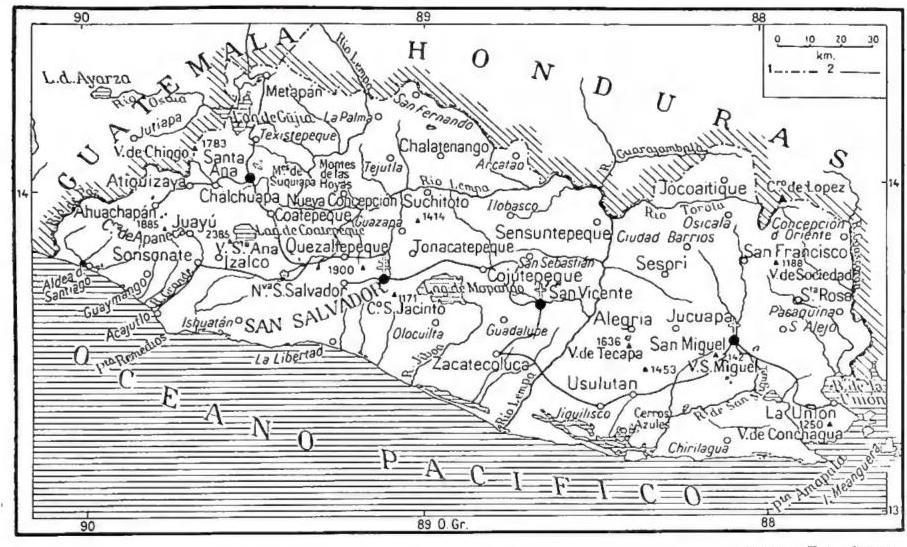
The territory is formed by an internal high plateau (600 m. in elevation, on average), with volcanoes partly still active, and by a narrow coastal fringe, interrupted by lagoons. The climate is hot and humid on the coast, more temperate and healthy in the elevated regions. El Salvador is an agricultural country; the main products are: coffee, largely exported, sugar cane, cacao, tobacco, agave and, recently, cotton; cereals (corn and rice) provide for domestic needs. The forests are rich in valuable timber; mineral resources (gold and silver) are mediocre. Industries, despite modern progress (textiles), have a merely local value. It should nevertheless be noted that El Salvador is, due to its economic development, the most evolved State in Central America.The population (2,200,000 inhab.) consists of 15% whites, 10% Amerindians, and 75% mestizos. Its density (60 per sq. km.) is the highest in Central America. The only city exceeding 100,000 inhabitants is the capital, San Salvador. La Unión (10,000 inhab.) is the port with the greatest traffic.
El Salvador is a unitary republic, with a president renewable every six years and a legislative assembly elected by universal suffrage.
II. CIVIL AND ECCLESIASTICAL HISTORY
At the time of the discovery of America and the subsequent Spanish penetration into the continental lands, present-day S. was inhabited by the Pipils, an Aztec population whose capital, Cuscatlán, was occupied in 1525 by Pedro de Alvaredo, who had entered the country from Mexico through Guatemala.Three years later Pedro's brother, Jorge, founded the city of S. S. at a short distance from Cuscatlán. S. thus became part of the Captaincy General of Guatemala, whose jurisdiction extended over all the present-day Republics of Central America (Costa Rica, Nicaragua, Honduras, S., Guatemala) and over the Mexican provinces of Chiapas and Yucatan.
(prop. Enc. Catt.)
III. LEGAL SITUATION OF THE CHURCH
The recent Constitution, promulgated on September 14, 1950, recognizes the legal personality of the Catholic Church (art. 161), whereas other Churches can receive recognition by requesting it on a case-by-case basis.However, all the modifications introduced by the Constitutional Charter of 1945 to that of 1886 that were favorable to the Church itself have been abolished. No mention, for example, is made of the Catholic religion as that professed by the vast majority of the people. Ministers of any cult are prohibited from belonging to political parties and from holding public office (art. 24). Likewise, the establishment of contemplative orders in the national territory is prohibited (art. 156), and there are limitations on the right to property of religious entities and congregations (art. 140). Since 1882, the precedence of the civil
act over religious marriage has been imposed; the Civil Code easily permits divorce; illegitimate children are placed on an equal footing in every respect with legitimate ones. This legislation contributes in no small measure to the regrettable conditions of the family institution in S.
Article 201 reaffirmed the secular nature of the school system, which had been suppressed by the constitutional reform decree of December 1945, and the situation of private schools has also become less favorable, as they have been subjected to regulation and inspection by the State, which may furthermore arrogate to itself, in an exclusive manner, the training of teachers (art. 202). The Constitution further provides that private schools may not refuse to accept a student on the grounds of illegitimate birth (art. 202). Other legislative provisions, dating from 1926 for secondary schools and from 1939 for primary ones as well, require that 80% of the teachers be Salvadoran. These provisions, however, which would prove severely detrimental to schools run by religious personnel, are not strictly enforced.
In the appointment of bishops, the government of S. has no interference nor any form of patronymic right.
Relations between the Holy See and the Republic of S. are normal. Diplomatic relations exist between the two parties, with an apostolic nuncio accredited to the government of S. and an ambassador to the Holy See.
Since 1935, the pontifical representation in S. has been united, in the person of the incumbent, with that of Guatemala.
IV. SCHOOL SYSTEM
It must be noted that the Republic of El Salvador is making a commendable and effective effort to improve both the level of instruction and education of the people, and the treatment of the teaching staff.The elementary school covers 6 years; in 1951 there were 1,520 schools (with a tendency to increase significantly) directed by 3,700 teachers with 11,000 pupils. Secondary school, called "Five courses of science and letters," covers 5 years; in 1951 there was 1 normal school and 22 vocational schools, with a total of 3,336 pupils. It grants the title of bachelor and with this opens access to the University. The latter is established in the capital, is equipped with five Faculties and attended by 900 students.
Noteworthy is the "Rafael Campo Rehabilitation Farm" for juvenile delinquents, in which the most recent experiences are implemented both in the field of agriculture and in that of re-education, taking into account the environment and character of the re-trainees to better prepare them for the social circumstances to which they will return to live. Likewise, the impetus given to facilitating the reading of books and documentation should be noted, by creating new public libraries and expanding existing ones; all with free lending.
The sums allocated for culture and popular education represent 13.5% of the general state budget.