
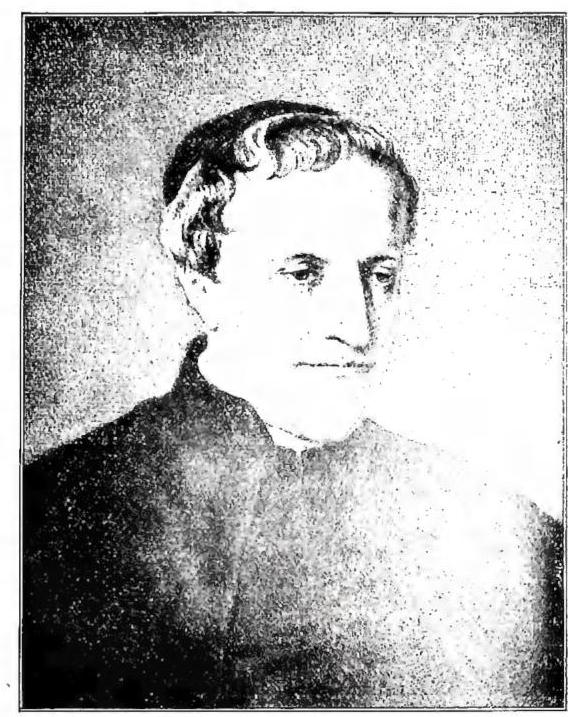
ROSMINI SERBATI, ANTONIO – Philosopher, theologian, founder of the Institute of Charity, born in Rovereto (Trento) on March 24, 1797, to Pier Modesto and Giovanna dei Conti Formenti, died in Stresa on July 1, 1855.
CONTENTS:
I. Life
II. Asceticism
III. Philosophy
IV. Theology
V. Pedagogy
VI. Political and Social Doctrines.I. LIFE. – A singular and precocious intellect, after his early schooling he continued his studies privately. In 1816, he attended the theology course at the University of Padua, where BADIA, TOMMASO (v.). Ordained a priest in 1821, he pursued various studies for several years (politics, history, mathematics, medicine, metaphysics, etc.) and attempted to establish a "Society of Friends." In 1826, he went to Milan, Manzoni (v.) began. In 1828, Institute of Charity (v.) on Mount Calvary near Domodossola. That same year, he traveled to Rome, where Pope Pius VIII expressly ordered him to devote his activity primarily to writing. Gregory XVI confirmed his predecessor’s judgment with public expressions of esteem for his "knowledge of divine and human things" (Apostolic Letter: In sublimi, 20 September 1839). In 1830, Rosmini published in Rome the Maxims of Perfection and the New Essay on the Origin of Ideas, which laid the foundations of his asceticism and philosophy. Returning to northern Italy, he divided his time between Trentino and Piedmont, overseeing the governance of the Institute (which in 1833 expanded to include a female branch, the Sisters of Providence, and in 1835 extended to England) and composing his numerous works, which earned him widespread renown in Italy.
Yet under Leo XIII, on 7 March 1888, a decree of the Holy Office "Post Obitum" (prepared as early as 14 December 1887) was published: it condemned forty propositions of Rosmini, drawn from both his previously dismissed works and his posthumous writings (the latter more extensively censured). The decree did not attach any theological note to the propositions but stated in its introduction that they had been denounced because they "seemed not in accord with Catholic truth." In fact, the accusers under Leo XIII repeated the same charges made under Pius IX. Opinions differ on how to resolve the apparent contradiction between the two judgments; nevertheless, the "Post Obitum" decree carries the full authority of analogous judgments of the Holy Office. In the last century, debates over Rosmini were intense and at times acrimonious, but they have since subsided. Speculative disagreements about his philosophy persist, yet there is growing consensus in the appreciation of his ascetical writings and his personal sanctity.
II. ASCETICS
Rosmini’s figure is characterised by a profound unity, constituted by the supreme appreciation of moral and spiritual values.In his personal diary at the beginning of 1813, he notes: « questo fu per me anno di grazia: Iddio mi aperse gli occhi su molte cose e conobbi che non eravi altra vera sapienza che in Dio » (Scritti autobiografici, p. 419). At the age of 24, he establishes as a rule of life the « principio di passività », by which he intends to overcome a nature rich in all the most human instincts, inclined toward activity and command and toward intellectualistic « passione », withdrawing into a life of retreat, prayer, and patient, solid study, to make himself fit for God’s « chiamata ». In 1828, he applies this principle to a society by founding the Istituto della Carità, and from that moment, he deprives himself of the advantages he could have derived from the affluence into which he was born and from the Milanese environment, but above all, he renounces any arbitrary choice of his place in the world. His Massime di perfezione cristiana and his discourse Della carità (in the volume La dottrina della carità) summarise his ascetic ideal, echoed in his complete Epistolario (13 vols.), a documentation of extraordinary industriousness and, at the same time, of a constant commitment to subordinate this to a single principle: which presents itself as « carità », if considered in God, as the realisation of the essential « Bene » in itself and the source of all participated good, or as « Giustizia » (in the sense of Mt. 5:6), if considered in us, that is, as our participation in the essential Love and Good, through Grace and our voluntary correspondence. For Rosmini, this single principle leads the Christian to seek both the greatest direct union with God and—within a disposition of full indifference to the divine will—the greatest cooperation with Him in the unfolding of His creation. Active life thus becomes another way of practising union with God, insofar as it is adherence to His will, which manifests itself expressly in the « chiamata ». It seems that Rosmini attempts, by this path, an organic solution to the problem concerning the value of the two lives, the contemplative and the active, safeguarding the traditional doctrine of the intrinsic primacy of the former while recognising the modern demand for a higher valorisation of the latter. The foundation and nourishment of the entire spiritual life, however, remains contemplation.
On the other hand, Rosmini insists on the character of unlimited potentiality proper to charity, making it one of the principles of his personal conduct and of his Institute. To those who objected that man must still limit himself in his practical activity, he responded that the limit must come not from our choice but from God, according to those indications of Providence that determine for each a certain field of action. One of the consequences of this principle of Rosmini’s is the adaptability of his Institute, with the exercise of the most diverse forms of charity—albeit within the limits suggested by the dispositions of Providence—to the variations of circumstances and times. He also believed that his Institute, born not from a special and extraordinary inspiration of God but from the simple and immediate meditation of the Gospel, the common patrimony of Christians, should be considered before the Church simply as an eventual auxiliary, a second-line militia. Another characteristic of Rosmini’s ascetics is the profound union Christ (v.); the work of individual sanctification is identified with full dedication to the Church, to whose « incremento e gloria », according to the very title of the second Massima di perfezione, « tutti i propri pensieri e azioni » must be directed. Hence also the importance Rosmini gave to liturgical life, though tempered by his study of Ignatian ascetics, whose new developments he proposed in the Manuale dell'esercitatore. Love for the Church was his most constant passion, and from this came the occasion for the deepest sorrows of his life. Even Rosmini’s activity as a writer and philosopher was directed by his ascetic principles. For him, it was a way of exercising charity (cf. G. Capograssi, in Studi rossiniani, Milano 1940, p. 104); and although by nature inclined toward philosophy and urged by friends, especially Manzoni, to devote himself entirely to it, he did not decide to do so definitively until after the exhortation and command of Pius VIII, in which he saw the most authentic sign of the divine will (Introduzione alla filosofia, n. 11).
III. PHILOSOPHY
For Rosmini, charity extends even to knowledge. Hence his effort to understand modern thought. He was concerned with what he called the "conciliation of opinions" (Introd. alla filos., 45-54), that is, the study of highlighting what is common in the thought of philosophers from the most opposing schools and of valorizing the element of truth found in doctrines unacceptable in their entirety. He sought a Christian philosophy, that is, as he understood it, not a philosophy "that mingles with the dogmas of religion" or that has a direct apologetic intent, but a philosophy valid in itself, capable of forming minds vigilant against the snares of error and open to Truth, by whatever path it may present itself, including Revelation. Hence the not insignificant pages he dedicated to the principle "of the freedom of philosophizing" in the Introduzione alla filosofia (20-40). Even if he did not follow a strict systematic order in the exposition of his thought, he believed that philosophy must compose itself into a system, that is, into an order that gathers all the reflections of human thought, varied in purpose and matter, around a single principle, from which they receive an imprint of organicity; a principle he identified with being (v. below). Profound was his historical sense. He intended to reconnect with the philosophia perennis, valorizing tradition and particularly Scholasticism andSt. Thomas, of whose revival in the second half of the 19th century he may be considered a conscious precursor. In all his works, there is evident a continuous concern to show the substantial agreement of his doctrines with those of the Aquinate along the lines of classical metaphysics.
It is appropriate here to indicate only the main directives of Rosminian doctrines. First and foremost, Rosmini gives the utmost importance to immediate experience as the basis of dialectical reasoning. He reproached German idealism for the grave methodological error and true sophism of having pretended to start from the Ego (self-consciousness) and from philosophical thought, without taking into account the human rational activity that precedes and founds them, indeed presuming to be able to deny or entirely devalue it (Teosofia, V, ch. 6 and passim). Profound in Rosmini is the tendency toward psychological analysis and the search for what constitutes the "direct" life of man (Psicologia, nn. 1670-75), in contrast to that of which the subject is conscious and which he directs with a reasoning will. The unconscious is one of the laws of human activity (ibid., 1479-84); and many things "are or arise in the mind and heart of man without his forming consciousness of them. This is one of the factors of the human spirit that easily escape notice and that are nonetheless of supreme necessity to whoever wishes to philosophize" (Filosofia del diritto, II, n. 638, note).
Psychological analysis leads Rosmini to the conclusion that the first act by which man exists is a synthesis, whose elements are: 1) the fundamental corporeal sentiment; 2) sensitive perception; 3) the intuition (or intellection) of being. The first two posit and circumscribe the individual subjectivity of man; the third actualizes man as intelligent; but their subsistence is one and the same, given the reciprocal exigency they have for one another in order to be realized. The saying of St. Augustine: "Commonebo, si potero, ut videre te videas" (De Trinit., XI, 12) is placed as a motto at the beginning of vol. II of the Nuovo saggio, where Rosmini expounds his knowledge (v.) and illustrates the three indicated elements. These are something immediately present in us, even if habitually unnoticed (cf. Nuovo saggio, nn. 1038-39). In the Nuovo saggio (nn. 693-719), the "fundamental sentiment" is illustrated especially in relation to the body. Later, in the Teosofia, it takes on a broader meaning: "man knows in himself no other reality than his own fundamental sentiment and his own intellective sentiment" (II, n. 513). But these two sentiments in fact do not exist except in a living unity, the "rational sentiment," which is truly "fundamental to us" (ibid., III, n. 1419). Such sentiment individualizes the human subject, who is a unique principle of two terms that simultaneously characterize him: 1) the body, in which and through which man finds himself in relation with the world of material sensitive experience, 2) the ideal being ("idea of being" in the Nuovo saggio), objective form or "formal object," whose presence gives the subject his true intellective and thus rational actuality. Therefore, man results from an intellective principle that individualizes itself by means of a corporeal sentiment "perceiving it" (Sistema filosofico, n. 142), that is, actualizing itself through a permanent synthesis with II.
The fundamental corporeal sentiment is the unique, uniform, continuous, unfigurable act by which we feel our body as alive: it enables the body to react to external stimuli and to occasion sensations, varied, discontinuous, particular, determined by the different sense organs, but identical in their belonging to a single "individual" of which they are transient modifications. One's own body, "a substance endowed with extension, which produces in us a pleasant or painful sentiment, which terminates in extension itself" (Nuovo saggio, n. 871), is perceived in the fundamental sentiment as a force with respect to which the soul is passive, and this is proof of the alterity of the body with respect to the soul. But at the same time, the soul reacts upon the body, occupies it, and makes it its own (a psychological fact from which arises the concept in general of property), using it as its instrument and yet—
(from ed., Turin 1882)
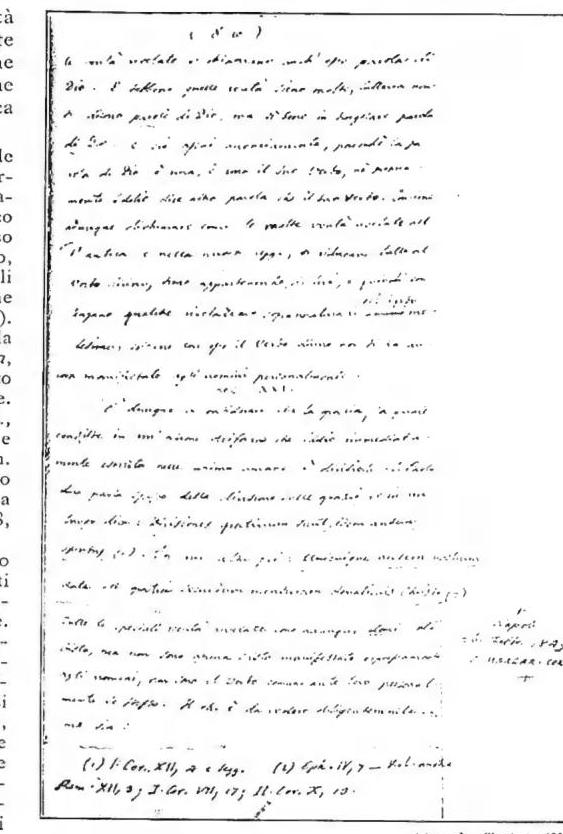
ROSMINI SERBATI, ANTONIO - Autograph from the manuscript of the Introduction to the Gospel of St. John Commented, written by Rosmini during his return from Gaeta to Piedmont (1846).
Neither sentiment nor perception is a human act unless both synthesize with what for Rosmini is the form of the "rational sentiment" proper to man, that is, the presence of the formal intellectual object, the ideal being, being as the light of the mind. This "form" renders perception true cognition, that is, intellectual perception (Nuovo saggio, nn. 528-38; Psicologia, nn. 256-72); a "form," in a sense very different from the Kantian one, because it is objective and not merely functional (Rosmini’s critique of Kant is incisive, both for the persistent subjectivism—an involuntary residue of sensism—in human knowledge and for the groundlessness of "synthetic a priori judgments": ibid., nn. 346-60). The objectivity of the "form" of human knowledge is what Rosmini most insists upon against Kant and idealism. From a passage in the Summa Theologiae: «Obiectum intellectus est ens, seu verum commune» (I, q. 55, a. 1), he drew inspiration for his theory of the idea of being, the innateness of which he expounds in minute detail in the Nuovo saggio (nn. 413-72), distinguishing, however, his innatism (v. innatism) from that of Plato and other thinkers, because what he posits as innate in the mind has the characteristic of indeterminacy. Hence, in the Teosofia (V, n. 57), he declares that "if by cognition one means those notions that come to man from his own mental operations, the notion of indeterminate being as it stands present to intuition cannot be called cognition." This being is "indeterminate" in the sense that it carries with it an infinite potentiality for determination, dialectically prior to any actual distinct operation of the intelligent subject. It is what renders the subject capable of performing such operations; it is the light of reason, possessing the characteristics of universality, absoluteness, and necessity, and containing implicitly the principles of reason. It must not, however, be confused with the idea of being as the ultimate result of the abstractive process. To avoid the danger of this confusion, Rosmini later preferred the expression "ideal being," which also seemed to him apt for showing ontology (v.).
Being has an immediacy of relation with the human soul not only in the ideal form (by which man is made capable of realizing truth and certainty: Nuovo saggio, nn. 1044-1142), or in the real form through the perception of the self or of bodies, but also in the moral form, that is, insofar as being is the object and criterion of appreciation. The light of reason indeed has a logical priority over the principle of morality, but together with this it "informs" the human soul in a single primordial act, and thus reason and will arise in him simultaneously; and the "primitive perception" (Psicologia, n. 265), or first substantial synthesis by which man begins to realize himself, is at the same time an act of appreciation (Rosmini will later apply this in his theory of original sin; Antropologia soprannaturale, II, p. 255). The formula of the supreme moral principle is the "practical (voluntary) recognition (esteem, love) of being in its order" (Principi di scienza morale, ch. 5, a. 4, and passim). The concept of the order of being arises from the measure that each thing has when viewed in the universal relation of entities, and it becomes increasingly clear with lived experience: "love being wherever you know it, in that order which presents itself to your intelligence" (ibid., ch. 4, a. 7). Every moral act, while directed toward a particular and limited object, sees and loves it in the universal order of which it is a part, and thus implicitly loves all being in it: morality in itself renders to the infinite good. When, moreover, the intelligence presents to man the First Absolute and Supreme Being, man sees that "all other beings, compared to Him, have only a relative entity, and therefore He is the end of all. Hence... all other beings and the esteem given to them must be ordered and referred to that Supreme One" (Storia compar. e crit. dei sistemi intorno al princ. della mor., ch. 1, a. 111). It follows that morality finds its fulfillment, indeed its most real and concrete foundation, in the Absolute Being "as that to which every entity and consequently every esteem given to the various entities is referred" (ibid.). Here morality meets religion, and it is understood in what sense there can be no full morality that is not religious (Filosofia del diritto, I, Sistema).
BIBL.:
C. Caviglione, La filosofia di A. Rosmini, Torino 1883; G. Gentile, Rosmini e Gioberti, Pisa 1901; G. Morando, La filosofia di A. Rosmini, Brescia 1927; M. F. Sciacca, Il pensiero di A. Rosmini, Milano 1938; id., Rosmini, Brescia 1940; G. Bontadini, Saggio di una metafisica dell'esperienza, Milano 1938; id., Studi sull'idealismo, Brescia 1942; A. Guzzo, Rosmini, Torino 1940; C. Mazzantini, La filosofia di A. Rosmini, Torino 1941; P. Prini, Il pensiero filosofico di A. Rosmini, Brescia 1946; G. Capone Braga, La gnoseologia di A. Rosmini, Padova 1947; M. Casotti, La pedagogia di A. Rosmini, Brescia 1947; A. Carlini, Il problema di Dio e della religione nella filosofia di A. Rosmini, Brescia 1948; G. Rossi, La filosofia religiosa di A. Rosmini, Roma 1948; A. Del Noce, Riforma cattolica e filosofia moderna, I, Cartesio, Bologna 1965; id., Il problema dell'ateismo, Bologna 1964; F. Evain, La philosophie religieuse de Rosmini, Paris 1951; G. Radetti, Rosmini, Firenze 1954; C. Fabro, L'obiettività del conoscere in A. Rosmini, Roma 1955; id., La fenomenologia della percezione in A. Rosmini, Roma 1955; id., La dialettica rosminiana dell'essere, Roma 1956; id., Rosmini interprete di S. Tommaso, Roma 1957; id., L'essere e la persona in Rosmini, Roma 1957; id., Rosmini e il problema della fondazione della metafisica, Roma 1959; id., Rosmini e la vita dello spirito, Roma 1964; id., Rosmini per tutti, Brescia 1978; L. Stefanini, Rosmini, Padova 1954; P. P. Ottonello, Il problema della storia in Rosmini, Genova 1965; id., Rosmini e la filosofia del diritto, Milano 1967; G. Beschin, La filosofia della religione in A. Rosmini, Brescia 1966; M. F. Sciacca, L'interiorità oggettiva, Milano 1967; id., Rosmini: la filosofia come ascesi, Milano 1967; A. Ales Bello, La filosofia di A. Rosmini, Roma 1990; G. Beschin, Rosmini e la filosofia contemporanea, Brescia 1991; M. D'Addio, Rosmini e la tradizione filosofica italiana, Roma 1991; G. Beschin, Rosmini e la filosofia del diritto, Brescia 1994; M. Nicoletti, La teoria della percezione in A. Rosmini, Brescia 1995; G. Beschin, Rosmini e la filosofia della politica, Brescia 1997; M. F. Sciacca, Rosmini: la vita e il pensiero, Milano 1997; G. Beschin, Rosmini e la filosofia della religione, Brescia 2001; M. Nicoletti, Rosmini e la democrazia, Brescia 2002; G. Beschin, Rosmini e la filosofia della storia, Brescia 2004; M. F. Sciacca, Rosmini: la filosofia come scienza dell'essere, Milano 2004.
C. Caviglione
Morality is in man, entering into the very act by which he is constituted as a man with intelligence and will, yet it does not thereby become his subjective and individuating element; rather, in relation to this, like the light of reason (the idea of being), it remains in a relationship of immediacy but also of objectivity, preserving its absoluteness before the relativity of his existence as an individual. In this way, R. seeks to safeguard the interiority of moral life while simultaneously upholding the absolute supremacy of the law. He also preserves the reconciliation between human reality, with its ineradicable need for happiness (eudemonology), and the moral demand: "Both justice and beatitude may be called the end of man; but justice is the end that man must propose to himself, while beatitude is the end that God proposed in creating man. Human nature essentially desires beatitude; for this very reason, beatitude is not a duty, nor is it, as such, the end that man’s will must propose to itself, but it is the end that it can propose, and that it cannot help but propose. Yet if one considers in beatitude... that which is just, then beatitude too is an end that man must propose to himself: that is, he must... love happiness considered as the effect of justice, and thus as something willed by God: for God wills the beatitude of the just; and it is only right that the just should be blessed" (Lezioni spirituali, X, 1).
Against idealism, which sought to reduce the whole of man to pure thinking activity, R. affirmed the true concept of man as an "intellective and volitive animal subject," highlighting his manifold nature in its unity. The subject "man," insofar as he is rational and a persona. To the person belong all the activities of nature, including instinct, of which R. illustrates the two aspects, citate and sensual (ibid., nn. 370-426), showing how it imitates rational activity (ibid., nn. 430-94); but the human person has as its principal instrument and foundation the will (ibid., 833-51), which R., against Kant, does not identify with the moral law, reclaiming the true nature of moral obligation (v. OBBLIGAZIONE). This is "the obligation that a person has to act in a certain way so as not to render himself defective," that is, so as not to diminish the value that derives from his communion with the objective order of being (Filos. del dir., Sistema morale, sez. 1ᵃ, VII). It can refer only to a free being: freedom is precisely the pinnacle of personal action. Free will is the faculty of choosing between the objective order and a subjective good (Antropologia... morale, nn. 580-82), that is, between two criteria of evaluation that may come into conflict—one offered by the exigency of subjectivity, necessary for man to exist as an individual, the other by the exigency of the objective and universal value of being, also necessary for man to exist as a person. It is up to man to decide between these two exigencies, each of which, in its own way, possesses something totalizing and irreducible, while each promises man, if satisfied, an increase: one of natural life, the other of personal value. In the Antropologia morale, the conceptual distinction between natura (v. NATURA) and persona (v. PERSONA) is given. While both embrace the entire subsistence of the same being, the first indicates the complex of all the elements of the being (evaluated in their proper quality and function), the second the intrinsic order of these elements: "a person is an intellective subject insofar as it contains a supreme (independent) active principle" (ibid., nn. 769 and 832-37). R. developed applications of this doctrine not only in ethics but also in law, politics, education, and theology: the doctrine of the Trinity, the Incarnation, original sin. The human person possesses absolute dignity, insofar as man by nature has a divine light inherent in his reason (the ideal being), and "since the dignity of this light is infinite, therefore nothing can stand above the personal principle" (Filos. del dir., I, n. 53).
The metaphysical justification of this affirmation is provided in the vast posthumous work, the Teosofia (that is, theory of absolute thought). The central question is the antinomy (R. acknowledged Kant’s merit in having posed the problem of antinomies) between the unity of being and the multiplicity of entities. For R., unity is found in the "ens communissimum," which he calls the "essence of being" (Sistema filosofico, n. 10 and passim; Teos., I, n. 174; III, 757, etc.), the common ground of all the determinations in which being manifests itself. It is not the "idea of being" of the Nuovo saggio, which is one of its determinations as the light of the mind. Its fundamental character is the infinite virtuality of receiving determinations, in which precisely lies the reason (the capacity to be thought) for multiplicity. It is therefore the "dialectical beginning" of all entities. To have confused it with God (idealism) had to lead to pantheism (v. PANTEISMO). It is true that the "identical initial being is in the divine Mind, in the human mind, and in finite entities, created by the divine Intelligence and perceived by man" (Teos., II, n. 483); but this is as a consequence of creation. God draws it from Himself in His will to participate: in relation to God Himself, it is nothing but an abstract, and its ontological existence is founded in its relation to the creative act. It is with respect to us that it exists as something truly ontological; it dialectically precedes every single existence in the created order and formally constitutes the light of reason. Yet it first possesses an intrinsic multiplicity.
The doctrine of the three forms of being thus emerges. Ideal, real, and moral (or subjectivity, objectivity, and morality) are no longer merely, as in Rosmini’s earlier works, supreme categories inductively derived from observation; under another aspect, they are essential forms that are deductively demonstrated to be all three necessary to the "essence of being," distinct from one another yet interdependent. The demonstration is provided in the Teosofia (I, 175): «I. Supposing that ideal being existed, but that there were nothing real in the universality of things, one would posit an absurdity, that is, a contradictory concept. II. Supposing that real being existed, but that ideal being were not found at all in the universality of things, the supposition would be equally absurd. III. Supposing that ideal and real being existed, but that there were no relation between them constituting the moral form, the supposition would still be absurd.» The characteristic virtuality of the "essence of being" is therefore a virtuality of the real, ideal, and moral simultaneously; if it were not so for all three and their organic relation, it would be nullified. Form of being is: «being itself which, though entirely whole, exists in different modes essential to it» (ibid., n. 148). The analogy with the three Divine Persons of Catholic dogma is evident, an analogy Rosmini excluded could lead to confusion when one kept in mind the essential impersonality of the "essence of being" and thus of its "forms." Ideal being, moreover, is the only "form" wholly communicated to man as the light of his mind. As for real being, man, like other created entities, participates in it only in a limited way, and even for moral being, he attains only a limited measure, albeit one capable of continuous development. This is due to the intrinsic multiplicity of being. The essence of being is also open to an extrinsic multiplicity—that is, one not essential to it—receiving limited determinations or terms. Proper terms are those that align with the intrinsic characteristics of the aforementioned essence of being: absoluteness, necessity, and totality. It is evident that only one actualization of such terms can exist. In this way, the human soul, having directly received from God ideal being as the light of reason (a quid that absolutely is, without however being the subsistent Absolute), through it ascends to God. It ascends through an act of reasoning (Nuovo saggio, nn. 1457-60; Teos., III, 744-45, 796-97, IV, 1341-44, etc.): ontologism (v.), Gioberti (v.). The actualization of being in improper terms—that is, relative, contingent, and partial—is instead multiple: experience (v.). Unlike proper terms, these correspond to limits imposed on being (Teos., II, 518, 679-726, etc.). How do they come to be? In themselves, they have no reason to exist. Nor does the "essence of being," the dialectical basis of their possibility, possess—due to its impersonality—the power to actualize them. Hence, the human mind must turn to the activity of the Absolute and personal Being: creation (v.). Yet the manner in which these limits are inserted into the virtual and initial being, synthesizing with it without merging into it, remains mysterious. In any case, the theory of creation becomes inseparably linked to the entire ontology.
Rosmini’s views on the mode of creation are original, as are those on the soul (v.), the connection between psychology and the principle of medicine, moral consciousness, aesthetics (v.) and callology (the science of beauty), logic Hegel (v.), and the interpretation of Aristotle and Plato (v.) in their influence on all philosophy, etc.
IV. THEOLOGY
In his philosophical works, R. constantly keeps in view the points of contact between Catholic dogma and philosophy. In his writing against Wegscheider (in the appendix to vol. I of Antropologia soprannaturale), he demonstrates the inconsistency and absurdity of a "liberal theology" that ignores the reality and raison d'être of the Supernatural (v.).Rational truths and revealed truths coincide as truths (manifestations of Being), but they differ specifically in the distinct determination of their content and in the mode by which they are communicated to man. At the foundation of rational knowledge and natural life lies (in the act by which the soul is created by God) the communication of being, in its entirety, in ideal form, whereas with regard to real being, man can grasp, through subjective bodily sentiment, only certain limited actualizations. Instead, at the foundation of supernatural knowledge and life lies the communication of being once more, but of the Being of God, with the new faculty of perceiving it "initially" precisely as the full actualization of real Being. In the light of nature, "a belonging to God" is imparted to man; in the light of Grace, God Himself: God in His indivisible and ineffable totality, though not totaliter. "Eternal life" (Jn. 6, passim) is communicated to man only as a beginning, open to development during earthly life, in which the free correspondence of man, elevated to a new state, plays a part. Great importance is given to the sacred humanity of Christ as the "means" of communicating "eternal life" to man, and likewise, in the theory of the Sacraments, the utmost emphasis is placed on the intervention of that sacred humanity (Antropol. soprannatur., III, p. 174 et passim); the Grace of the New Testament is considered as bound to the mystery of the Divine Trinity. original sin (v.), R. did not accept the theory that it consists solely in the privation of Grace; he included in it also a voluntary element, connected with the sinful will of Adam, but also proper to each individual. In his psychology, R. believed he found the data to render this thesis plausible. He devoted particular interest to the question of the justification of Divine Providence in the creation and governance of the universe, from which arose his extensive work Teodicea.
V. PEDAGOGY
Rosmini is recognized as occupying a distinguished place among the great educators of the 19th century. His early work On the Unity of Education (1826) is also appreciated by philosophers of other schools (G. Gentile [v.]).Rosmini also founded, in Italy and abroad, colleges for classical education, elementary and industrial schools, and infant asylums (a novelty at the time). He dedicated intense activity to this work, employing not a few of his religious men and women. He had also accepted (1840) the chair of pedagogy at the University of Pisa, a project that was not realized. More than through his specifically pedagogical writings, he contributed to the most fundamental educational problems through his Anthropology and Psychology. Numerous and interesting are his letters on the subject of education, exchanged with the leading pedagogues of the time, such as Lambruschini, Aporti, and Parravicini.
VI. POLITICAL AND SOCIAL DOCTRINES
Of the many youthful writings (1821-26) on political theories, Rosmini published few, later revising them. Most remained unpublished until recent years. In these, it is possible to trace the gradual evolution of his thought from the concept of the "prince" (paternal government) to a regime of liberty. By 1848, he made this conclusion manifest, having long since matured it in his spirit. Hence the accusation of being a "liberal." Yet in Rosmini’s works, one finds a deliberate and forceful critique of historical liberalism.He affirms that one of the functions of the State is to provide for the conditions of the poor (Filos. del dir., II, n. 2630), but he condemns the equality of the vote for the election of Parliaments as unjust in itself and contradictory to a true regime of liberty, as it necessarily leads to demagoguery and thus to the loss of liberty (La costituzione secondo la giustizia sociale, aa. 48-53). Instead, he supports a vote proportional to each elector’s contribution to the well-being of society. Furthermore, Rosmini accuses contemporary liberal doctrine of a vague or erroneous concept of the "human person" and its essential rights, which are prior to the State. An example of the violation of such rights is the suppression of religious Orders (La società e il suo fine, II, cap. 13) and the imposition of civil marriage on Catholic peoples. For Rosmini, the fundamental liberty for a Christian people is the liberty of the Church, without which every other liberty is destined to perish. Liberal governments deny, both in law and in fact, the freedom of education (v. EDUCAZIONE), and parliamentary governments easily degenerate into the tyranny of the majority, due to ignorance of the principle of justice, which is superior to every human power, including legislative power. Rosmini thus proposes, anticipating the times, a supreme Court of Justice, which he calls a "Political Tribunal," elected by universal suffrage (here Rosmini admitted the equality of the vote), with the task of judging not only the possible unconstitutionality of laws passed by parliamentarians but also any violation of "rational" (or natural) law. That the happiness of peoples, to which politics is ordered, ultimately reduces to an ever deeper and more vivid consciousness of justice and its practical consequences is the guiding thought of all Rosmini’s political writings. Hence the emphasis on the connection between politics and law, and between law and morality (Filos. del dir., I, cap. 1; II, part 3ª and passim). The problem of nationality (v. NAZIONALITÀ), which had then dramatically emerged, is framed by Rosmini in these terms: just as the consciousness of political liberties, so too the consciousness of national independence, insofar as it indicates a maturity of the human spirit, is a real fact that is just to recognize. Thus, the national movement of the Italians, like that of any other people factually mature for it, is legitimate. Nevertheless, in the final pages of Filos. del dir. (1841-45), Rosmini denounces the danger of national egoisms, hoping that the Church of Christ might serve as a teacher of justice and mediator of peace.
Law is a synthesis of subjective activity and objective exigency, in which an application of the "moral form" of being appears. The complete realization of law is thus found in the human person, declared precisely as "subsistent law" (Filosofia del diritto, I, nn. 48-52). Notable is Rosmini’s treatment of family law and, in particular, of marriage (ibid., II, nn. 983-1068), remarkable for its singular psychological acuity, as well as his discussion of civil society, to which is attributed the faculty of regulating, in view of the common good, the modalities of rights while respecting their essence, over which the State has no power. Such "essence" reduces to two fundamental points: liberty and property (ibid., nn. 59-67 and passim). Liberty pertains more directly to the person in its essential and inalienable duties and rights. These are: 1) the search for Truth, and principally the truths concerning the supreme destinies of man; 2) moral life and the commitment to justice or personal sanctification; 3) the tendency toward beatitude, which is the fulfillment of justice and the full possession and enjoyment of being. Property concerns the natural means that man must have at his disposal to freely pursue his essential ends and preserve his dignity as a person. The first of these means is the life of the body, with all that pertains to it; so-called external property is an extension of this and is founded on the physical-moral nexus that persons have with things, under certain conditions (ibid., nn. 382-402). The State may determine the modalities of these conditions but cannot destroy the principle of property itself, which belongs to the natural order. Man may, but only by a free act, renounce it in view of a greater "personal" good. Normally, however, individual property must be preserved as a real guarantee of the dignity and liberty of the person and the family, the primary factor of the common good of society. Hence his decisive condemnation of communism (Saggio sul comunismo, passim).
The rights and duties of the human person acquire new value with the elevation of man to the supernatural state and his participation in the supernatural society, the Church (cf. Filos. del dir., II, nn. 536-568). Rosmini’s love for the Church appears in the work Delle cinque piaghe della S. Chiesa (1848, though written in 1832). His observations are today more appreciated, and many of his suggestions have been adopted in practice. However, in the stormy days of 1848, some of his assertions seemed inopportune, particularly the proposal for the election of bishops by the clergy and the people, which appeared as a concession to demagoguery. In Rosmini’s intention, however, it was merely a way to remove from lay princes (returning to the practice of the first ten centuries) the long-usurped right to appoint bishops. A fierce opponent of Josephinism and any intrusion of lay authority into the governance of the Church, Rosmini nevertheless excluded the principle of the separation of Church and State, which is ultimately a mutual ignorance, unreal and insincere. Instead, he advocated the principle of organic harmony. There should be neither confusion between the two powers nor protection of the Church by the State, from which nothing can benefit the Church more than true liberty. Notable is his theory of "political equilibria" (cf. Filos. del dir., II, nn. 2577-2646), as well as his studies on the Constitution, now being published in the national edition. Among these is his Progetto per lo Stato Romano (1848), hitherto unpublished, in which there is no mention of the election of bishops by clergy and people. The misfortunes of 1848 and 1849, along with the abuses or deviations of historical liberalism, did not diminish his convictions regarding the principle and genuine use of liberty.
(fot. Fizzrelli)
ROSONE - R. and bifora windows of the Cathedral on the side of the Archbishop's Palace (12th century) - Bari.