
SUPERNATURAL, ORDER OF. - I. TERMINOLOGY AND HISTORY. - According to the common doctrine currently upheld in the Church, it is a truth of faith (Council of Trent, sess. V, can. I [Denz-U, 788]; proposition 23 of Baius condemned by St. Pius V: [ibid., 1023]) that humanity from the very beginning was gratuitously elevated by God, through sheer liberality, to the supreme end, beatific vision (v.), and to the state of Grace, of virtue, and of the gifts of the Holy Spirit, which constitute the appropriate means to that end: means and end that transcend human nature in its being and operation, in its capacity and its own exigencies, and therefore belong to an order of the supernatural (o. s.), which is understood and defined by reference to the concept of nature and to what belongs to nature as its own, ontologically and dynamically. The Christian religion not only affirms but has lived for twenty centuries the truth and reality of the o. s.; theology, however, of the o. s. has developed slowly through the crises of errors, the reaction and reflection of the Doctors, and especially under the influence and vigilant control of the ecclesiastical magisterium.
Theological elaboration is accompanied by a progressive precision of terms and formulas. The term "nature" and its corresponding concept pass well-defined from Greek philosophy (especially Aristotelian) into Christian language. Both the Latin word natura and the corresponding Greek φύσις derive from a verb (to be born = φύσιν), which means to be born, to come into the light, and therefore imply the fundamental idea of "origin," especially of the living from another living being, hence the genesis of one being from another. In living beings, genesis is true generation, which has as its principle and term the same nature (e.g., identical human nature in father and son).
From this arises the Aristotelian concept of nature as the first and immanent principle of activity, which coincides with the specific essence (οὐσία): two terms that indicate the same thing under different aspects, that is, the quidditative principle of the being on the line of being (essence - οὐσία) and on the line of action (nature - φύσις). The concept of nature as a genetic principle received greater determination within Christianity through the development of the doctrine on personality (v. PERSONA), imposed by the exigencies of Trinitarian and Christological dogma. But Greek philosophy also suggested a broader sense of the term nature, insofar as it was used to signify the complex of beings with their genetic principles, which constitute the universe, called by the Greeks simply φύσις (τὰ φυσικά) and by the Latins rerum natura.
In both senses, for Christian philosophy, especially Aristotelian-Thomistic, "nature" signifies a stable principle with a necessary character in itself and in relation to its activity, its laws, and its properties. Consequently, the term "natural" is used to indi-
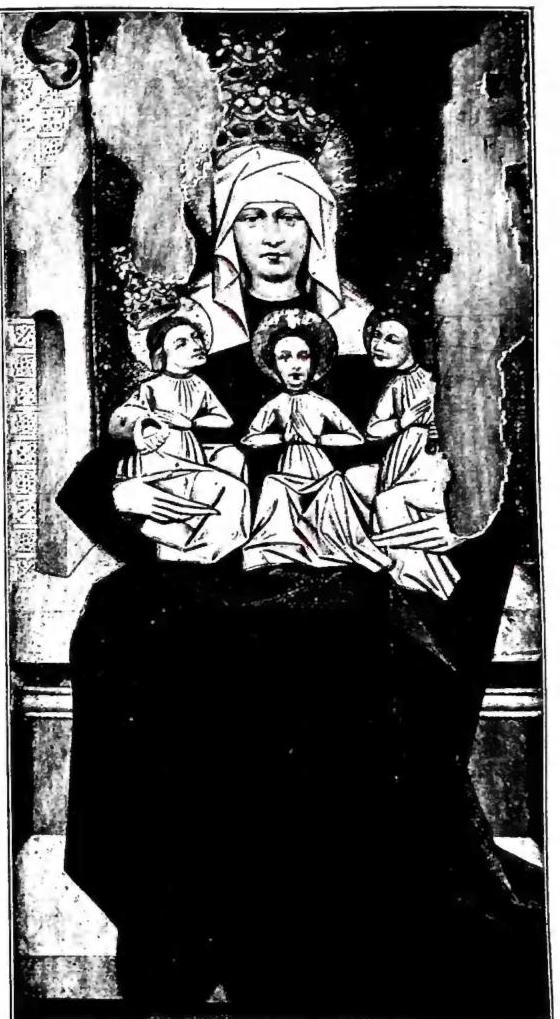
(from G. de Tervarent, in Anal. Boll., 68 [1950], tav. 1)
Natural in a cosmic sense is all that is part of created nature and unfolds within it according to the operative powers and laws of the particular natures that compose the universe. This concept of nature and the natural as a fixed reality determined by stable laws of a necessary character is in force among the Scholastics, especially among St. Thomas and later theologians, and has its roots in the Fathers and Greek philosophy. However, alongside this conception, another develops, which originates with St. Augustine and presents nature as a being that exists and operates in one way or another not by intrinsic determination but by an influence of the divine will, which adapts effects to causes as it sees fit. St. Augustine, while upholding the absolute dominion of God's will, recognizes the intimate structure of beings according to fixed laws and therefore is not in conflict with the Scholastic conception, which connects to St.
Thomas. But his disciples emphasized the function of the divine will in comparison with the intimate structure and function of nature.
Another concept influences the theological elaboration of the natural and the supernatural: exigency. To demand is equivalent to claiming for oneself, attributing to oneself by right, in such a way as to create a debt in another subject. In the proper sense, exigency, implying a right, refers to persons. But it can be extended, in a transferred sense, also to things, and therefore one can speak of the exigency of nature. If nature is created, it first demands its cause, which posits and explains its origin; it further necessarily demands all that intrinsically constitutes it; for example, human nature demands a rational soul with its faculties and a body with its organs and its determined structure. Nature also demands the means and objects indispensable for the expression of its energies and potentialities. This third exigency (the most important) is founded on the operative faculties of nature, which, like the intellect and will in man, can open toward the infinite without being able to reach it with their own resources. In this case, the exigency has as its term a complement of nature, which can derive from it only from a superior cause. Thus, one arrives at conceiving a kind of debt on the part of God toward the creature. It has been said (De Lubac) that the Scholastics are dominated by the juridical and therefore would exclude from nature a juridical exigency, which would make God a debtor, but not an ontological exigency. It is, however, historically certain that the Scholastics unanimously deny as absurd a juridical exigency of the creature before God, even in the sphere of merit, which they generally conceive as subordinate to a divine promise (Peter Lombard, II Sent. d. 43: "Non est debitor nobis, nisi forte ex promisso").
A fortiori, the Scholastics exclude an ontological exigency, which would be the only true one, when it comes to relations between creature and Creator, in regard to a complement of created nature. Nor is the distinction between the absolute divine power and the ordained divine power valid for the Scholastics, especially for St. Thomas. Based on this distinction (dear to the Augustinians of the 18th century), one reasons as follows: God could leave a creature, and in particular man, in the conditions in which He created him, without special aid, by virtue of His absolute power; but He cannot do so by virtue of the power coordinated with other attributes (goodness, love, etc.). Therefore, the complementary assistance is not due on the part of God in view of the absolute power but is due in view of the ordained power. And thus, the exigency of that assistance, already excluded, would return by virtue of this latter power.
But already St. Thomas, in his maturity (Sum. Theol., 1ª, q. 25, a. 5, ad 1), eliminates the distinction between the two powers, given the necessary concurrence of all attributes (identical with the single essence) in every divine operation: «Nihil potest esse in potentia divina quod non possit esse in voluntate iusta ipsius et intellectu sapiente eius». Therefore, there can be no demand in the creature—neither juridical nor ontological—that would render God indebted (at least according to the ordained power) for an extraordinary complement to nature. If there are ontological demands in nature, they belong to the very structure of the creature, willed as such by God according to His ordained power, and thus those demands must be such as to be satisfied without any special intervention by God. In other words, every created nature possesses all that is necessary and sufficient for its being and its operation, already by the creative act flowing from God’s ordained power. Therefore, such a nature cannot demand anything more in any way, and thus God owes it nothing beyond what He has given to constitute it in its degree of being.
From these principles arises the concept of gratuity applied to the supernatural. For if there is no demand (neither juridical nor ontological) in created nature for an extraordinary intervention by God, it is clear that if such an intervention occurs, it is entirely gratuitous. The intimate reason for gratuity is only understood from the fact that in an extraordinary intervention by God, due to its contingent character, the freedom of God is manifested more openly than in any natural effect, since He could do without it without offending His divine attributes. All that God works outside Himself is gratuitous, even the world of nature, and thus free; but the supernatural sphere, not corresponding to any demand—neither on God’s part nor on the creature’s—is a more evident sign of divine freedom and liberality.
The term supernatural (cf. H. De Lubac, Remarque sur l'histoire du mot « surnaturel », in Nouv. revue théolog., 61 [1934], p. 225 ff. and 350 ff.; id., Surnaturel, Paris 1946, p. 325 ff.; G. de Broglie, De fine ultimo humanae vitae, ibid. 1948, p. 141 ff.) was introduced into Latin theological terminology by Scotus Eriugena in a translation of Pseudo-Dionysius; however, until St. Albert the Great and St. Thomas, who adopted Aristotelianism (with the precise determination of "nature"), that term was not widely used by the Scholastics. From St. Thomas onward, it became common in theology and later (Propositions of Baius) also in the language of the Magisterium.
In the Greek world (pagan and Christian), the term corresponding to supernatural, that is, ὑπερφύσης, is the culmination of a not brief itinerary marked by the terms ὑπερουράνιος (supercelestial), used especially by Plato, and ὑπερκόσμιος (superworldly), preferred by the Neoplatonists, as well as other similar terms (ὑπερκόσμιος, ὑπερκείμενος, etc.). Among Greek philosophers, these terms are generally used in a cosmic, local sense; among Christian writers, however, they gradually assume a spiritual meaning. Already Clement of Alexandria and Origen used the Platonic ὑπερουράνιος to indicate transcendent, divine realities (Origen, De principiis, I. IV, ch. 1, n. 7 and elsewhere). Marius Victorinus, in the same sense, spoke of invisible, divine things using the term "supercelestial" (= ὑπερουράνιος). The other related term, ὑπερκόσμιος, underwent a similar development among the Fathers. For example, Clement of Alexandria, Hippolytus, Pseudo-Dionysius, and St. Gregory of Nyssa used it in the sense of mysterious, eternal, spiritual (citations in De Lubac, op. cit., in the note on p. 341). Moreover, St. Paul also uses ὑπερκόσμιος to signify the celestial, spiritual man (1 Cor. 15:46 ff.). But Christian writers more readily adopted the term ὑπερφύσης, which first took on the meaning of wonder (miracle), then of ineffable, divine, transcending earthly and human things (cf. especially Isidore of Pelusium). The idea is also expressed with the phrase ὑπὲρ φύσιν, which, both among pagans and the Fathers, is found in contrast with παρὰ φύσιν (= against nature) and κατὰ φύσιν (= according to nature). St. Cyril of Alexandria, following Isidore of Pelusium (his friend and relative), notes that the superior gifts given by God to man for his elevation are superior not only to his (man’s) nature but to nature (as a whole). More extensively, St. Maximus uses the phrase, outlining the itinerary of Redemption: man is freed from passions (παρὰ φύσιν), is restored to the rational sphere (κατὰ φύσιν), is enriched with supernatural goods (ὑπὲρ φύσιν) (Ad Thalassium, q. 65: PG 90, 769). In Latin, the Greek term is rendered as "supernaturalis" already in the translation of the 19th letter of Isidore of Pelusium, then in the translation of Pseudo-Dionysius made by Scotus Eriugena, as mentioned above.
H. De Lubac, Surnaturel, Paris 1946; G. de Broglie, De fine ultimo humanae vitae, Paris 1948; J. Rivière, Le problème du surnaturel dans la théologie contemporaine, in Revue des sciences religieuses, 1934; M. Blondel, Histoire et dogme, Paris 1904; E. Mersch, Le corps mystique du Christ, Louvain 1933; A. Gardeil, La crédibilité et l'apologétique, Paris 1908; J. Maritain, Les degrés du savoir, Paris 1932; R. Garrigou-Lagrange, Le sens commun, Paris 1909; P. Parente, De gratia, Rome 1946. A. Piolanti
II. DOCTRINE
1. Magisterium of the Church
The documents of the ecclesiastical magisterium explicitly contain the affirmation of the supernatural (s.) as a fact under various aspects: a) empirical: a verifiable effect of a cause that cannot be natural: miracle (v.) in the physical and moral order, which the Church recognizes in the life of Jesus Christ and the saints and considers as a seal of divine Revelation, making it a certain argument of credibility (cf. Vatican Council, sess. III, ch. 3 and can. 4 de fide: Denz-U, 1790, 1813); b) theoretical: truths revealed by God that surpass the capacity of human reason, such as the mysteries of the Most Holy Trinity, the Incarnation, the Word, etc.; the Church, while recognizing the powers and rights of reason, Mystery (v.), object of divine faith (cf. Vatican Council, sess. III, ch. 4; cf. can. 1 de fide et ratione); c) practical: proper to human activity in relation to eternal life is the divine Grace infused into the soul and its faculties together with the theological and cardinal virtues and the gifts of the Holy Spirit, which elevate man to a supernatural state, in which he lives and acts in a deiform manner (cf. the anti-Pelagian documents: Council of Carthage, a. 418, and II of Orange, a. 429; Council of Trent, sess. III, especially can. 1 and 3 de iustificatione).
Beyond the affirmation of the supernatural as a fact, in its triple aspect—empirical, theoretical, and practical—the magisterium of the Church has also pronounced on the nature of supernatural reality, on the occasion of the errors of Baius, Jansenius, and the modernists. Among the propositions of Baius condemned by Pius V (1567), some (21st, 23rd, 24th, 26th, 42nd) openly deny the existence and function of divine Grace as a supernatural gift added to human nature to transform and elevate II. From the condemnation of these propositions, it is deduced that the Church holds that God infuses Grace as a gratuitous gift, which transcends the conditions and demands of nature.
But a more precise negation of any true exigency of human nature in the face of the gift of Grace, and thus of its supernatural transcendence over nature, is found in the encyclical Pascendi of Pius X (1907), where, regarding the immanence (v.) adopted by the modernists, it reads: « Here we must again lament that there are Catholics who, although they reject immanence as a doctrine, nevertheless use it for apologetics, and do so so imprudently that they seem to admit in human nature not only a capacity and a suitability for the supernatural order, as Christian apologists have always done with appropriate reservations, but also a true and proper exigency » (Denz-U, 2103). This important clarification highlights the absolutely gratuitous character of the supernatural and its transcendence over nature, to which it is not at all due and which has neither active capacity nor any right with respect to II. This concept is reaffirmed by another route by Pius XII in Humani generis (12 Aug. 1950): « Others pervert the true gratuity of the supernatural order, holding that God cannot create a rational being without destining and calling it to the beatific vision. » In these words emerges the concept of the possibility of a pure nature (without supernatural gifts), which God could have created without violating His justice and goodness.
2. Positive Proofs. - a) Sacred Scripture: the beatific vision, the formal reason for the entire supernatural order, is promised to the pure of heart (Mt. 5:8) and is proper to the angels and the blessed in heaven (Mt. 18:10 and 22:30). St. Paul exalts, as a participation in the very knowledge of God, the beatific vision, which surpasses every possible knowledge of God during earthly life, even faith (I Cor. 13:8-12). And St. John (I Jn. 3:1-2) declares the adoptive filiation and even more the beatific vision as a gift of the Father, which is the supreme term of assimilation with God worked in us by divine Grace, beyond every capacity or right of nature. The sanctification of man through faith or Grace is called by St. John rebirth, regeneration in God (Jn. 1:12-13; 3:5), communication and vital immanence in Christ (Jn. 6:57; 15:1 ff.). Likewise, St. Paul speaks of a new creature (II Cor. 5:17), of the renewal of man by the power of the Holy Spirit (Tit. 3:5), to which is linked all the life of faith and charity, therefore called pneumatic, charismatic, in antithesis to the life of the natural man (ψυχικός). b) Fathers: especially the Eastern Fathers all insist on the concept of deification (θεοποίησις) to indicate the life of sanctification through Grace. The most effective are St. Athanasius and St. Cyril. For the West, the testimony of St. Augustine suffices, who exalts the gratuity of Grace to such an extent that he sometimes seems exaggerated. For all scriptural and patristic documentation, V. PARADISO.
3. Theological Synthesis. - From these and other documents of Revelation, a well-defined theological doctrine has been formed regarding the two orders, natural and supernatural, which can be reduced to this schema. Natural and supernatural are said with respect to nature considered in its being and in its active or passive potentiality. Natural are the essential constitutive elements of a being, natural also its operative power in relation to an effect proportionate to it, natural finally its capacity to receive the action of a cause that is also natural. Consequently, the supernatural transcends nature in its essential constitution, in its power, and in its proper capacity: in a word, the supernatural surpasses the forces of nature, is above its sphere of action, bound to secondary causes. But this notion must be integrated with that of absolute gratuity, by which the supernatural, as divine intervention or gift, excludes any right or exigency on the part of the creature and any debt on the part of God. The two notions of transcendence and gratuity lead to the concept of an entitative difference between the natural and the supernatural in its most formal sense.
Supernatural reality can be substantial or accidental, essential or modal. Supernatural in a substantial and absolute sense is only God, who transcends all created nature; indeed, God considered in Himself and for Himself, without relation to man, is improperly called supernatural, being absolutely His very nature. It is not easily conceivable a properly supernatural substance, created (although some theologians admit its possibility: Molina, Ripalda); the supernatural is fundamentally a participation in the divine in a rational nature, by way of modification in being and operation, and thus reduces to accidental reality, Grace (v.) and the other habits infused by God into the soul. But there is a gradation from the extreme limits of nature to the properly supernatural. To the miracle approach the effects called preternatural, which include a good already belonging to nature, but perfected by divine action in conditions and duration; such as, for example, the bodily immortality of the progenitors, which was a miraculous continuation of the natural life of the body, perhaps in superior conditions. In the third place, there is the relative supernatural, which transcends this or that nature, but not all created nature: thus, for example, infused science, proper and natural in Angels, granted by God to man. Finally, the essential supernatural, which is an entity realized by God in the rational creature and which surpasses all created nature in its constitution, in its potentiality, and in its exigencies; such is Grace communicated to the soul as a mysterious participation in the very divine nature, along the line of a quasi-formal causality. Grace refers to glory, that is, to the beatific vision, which is the apex and supreme reason of the entire supernatural sphere: it, in the line of final causality, governs the entire economy of Grace (means) and is formally realized as the immediate intentional communication of the divine essence to the created intellect.
In conclusion: a) the natural order consists of a nature or of all created nature, considered in its essential constitution and in its active and passive potentiality in relation to its own end, proportionate to its powers and its native exigencies; b) the supernatural order consists in the divine action by which God elevates and disposes a rational nature to the attainment of an end transcending all created nature, through a deiform vital activity that culminates in the beatific vision, the supreme term of the economy of Grace. Given the absolute gratuity of the supernatural being, it is clear that there is no intrinsic nexus between the one order and the other; in nature there is only a passive capacity to receive the divine action, which freely realizes the supernatural within II. Theologians call this capacity potentia oboedientialis (St. Thomas, De verit., q. 29, a. 3, ad 3; De potentia, q. 6, a. 1, ad 18, and elsewhere: V. below). Therefore, considering human nature in itself and prescinding from divine Revelation, reason cannot positively demonstrate the possibility of the supernatural order, but after Revelation, it can demonstrate that the supernatural not only does not repugn but is indeed fitting to human nature. On this point, ardent discussions have flared even among Catholics, from the 16th century onward.
4. Controversial Points. — The Scholastics had inherited from St. Augustine a conception in which the supernatural order was not clearly distinguished from the natural order, though not in the sense that the holy Doctor identified the one with the other. In struggle with Pelagius, an advocate of exaggerated naturalism, he found himself compelled to emphasize the supernatural and its function even at the expense of nature. But many would wrongly abuse his authority to arrive at conclusions foreign to his thought, which was substantially orthodox.
The first controversy arose among the Scholastics regarding the relationship between nature and the supernatural, in light of the beatific vision. The Augustinian tendency found its expression in Scotus, who, starting from the univocity of being, admits in nature a congenital desire for the full possession of God (beatific vision), and thus a potentia oboedientialis not purely passive but also in some way active. In other words, the Franciscan school, following Scotus, is decisively averse to the concept of the supernatural as something extrinsic to the spirit (extrinsicism) and tends to bind nature and the supernatural in such a way as to temper transcendence with a motive of immanence (intrinsicism). St. Thomas, on the other hand, starting from the analogy of being, was more concerned with the transcendence of the supernatural and drew a strong line of demarcation between it and human nature, in which he recognizes only a passive potentia oboedientialis (= capacity to receive the action of God). Nevertheless, the same St. Thomas mitigated here and there the harshness of this systematic position and spoke of a natural desire (v. DESIDERIO NATURALE DI DIO) for the vision of God, an object of much discussion even today. However, the Aquinate, like the great Scholastics in general, consistently defended the absolute gratuity of the beatific vision and of the entire supernatural order, maintaining that God could have not elevated man to the ultimate end that is eternal life but left him with the end proportionate to his nature, such as the logical knowledge of God through creatures. He thus clearly distinguished two supreme ends for the rational creature: «Ultima autem perfectio rationalis seu intellectualis naturae est duplex. Una quidem quam potest assequi virtute suae naturae... Alla felicitas, quam in futura expectamus, qua videbimus Deum sicut est. Quod quidem est supra cuiuslibet intellectus creati naturam» (Sum. Theol., I, q. 62, a. 1; cf. ibid., q. 23, a. 1; De veritate, q. 14, a. 2 and 10; q. 27, a. 2; In III Sent., d. 23, q. 1, a. 4, and elsewhere). De Lubac (Surnaturel, cit.) misinterprets St. Thomas when he attributes to him the opinion that there is only the supernatural end, to which God had to ordain man. De Broglie (De fine ultimo humanae vitae, Paris 1948) is right to refute De Lubac on this point. Coherently, St. Thomas asserts that God could (even by ordained power) create man «in puris naturalibus» (In II Sent., d. 31, q. 1, a. 2, ad 3; De malo, q. 4, a. 1, ad 14 and q. 5, a. 1, ad 15), where the concept of the possibility of pure nature clearly appears, which would soon become the object of great discussions. The error of Baius (16th century) compelled a deeper examination of the problem of the relationship between nature and the supernatural. Luther had already said that the gifts constituting the state of innocence and original justice in Adam were a constitutive part of human nature, which therefore remained intrinsically corrupted when it lost those gifts through the sin of the first man. Baius attenuated this concept, making Grace and the other gifts an integrative part of human nature. In this way, the idea of the gratuity of the supernatural order was eliminated, which was presented as the term of an exigency of nature. The theologians of the time, with the magisterium of the Church, rose up against this error (which Luther, Baius, and later the Jansenists dared to attribute to St. Augustine) and developed what in St. Augustine and St. Thomas was more or less implicit, that is, the concept of pure nature (v.), and consequently rejected every sort of exigency (juridical and ontological) of human nature with respect to supernatural realities (Grace and beatific vision). The reaction against Baianism pushed the Scotistic conception into the shadows, which at that moment could have favored the error. Later (18th century), the Augustinians (Norris, Berti, Bellelli) took up again the theme of the single end, the supernatural one, to which God could not (by ordained power) not destine man. This return to an exigency (even if only ontological) of the supernatural was not progress but a veiled concession to Baianism.
The question has been stirred anew in our era, immanentism (v.), modernism (v.), and under the thrust of religious psychologism, which is grounded in the entire doctrine of the subconscious. Immanentism as a doctrine cannot be taken into consideration, as it is irreconcilable with Catholic doctrine, which absolutely demands a transcendence—that is, a God personally distinct from the world and, in general, a reality, both natural and supernatural, as the object of knowledge. However, within Catholicism itself, particularly in apologetics, some authors have attempted to adopt immanentism as a method, demonstrating the truth of Christianity through religious experience (harmony with the aspirations of the human heart and spirit). This tendency, already present in Pascal (Pensées), was systematically developed first by Cardinal Dechamps on the ecclesiological terrain, then by Maurice Blondel on the individual psychological terrain. Blondel poses a problem that directly concerns the relationship between human nature and the supernatural, asking whether, apart from Revelation, our spirit can, through introspection and subjective experience, reach the threshold of the supernatural and affirm its existence. Considering man not from a metaphysical standpoint but in his historical reality, in the drama of his intimate life, Blondel highlights what each person feels within themselves: a void, a discomfort, an indigence, manifested in the inexorable gap between the ideal and the real, between the willing will and the willed will. Assuming God as Creator, infinite Wisdom and Goodness, it would be obvious to think that man is not left in this painful condition without help from above, which would make it possible for him to attain his end. Therefore, there must exist a succor beyond the limits of the natural order, which completes and elevates nature and its faculties to achieve the destiny worthy of man. In this way, philosophy flows into religion and, under the pressure of the need for supernatural aid, the spirit moves on to seek divine historical Revelation in the guarantees of Christianity. Y. Montcheuil (Maurice Blondel. Pages religieuses, Paris 1942) interprets Blondel’s thought as meaning that philosophy leads to opting for the ultimate end through an act that is in itself supernatural, at least implicitly. But Blondel himself protested against this exaggeration of his thought (cf. B. Romeyer, La philosophie religieuse, Paris 1943, in appendix).
The obscure point of this theory is that exigency of the supernatural, which the encyclical Pascendi declares erroneous if taken in a strict sense. Blondel did not fail to attenuate it to align with the thought of the Church, but that expression remains at least dangerous. Nevertheless, the concern of these authors has its justification and is not entirely new. St. Augustine felt and developed it in the Confessions. Even St. Thomas anticipated it, as demonstrated by his doctrine natural desire for God (v.). Moreover, St. Thomas expresses the relationship between nature and the supernatural through the concept of obediential potency, which implies an order to divine action; but he emphasizes that Grace is not created but is concrete with the soul insofar as it is "drawn from the obediential potency of the soul" (De potentia, q. 3, a. 8, ad 3; De veritate, q. 27, a. 3, ad 9; q. 29, a. 3, ad 3). This implies at least a material causality in the soul with respect to Grace, in the sense that the soul is not materia ex qua but at least materia in qua God produces Grace (De verit., q. 27, a. 3, ad 9). Notable are expressions such as this: "the soul is capable of Grace; for by the very fact that it is made in the image of God, it is capable of God through Grace" (Sum. Theol., 1°-2°, q. 113, a. 10).
These and other reasons demonstrate that St. Thomas, while defending the absolute gratuity of the supernatural order, tempers its transcendence with a cautious immanence. Certainly, in him the metaphysical consideration of man generally prevails, but, as seen in this argument, he does not ignore its psychological aspect.
Blondel and other modern authors, on the other hand, emphasize the historical-psychological consideration of fallen man and thus perceive more dramatically his appeal for extraordinary aid from God.
BIBL.:
M. Blondel, L'Action, Parigi 1893; Id., Lettre sur les exigences de la pensée contemporaine en matière d'apologétique, Parigi 1896; Id., Histoire et dogme, Parigi 1904; A. Valensin, A travers la métaphysique, Parigi 1925; Y. de Montcheuil, Maurice Blondel. Pages religieuses, Parigi 1942; B. Romeyer, La philosophie religieuse, Parigi 1943; J. Maritain, De la philosophie chrétienne, Parigi 1933; H. de Lubac, Surnaturel, Parigi 1946; E. Mersch, La théologie du corps mystique, Parigi 1946; G. Philips, La grâce de Dieu, Parigi 1933; A. Gardeil, La crédibilité et l'apologétique, Parigi 1908; H. Bouillard, Conversion et grâce chez S. Thomas d'Aquin, Parigi 1944.
A. Piolanti
III. CONCLUSION
The problem of the relationship between nature and the supernatural (soprannaturale, hereafter s.) is one of the most lively and delicate in modern theology. After the experience of Modernism and its condemnation (encyclical Pascendi), it can now be addressed with greater understanding and precision. There are fixed points imposed by the doctrine defined by the Church, such as these: a) the supernatural world exists, distinct from human nature and from the entire cosmic universe (natura naturae and natura naturata); b) the s. transcends all the forces and all the exigencies of created intellectual nature (angel-man) in the sense that this nature cannot attain the s. by its own powers, nor does it possess such a right as to make God a debtor with respect to it; c) in fact, today man has no other end designated by God than the supernatural one (beatific vision), but by right God could have created man without elevating him to that end; d) the hypothesis of a pure nature (natura pura) is therefore legitimate, as it does not repugn to either the absolute or the ordained power of God. This hypothesis is the condition of the absolute gratuity of the supernatural order (o. s.).However, this well-defined and traditional doctrine does not exhaust the problem. Blondel’s contribution, once its sharp edges are softened, may be useful in mitigating the rigid transcendence preferred by many classical and modern theologians. First, it must be noted that the hypothesis of pure nature cannot be equated with the current state of man following original sin. In pure nature, there would have been only the absence of the s., whereas in fallen nature there is instead its privation. Hence arises the anguished discomfort of the spirit, which over the centuries has given rise to pessimism in religion, philosophy, and art. From this discomfort springs an appeal to God to overcome the conscious insufficiency of nature. Without Revelation, the term of this appeal remains obscure, but it implies a presentiment of extraordinary aid. In a broader sense, Blondel is right to extend the sense of man’s indigence to the entire created universe, in which limit and contingency dominate, and which thus implicitly calls upon the Absolute.
A more delicate point, however, is the obediential potency (potenza obbedienziale) of nature. St. Augustine and St. Thomas, though so insistent on the transcendence of the s., nonetheless agree in asserting a natural capacity to receive it from God: « Posse habere fidem, sicut posse habere caritatem naturae est hominum; habere autem fidem, quem admodum habere caritatem, gratia est fidelium » (St. Augustine, De praedestinatione sanctorum, ch. 5, 10). And St. Thomas, as we have seen, speaks of the natural capacity of the soul with respect to Grace and of man’s natural desire for God, but he constantly warns that nature can never attain Grace or the possession of God in the beatific vision without supernatural means: « Quamvis enim homo naturaliter inclinetur in finem ultimum, non tamen potest naturaliter illum consequi, sed solum per Gratiam, et hoc est propter eminentiam illius finis » (In Boeth. de Trinitate, q. 6, a. 4 ad 5).
It is therefore legitimate and just to see in obediential potency something more than a dead passivity or mere non-repugnance. Finally, to avoid an absurd extrinsicism in the economy of Grace (which is so profoundly and humanly vital), the s. must be presented as the complement and perfection of nature, with which God Himself is not unconnected—a complement of supreme ontological and psychological convenience, which fully responds to the aspirations and indigence of nature, weakened by original sin.
In this way, the latest developments in Catholic doctrine compose in a harmonious synthesis transcendence and immanence, resolving the apparent antinomy between extrinsicism and intrinsicism within the framework of a supernatural anthropology, in which human nature is elevated, without being annihilated, to a vital participation in God.
IV. OBOEDIENTIAL POTENCY
This is the capacity of every created being to receive within itself God’s action with its effects. St. Thomas describes it thus (De virtutibus in communi, q. unica, art. 10, ad 13): «In tota creatura est quaedam oboediantialis potentia, prout tota creatura obedit Deo ad suscipiendum in se quidquid Deus voluerit.»Theologians differ in their conception of obediential potency according to the various ways in which they understand and explain that relationship.
The Thomists, following St. Thomas (De veritate, q. 29, a. 3, ad 3; Sum. Theol., III, q. 11, a. 1), advocate a clear distinction between the two orders and thus for the perfect transcendence of the supernatural. Consequently, they distinguish in every creature a natural passive potency or capacity to receive from natural agents perfections proportionate to its own conditions, and a supernatural passive potency, which is the capacity to receive from God those perfections that do not imply metaphysical repugnance for the nature that receives them. This passive potency is pure capacity and does not imply a direct order toward the perfection, but toward God, who can bestow it if He wills. Thus, for example, the human intellect is naturally capable of receiving intelligible species abstracted from phantasms, but it cannot intuitively see the divine essence unless God elevates and disposes it with Grace and the light of glory. Therefore, the human intellect can do nothing by its own powers to attain the beatific vision; indeed, it cannot even desire it explicitly (v. DESIDERIO NATURALE DI DIO).
Against this Thomistic doctrine, the Scotists (cf. Scotus, Opus Oxoniense, IV, d. 49, q. 9) maintain that, since the natural order and the supernatural order are intimately connected, obediential potency is not pure passive capacity, nor does it belong to the supernatural sphere, but is an innate tendency to reach a higher-order object to which it is naturally open, without a special intervention of God. Suárez also departs from Thomism, attributing to obediential potency a certain innate virtuality in relation to the supernatural. Authors who, like Blondel, tend to moderate the transcendence of the supernatural with a softened form of immanence logically prefer the Scotistic theory. Here, as in the question of the relationship between the two orders, natural and supernatural, extremes must be avoided. To affirm an innate tendency or an active capacity of nature in relation to the supernatural is equivalent to positing in nature a true exigency for the object that transcends II. This is irreconcilable with Catholic doctrine as expounded by Pius X in the encyclical Pascendi. On the other hand, reducing obediential potency to a purely inert passivity seems to suggest the concept of a supernatural that is entirely foreign to human nature and psychology, in which it is nevertheless realized in a vital manner. It is therefore necessary to conceive obediential potency as an openness of the spirit which, especially following original sin, is stirred by nostalgia for the lost higher world. A potency, then, that is almost dynamic, though ineffective and unequal to attaining the object without divine Grace (v. DESIDERIO NATURALE DI DIO; IMMANENZA).