
SCOTO ERIUGENA, GIOVANNI. – Philosopher and theologian, born in Ireland (in Celtic Eriu, also called Scotia Maior; hence, presumably, the twofold appellation) in the first decades of the ninth century. It is uncertain whether he was a cleric; but if he was, as would seem likely from the nature of his culture, he held no ecclesiastical office. Nothing is known of his studies in his homeland. Certainly, before 847, he was in France, received at the court of Charles the Bald “a quo magna dignatione susceptus, familiarium pars habebatur, transigebatque cum eo tam seria quam ioca...” (PL. 179, 1652). It is not unlikely that for some time the Sovereign appointed him to direct the palace school. In 851 he took part GODESCALCO D'ORBAIS (v.) with the De praedestinatione. But the use of philosophical concepts and of a language unfamiliar in the West produced disturbance and confusion among the opposing parties whom he had undertaken to reconcile, and led to various condemnations of the work. It has not been proved that he intervened in the dispute over the real presence of Christ Pascasio Radberto (v.) Ratramno di Corbie (v.); for the Liber Joannis Scoti, from which Berengario later claimed to have drawn the symbolist doctrine, is Ratramno’s treatise, attributed to S. E. either through error or deliberately.
Between 851 and 862, at the King’s request, he translated the writings of the pseudo-Dionysius the Areopagite (v.), which Abbot Idulino (v.) had already begun several years earlier; the latter’s incomplete version, however, had remained unpublished because of its imperfections. The commentary In Martianum Capellam seems to belong to 859, and the commentary on metre IX of book III of the De cons. philos. appears to have been written shortly thereafter. The translation of the Ambigua Massimo il Confessore (v.) is generally assigned to 862–64; it was followed by that of the De imagine hominis of s. Gregorio Nisseno (v.). He may also have translated the Ancoratus EPIFANIA (v.). The extraordinary speculative light cast by these writings, in which Christian thought seemed to have merged with Neoplatonic philosophy, imbued with so profoundly religious a spirit, dazzled him; all the more so because he, like his contemporaries, regarded the works attributed to the Areopagite, the disciple of s. Paolo, as authentic, and therefore considered him a participant in the secrets of apostolic Revelation. Under the influence of this light he undertook to write his major work, De decisione naturae, completed no later than 866, and then to comment on some of the writings of the pseudo-Areopagite, perhaps between 865 and 870, and on the Gospel of s. Giovanni.
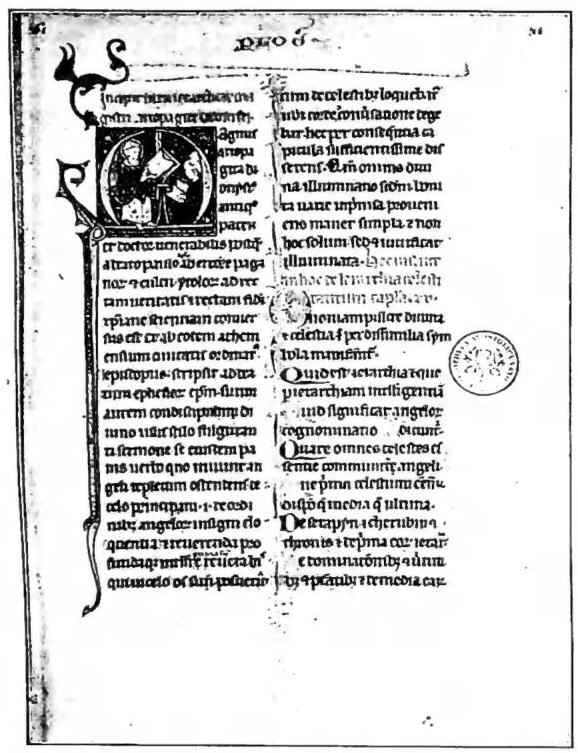
SCOTO ERIUGENA, GIOVANNI — Translation of the De Ierarchia of Pseudo Dionysius Areopagita. In the initial letter, a holy bishop lectures some monks — Vatican Library, cod. Urb. lat. 62, f. 1 (14th century).
Almost nothing is known about the final years of his life, nor when he died. A reference to him as already deceased has been thought to occur in a letter from Anastasius the Librarian, a Roman, to Charles the Bald, dated 875: «cum esset humilis spiritu, non praesumpati...» (PL 129, 740). But if he lived for several years after this date, as some maintain, his was a life of recollection and silence, since he had been deprived of the protection of the King, who died in the autumn of 877.
The De divisione naturae is a great work of Christian philosophy, that is, of speculative theology, conceived in the spirit of the Neoplatonism of St. Augustine, Pseudo Dionysius, St. Gregory of Nyssa, and St. Gregory Nazianzen. Greek philosophy, developed before and in ignorance of Christianity, had to appear insufficient to justify the new historical reality created by the spread of the evangelical message. Faith in the Revelation of Christ and the birth of a new society with a new intuition of life and the world: this is the new historical reality that the Christian thinker has the duty to justify to himself. The starting point and object of his philosophical reflection is the experience of this new reality, that is, his faith in Revelation and his awareness of being a member of the body of Christ. Hence, for S. E., as earlier for Augustine and later for Anselm, the need to understand springs from faith: «fides quaerens intellectum», according to the celebrated Anselmian expression at the head of the Proslogion, supplemented by the saying drawn from Is. 7:9 (according to the ancient version preceding the Vulgate): «Et nisi credidero, non intelligam». The distinction between philosophy and Revelation, and their opposition, or the subordination of the former to the latter, received no clear formulation before the 13th century, when philosophy came to mean the Aristotelian system of nature. «Rationalism» has been spoken of with reference to Eriugenian speculation; but it is impossible to transfer this wholly modern concept
to the interpretation of a thought that is indeed rational speculation and dialectical boldness, but proceeds from Revelation as from an unshakable principle of truth.
The starting point of Eriugenian speculation is the «simplicitas fidei» in accepting the revealed word; from this proceeds the «intellectus», that is, reflection and the effort to understand: «Petrus siquidem fidei symbolum, Joannes significat intellectum. Ac per hoc, quoniam scriptum est: 'Nisi credideritis, non intelligetis', necessario praecedit fides in monumentum sanctae scripturae, deinde sequens intrat intellectus, cui per fidem praeparatur aditus» (Hom. in Ioh.: PL. 122, 284-85). Proceeding from the unshakable certainty of Scripture, reason claims its freedom before human interpretations of the word of God, and the right to criticize them (De divisi. nat., I, 69), employing dialectical procedures better suited to revealing the spirit concealed by the letter. Of these procedures, two are principal: the first consists in dividing and distinguishing, proceeding from the one to the many; the second, beginning from the multiplicity of particular beings, tends to reconstitute their higher unity, toward which all things conspire. Thus there is a process of descent from the One to the many, and an inverse process of ascent from the many to the One, Neoplatonism (v.); the difference being that in Neoplatonism the process by which multiple things descend from the One seems to consist in logically dividing the supreme genus into subordinate genera and species, down to the most specific species and the individual, so that all things come to form part of a whole determined in its parts, whereas for S. E. the task is to establish the causal link joining the many to the One. Once nature has been divided into its multiple degrees, these are joined together by a dynamic process that S. E. expresses with the biblical verb «to create», taken in the broader sense, which nevertheless does not exclude the particular meaning commonly used among theologians.
At the summit and center of the universal order stands the «natura quae creat et non creatur», that is, God insofar as he is «causa eorum quae sunt et quae non sunt» (ibid., I, 1), and insofar as, in his absolute and infinite unity, he is unknowable, because he is neither a «quid» nor a being among the other beings of which the concepts of human categories are predicated: «Deus itaque nescit se quid est, quia non est quid» (ibid., II, 28). But in this transcendent darkness the eternal light of the Word shines, and in the Word the «natura quae et creatur et creat», that is, the «primordiales causae» and the «primordialia exempla» of all things. The verb «to create» is evidently not used here in the sense of «to draw from nothing», but in the broader sense of «to make, to give beginning» and the like. These eternal exemplars and primordial causes of all things are essentially the Platonic ideas, which Plotinus had gathered into the Nous and St. Augustine into the divine mind, that is, into the substance of the Word, as S. E. also does (ibid., III, 1, 9). And just as Plato had said that the true being of things is in the eternal and immutable idea, and not in its projection into the γῶρα, that is, into space and time, so for S. E. the true reality of things is the eternal reality of the «rationes primordiales». Multiple insofar as they are distinct from one another, like concepts in our mind, they are not distinct in the eternal Word, so that one and divine is the essence of all things in their eternal prototypes: «Ipse namque omnium essentia est qui solus vere est, ut ait Dionysius Areopagita» (ibid., I, 3; IV, 8; V, 3). By «creating» the primordial reasons, God «creates» himself, insofar as from the abyss of his unity he manifests himself in the multiplicity of the ideas that are the causes of contingent things: «Ipsius namque creatio hoc est in aliquo manifestatio, omnium existentium profecto est substitutio» (ibid., I, 13); «Creatur enim a seipsa in primordialibus causis, ac per hoc seipsam creat, hoc est in suis theophaniis incipit apparere» (ibid., III, 23).
The created and creating nature is followed by the «natura quae creatur et non creat», that is, the totality of contingent things existing in space and time. This is a new theophany, very different from the first, and in this second «procession» the verb «to create» also assumes a meaning quite different from that which it had in the pre-
ceding one: « aliter... consideratur creatura in rationibus suis aeternis in Deo, secundum quas condita est, et aliter in se ipsa sub Deo inquantum creatura est » (ibid., III, 24; cf. III, 8). True and substantial reality is that which things possess in God; outside the divine essence, « sub Deo », they are fleeting shadows and images of it: « Omnia siquidem quae locis temporibusque variantur, ... non ipsae res substantiales vereque existentes, sed ipsarum rerum vere existentium quaedam transitoriae imagines et resultationes intelligenda sunt » (ibid., III, 3). All visible and invisible beings, « sub Deo », belong to the created and non-creating nature, first of all the angel and man, endowed with a spiritual body. Inferior material nature is the fruit of original sin (ibid., IV, 20).
Con la creazione dell'uomo e della natura inferiore, il processo di discesa del molteplice dall'Uno è compiuto. E questo processo appunto è quello indicato dal titolo dell'opera De divisione naturale e che corrisponde al momento dialettico della διατρετική. Al quale processo e momento corrisponde quello dell'ascesa o ritorno o ἀναλυτική, che il titolo dell'opera sottintende ed implica (ibid., II, 1-6). Questo processo, per cui tutte le cose tendono a ritornare all'Uno, è significato dall'E. con l'espressione di « natura quae nec creat nec creatur ». Al termine di questa « reditio » o « reversio » è la « deificatio » (θεωσις) che corrisponde alla ἑνωσις dei neoplatonici. Principio della « deificatio » è l'incarnazione del Verbo, nell'unità sostanziale, come S. E. ama esprimersi sull'esempio dei Greci, della duplice natura umana e divina (ibid., II, 32; IV, 3; V, 26-27). L'incarnazione costituisce una nuova teofania, di cui traggono profitto gli angeli non meno degli uomini (ibid., V, 25). Dall'unione di tutti i salvati (uomini e angeli) risulta la Chiesa, corpo mistico del Cristo (ibid., IV, 1; V, 24, 38), che avrà il suo compimento nella gloria celeste. Compiuto il ritorno in Dio, il mondo materiale, frutto del peccato, sparirà e tutte le cose sensibili saranno spiritualizzate nella loro unione con le cause primordiali (ibid., V, 37). Dopo la risurrezione e la fine del mondo, tutte le cose saranno riassorbite in Dio, senza niente perdere dell'integrità della loro natura (ibid., I, 10), e godranno dell'ultima teofania che è appunto la deificazione (ibid., V, 23).
Come è facile avvertire, in tutta questa dottrina essenzialmente teologica gli ardimenti speculativi traggono impulso dalla gnosi alessandrina, dal platonismo o neoplatonismo cristiano dei tre Cappadoci e soprattutto dagli scritti dello pseudo Dionigi e di Massimo il Confessore. In sostanza (e tale è anche l'opinione del Gilson) le affermazioni di S. E., prese per il loro verso e chiarite nel contesto, sembra possano accordarsi con il pensiero teologico. Se alcune affermazioni ed espressioni uttarono i contemporanei, ciò è dovuto in massima parte all'aver egli introdotto nel linguaggio teologico dell'Occidente termini, modi di esprimersi e concetti ai quali i teologi e gli interpreti latini della Bibbia non erano avvezzi e che questi furono indotti a considerare come pericolose novità. È novità pericolose furono infatti per coloro che non compresero il pensiero di S. E. e lo travolsero a significati dai quali era alieno. Il che si verificò non soltanto BEMA (v.) - e ciò può spiegare le condanne da parte del Concilio di Parigi nel 1210 e di Onorio III il 25 genn. 1225 -, ma più ancora ad opera di taluni storici moderni della filosofia del periodo postkantiano (M. Saint-René Taillandier).
Con S. E. il velo della barbarie dei due secoli precedenti è squarciato da una viva luce speculativa che si rifrange in seducenti iridescenze. Tra i modesti pensatori del suo tempo, egli si erge come un'ardua vetta solitaria. L'ardore speculativo, anziché spegnere, alimenta la fede da cui prende le mosse e si conchiude con un acceso desiderio di indiamento che è la suprema aspirazione del mistico.
Meglio di ogni altro scrittore del sec. IX, questo irlandese venuto a stabilirsi in Gallia rappresenta il rifiorire della cultura antica nell'Occidente, nel periodo della cosiddetta rinascita carolingia. In lui si
trova perfino il primo accenno al risvegliarsi di antiche dottrine astronomiche, apprese dalla lettura del Timeo commentato da Calcido e da quella di Macrobio. Ma S. E. va più in là delle sue fonti, attribuendo un moto circolare intorno al sole, non soltanto a Venere e a Mercurio, come voleva Eraclide Pontico, ma altresì a Marte e a Giove, sì da precorrere Tycho Brahe.