
STIL NUOVO. — Also dolce stil nuovo, an expression that Dante, Purg., XXIV, 57, places in the mouth of Bonagiunta Orbicciani to indicate a new poetic manner different from that followed by the notary Jacopo da Lentini, Guittone d’Arezzo, and Orbicciani himself.
The initiator of this new poetic manner in Bologna had been Guido Guinizelli, whom Dante calls (Purg. XXVI, 97-99): “my father / and the father of the others who were better than I, / who ever used sweet and graceful love lyrics.” Certainly not without intention does Dante bring Bonagiunta into the discussion, since it was precisely he, in a celebrated sonnet to Guinizelli (cf. Rimatori siculo-toscani del Dugento, 1ª serie, edited by G. Zaccagni - A. Parducci, Bari 1915, p. 79).
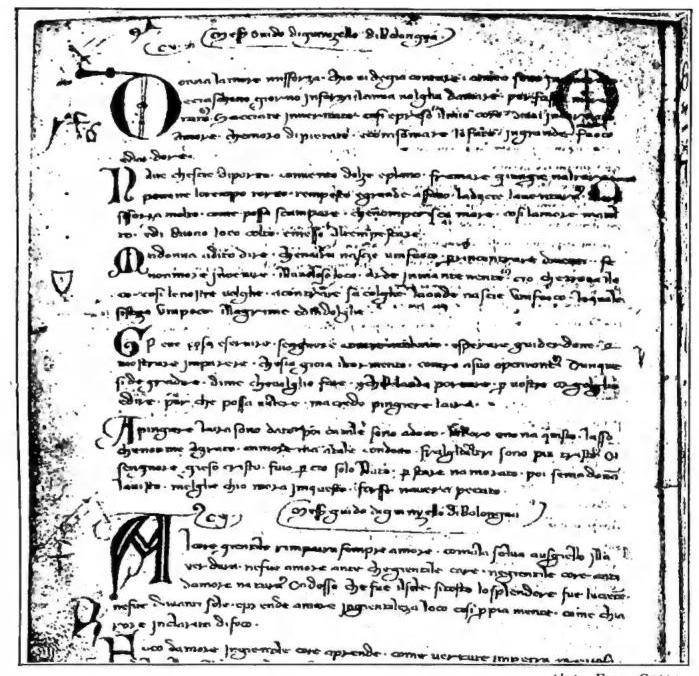
“Birds of strange kinds fly through the air
and have diverse ways of acting;
not all have the same flight or the same courage.
God and nature set the world in ranks
and made minds and understandings unequal.”
In short, to the Lucchese poet it seemed that there was only one “manner” of composing poetry; Guinizelli, on the other hand, held that there were as many “manners” as there are the “minds and understandings” of the men whom God made unequal. And as for “subtlety,” “obscure speech,” and “drawing a song by force of scripture,” he recalls that among birds there are not only sparrows and finches, nightingales and larks, but also hawks and eagles: “not all have the same flight or the same courage.” Every poet “must consider his condition and his nature,” since every poet has his own poetic world, corresponding to his spiritual interests, education, and culture.
The “manner” that Bonagiunta reproaches the Bolognese poet for having changed is that of the Notaro and Guittone. The uniform and tedious repetition of certain obligatory themes (“love is desire that comes from the heart...,” the cruelty of the beloved woman, the hope of “mercy” or “reward,” and so forth) constituted the poetic “manner” of the poets dear to the heart of the gluttonous Lucchese. And to express these worn-out ideas, they used a crude and labored language, bristling with archaisms and dialectal forms that offended the ear of a generation educated in the polished forms of Florentine speech and in the harmony of the verse of the “other Guido” and of Dante. The fact that among the poets of the old “manner” there were true poets, and that some of their rhymes still possess the freshness of a clear spring of living water, proves only that poetics is something different from poetry. This, moreover, does not prevent poetics, or “manners” of composing poetry, from arising alongside poetry from time to time: from that of the Sicilians to Petrarchism, Marinism, Romanticism, and Hermeticism. The s. n. is a reaction, in the name of poetry, against one such fashion or poetic “manner”; without this reaction, Dante would probably have stopped at Guittone. And Dante himself, replying to Bonagiunta, affirms that the novelty of his rhymes, beginning with the first great canzone of the Vita Nuova, “Ladies, you who have...,” consists in having given expression to the feelings of his inspired soul, without paying excessive heed to the “manner” of the Notaro from Lentini or of Guittone; that the true art of composing verse does not draw nourishment from the imitation of models, however excellent, but from inner inspiration, not stifled by technique:
“I am one who, when
Love inspires me, take note, and in the manner
that he dictates within, go on expressing it” (Parg., XXIV, 52–54).
To some, this principle of composing verse seems so little new that they have found it altogether obvious—at any rate, a principle sufficient to distinguish the true poetry of all ages from what is not poetry. But even if this is true, it is no less true that this simple principle has too often been forgotten, both before and after Dante, and that it was worth recalling. Orbicciani recognizes its appropriateness for himself as well as for the Notaro and Guittone:
“I clearly see how your pens
follow closely behind the dictating spirit.
This certainly did not happen with ours.
And whoever looks farther onward
sees no longer what distinguishes one style from the other” (ibid., 58–61).
“Looking farther onward” is what several modern critics have done, only to end up no longer seeing the knot that establishes the essential difference “between one style and the other”; instead, they have sought it in the content of stilnovistic poetry: now in a certain more or less philosophical, more or less Arabizing, Platonic, Franciscan, or Cistercian mysticism, and now in a certain “Seneistic (sic) and Averroistic rationalism,” traces of which they claim to have discovered even in the Vita Nuova—indeed, more in it than in the Convivio! Certainly the poetic world of the two Guidi, and even more that of Dante, is far richer and more complex than that of the Sicilians, the Lucchese, and the poet from Arezzo, although in Guittone’s poetry one can already perceive themes echoed in Alighieri’s philosophical rhymes. But this greater complexity and richness of content could not have flowed into the forms of stilnovistic poetry unless the “manner” had been changed and the freedom of poetic composition had been affirmed—a freedom nourished by what love “dictates within” and by everything that moves the soul, from feminine beauty to the terror of the storm, from the trill of the lark to the most concentrated philosophical meditation.
Understood in this way, the s. n. was certainly not a school, at least not in Guinizelli, Cavalcanti, and Dante, since each of the three had his own poetic world and his own particular way of expressing II. And if it begins to become a school in some of the lesser poets, this is due to the influence exerted by these three great figures and to the formation of habits or “manners,” as had occurred in Sicilian poetry and as was bound to happen with the s. n. as well, until Petrarch would infuse it with “the weeping of his heart,” without, however, preventing a new “manner” from subsequently taking his name for more than two centuries. When love inspires him, the stilnovistic poet takes note; and by carefully observing the movements of his own soul, he draws near to the inexhaustible source of all true poetry. By noting them, he gives form to his feelings and thoughts and gradually constructs his poetic world, truly his own, because it reflects the aspirations, spiritual interests, and problems of his his.
creatore: mondo d'aspirazioni morali nel Guinizelli che ha scoperto l'identità dell'amore con la nobiltà e il valore, e che ad esprimere questa identità chiama a raccolta la cultura racimolata nelle scuole di filosofia; mondo fremente di passione in Guido Cavalcanti, ma velato di malinconia, nella certezza che la seduzione amorosa, destinata a svanire, svia spesso la mente dal bene perfetto ed è cagione di morte; mondo di violenti contrasti in Dante e di sovrumane armonie. Dante comincia stilnovista per la suggestione che su lui esercitarono l'uno e l'altro Guido; ma ben presto introduce nella maniera di questi un motivo nuovo: la morte della donna amata. Indi l'amore per il virgineo fantasma di Beatrice si sviluppa in amore per la filosofia, cantata dapprima in canzoni allegoriche che consentono ancora l'uso delle « dolci rime d'amor » adattate alla « bellissima e onestissima figlia de lo imperadore de lo universo » (Conv., II, XV, 12). Questa seconda serie di rime amorose in lode della filosofia formano quello che taluno ha chiamato anche un secondo dolce s. n. Ma improvvisamente Dante interrompe questi canti allegorici e, padrone ormai del volgare, prende a trattare argomenti filosofico-morali con « rima aspra e sottile »; aspra, perché spoglia d'ogni abbellimento retorico; sottile, perché tutta pervasa della subtilitas propria dell'arte del loicare nel definire e distinguere. All'arte del dittare dei bolognesi si viene sostituendo nel suo animo una più complessa poetica, quella dello stile regolato della canzone, di cui vuol esser giustificazione il De vulgari eloquentia. Ma anche questa nuova poetica si rivela insufficiente, quando dal fervore della sua onnipotente immaginativa nasce l'idea del « poema sacro », nel quale l'umanesimo virgiliano si fonde con lo spirito profetico e apocalittico della Bibbia.