
CAVALCANTI, GUIDO. — Poet, true founder of the dolce stil novo, born in Florence around 1255, the son of Cavalcante de' C., a nobleman and Guelph; he married Beatrice, daughter of Farinata degli Uberti, a nobleman and Ghibelline. But the political marriage did not inspire in him any desire for political peace. In 1280 he stood surety for the Guelphs for the peace concluded by Cardinal Latino; in 1284 and 1290 he was a member of the city council; and in 1292, having just escaped an ambush set for him by Corso Donati, he went on pilgrimage to S. Jacopo di Compostella; but he did not go beyond Nîmes, and in Toulouse, in the church of the Daurade, a woman, Mandetta, stirred his heart. Having returned to Florence, although excluded from the popular government by the Ordinances of Justice of July 1295, he, a nobleman, took the side that stood closest to the people, that of the Cerchi, and from 1296 to 1300 was a passionate adversary of the Donati faction, until, together with the leaders of both factions, he was sent into exile, to Sarzana (24 June 1300). There he contracted malaria; recalled to his homeland, he died there on 29 August of that same year, 1300. His Rime comprise approximately 50 compositions, including canzoni, ballads, and sonnets.
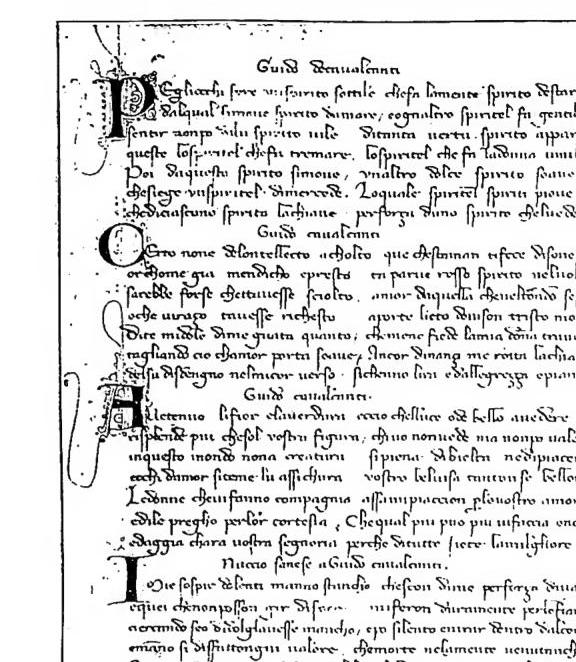
(from Guido Cavalcanti, Rime, Genoa 1931)
CAVALCANTI, GUIDO — Anthology of rhymes by various poets, including C. Cod. Chigiano L. VIII. 305, f. 56° (14th century) — Vatican Library.
who “enjoys solely a life of reason, which consists in the contemplation of truth”; and when the passion of love becomes so violent and consuming as to obscure the intellect, it brings about man’s death—that moral death which consists in the loss of the use and mastery of reason (Nardi). But rather than for the subtle verses in which C. investigates and analyzes his states of love, as a poet he is to be celebrated for the verses in which he pours forth images of beauty and grace, and of surrender to a most tender, tremulous, and dreamlike feeling of love, full of sighs, tremors, and fears almost of death.