
ALBERTUS MAGNUS (A. DE LAUGING [LAUINGEN], A. TEUTONICUS, A. OF COLOGNE, A. MAGNUS), Saint, Doctor.
---
### 1. Life
There are two conflicting opinions regarding the year of his birth. The first—and the more probable—places it at the end of the 12th century (1193) (Pelster, Callay, Scheeben, Puccetti, Weiss), while the second fixes it in the year 1206 (Endres, Michael, Mandonnet). Born in Lauingen, a town on the Danube in the diocese of Augsburg, from a military family (not from the counts of Bollstadt), he showed from his youth a great admiration for nature and devoted himself to study, contrary to the wishes of his family, who wanted to steer him toward an administrative or military career. For the sake of his studies, he attended the University of Padua, where he was won over to the Order of Preachers by the Blessed Jordan of Saxony and donned the Dominican habit. He was later sent to Cologne, to the central convent of Germany, and after serving as a lecturer in the convents of Hildesheim, Freiburg, Ratisbon, Strasbourg, and Cologne, he began teaching theology, at least from 1245, at the University of Paris. There he began to compile his great scientific encyclopedia, which, although well advanced by 1256, he continued to expand throughout the rest of his life.
As head of the new Dominican studium generale in Cologne (1248–54), in its early years he had among his disciples Thomas Aquinas, who there heard from the master his commentary on the De divinis nominibus of the Pseudo-Dionysius and on the Nicomachean Ethics. In addition to teaching, Albert devoted himself zealously to sacred ministry, the guidance of souls, and the work of peacemaking between princes and cities, between persons and institutions. Elected in 1254 provincial of the vast German province, he presided over provincial chapters, attended the general chapters of Milan (1255) and Paris (1256), visited convents, fostered the contemplative life of nuns, and in 1256 communicated to his brethren the Pope’s desire that they work in the missions of Livonia and Prussia. In September 1256, before the papal curia at Anagni, he defended the rights of the mendicant orders against their adversaries led by William of Saint-Amour, whose treatise De periculis novissimorum temporum was condemned by Clement IV on 5 October 1256. Following the curia to Rome and Viterbo until 1257, he illuminated it not only with his lectures on the Gospel of St. John and the Letters of St. Paul but also with his counsel and holy life. At the Pope’s request, he refuted in the De unitate intellectus the Averroist theory. During one of his stays in Italy (1257 according to Mandonnet, 1262–63 according to Pelster), he is credited with the discovery of Aristotle’s De motu animalium, which he later published with a commentary.
Relieved of his office as provincial by the general chapter of Florence in 1257, Albert resumed his studies and teaching in Cologne, drawing up with Buonomo the Breton, Florentius of Hesdin, Thomas Aquinas, and Peter of Tarentaise the “ratio studiorum dominicana,” approved by the general chapter of Valenciennes in 1259. Called as an arbiter in the dispute between Archbishop Conrad of Hochstaden and the city of Cologne, on 1 March 1260 he issued a celebrated sentence, followed by other judgments in disputes between Cologne and Utrecht, between churches and monasteries, and between private individuals.
On 5 January 1260, Alexander IV appointed him bishop of Ratisbon. There he restored the finances, reorganized charitable works, provided materially and spiritually for parishes and convents, and met with the bishops of the ecclesiastical province of Salzburg to reach common agreements. After reorganizing the diocese, in 1261 he asked the Pope to be relieved of the episcopate and went to settle in Italy until 1263. On 13 February 1263, Urban IV designated him preacher of the crusade for Germany, Bohemia, and all German-speaking lands. Arriving in Germany in early May, for two years he carried out the papal mandate “pro subsidio terrae sanctae.” It was the first time that a general collector with the faculties of a papal nuncio, vested with broad spiritual powers, appeared in Germany. The legate did not meet with great success. The death of Urban IV led him to cease his functions, rendered futile by the political misunderstanding of Clement IV. Settling in Würzburg (1264–67) and then in Strasbourg (1267–70), he devoted himself to teaching and episcopal ministry and enjoyed singular authority among his contemporaries.
At the beginning of 1271, Albert was again in the Rhenish metropolis to settle the dispute that had arisen between Archbishop Engelbert of Falkenberg and the city of Cologne. Many were the judgments in pending cases between chapters and convents, between private individuals and institutions; many also were the confirmations, the granting of indulgences, and the consecrations of churches and altars. Notable were the delegations of trust accorded him by the Pope for the election of the abbot of Fulda and by King Rudolph of Habsburg for the oath of fidelity of the bishop of Munich, Eberhard of Diest. He attended the Council of Lyons in 1274 and, during a visit to Paris in 1276–77, defended his Aristotelian positions and those of Thomas Aquinas, whose authority he commended to his Order.
In January 1279, “sane and unharmed,” he made his will by papal privilege. Death overtook him in his cell in Cologne on 15 November 1280. His body was laid in a magnificent tomb in the convent choir, and after the French Revolution it was transferred to the church of St. Andrew, where it still rests.
---
### 2. Personality, the Doctor, and the Saint
Of medium stature, strong, healthy, and lean build, of rather sanguine temperament, energetic disposition, extraordinary assiduity and application to work, with a keen and open eye both in his study and on his long journeys, Albert enclosed within his soul treasures of greatness and outstanding nobility. His acute, penetrating, and comprehensive intellect was steeped in speculation and contemplation; he grasped the spiritual problems of his time and, with a genius and titanic effort, set them on the path to solution. In this task his generous, magnanimous will revealed itself, ready to promote great things and forgetful of self. Beyond being an intellectual, he was also a highly spiritual man, a man of prayer, humble, a convinced and zealous son of St. Dominic. In him deep contemplation met with sure experience, unflagging research with the noble impulse to act and work. His learning, together with his works for culture and charity inspired by priestly and apostolic spirit, conferred upon him the highest personal authority in his time.
Ulric of Strasbourg (d. 1277) calls him in the Summa de bono, q. 3, 4: “a man so divine in all learning that he may fittingly be called the wonder and miracle of our age.” Ptolemy of Lucca (d. 1326) in Hist. eccl., XXII, 18 says: “Albertus Teutonicus, a man of most illustrious life... in the breadth of his learning and manner of teaching, he held the highest excellence among the doctors”; and Roger Bacon (d. 1294): “he had in life an authority that no man ever had on earth... a most studious man who saw infinite things and expended effort and thus was able to gather much from the boundless sea of authors... the common people adhered to them [Alexander of Hales and Albert] as to angels” (Opus minus, ed. Brewer, pp. 30, 327).
For contemporary appreciation of Albert the Great, one may consult Earle, von Hertling, Mandonnet, Grabmann, Scheeben, Wilms, Puccetti, and the bull of canonization.
The personal and doctrinal authority of Albert the Great was not separated in him from the cult that he merited soon after his death both within and outside the Dominican Order. At Cologne his tomb was venerated throughout the centuries. At Lauingen the chapel of All Saints was called, perhaps as early as the fourteenth century, the chapel of Albert the Great. An exhumation of the body took place at Cologne before 1415, and another in 1483 in the presence of the Master General Salvo Cassetta, authorized by Sixtus IV. Innocent VIII granted in 1484 to the Dominican churches of Cologne and Ratisbon the office of the blessed. The celebration of the feast was extended in 1622 to the diocese of Ratisbon, in 1670 to the entire Dominican Order, and in more recent times to the archdioceses of Cologne, Munich, Paris, as well as to the dioceses of Rottenburg, Würzburg, Fribourg, Augsburg. On 16 December 1931 Pius XI declared him a saint and Doctor of the Church (bull In thesauris sapientiae: AAS, 24 [1932], pp. 1-17), while Pius XII, on 16 December 1941, named him patron of cultivators of the natural sciences (brief Ad Deum: AAS, 34 [1942], pp. 89-91).
3. HIS WRITINGS
The literary activity of Albert the Great, extending to almost all profane and sacred disciplines, is considered the most gigantic of the Middle Ages. From the very beginning, many Albertine works were reproduced in print. Two editions were published under the title Opera omnia: the first, in 21 folio volumes, edited by Peter Jammy O.P. at Lyons in 1651, and the second, in 38 quarto volumes, by the Abbé Auguste Borgnet at Paris in the years 1890-99. Neither of these corresponds to modern scholarly criteria; indeed, the second is merely a reprint of the first. The authenticity of several writings moreover has still not been sufficiently clarified.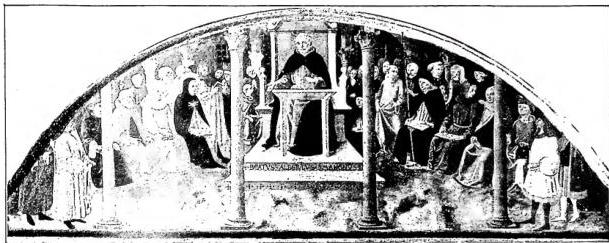
I. PHILOSOPHIA RATIONALIS OR LOGIC.
1. De praedicabilibus (= Super Isagogen Porphyrii, B. I, 1-148); 2. De praedicamentis (In Categorias Aristotelis, B. I, 149-304); 3. De sex principiis (Gilbert Porretani: B. I, 305-72); 4. In Boëtii de divisione (von Loe, Bonn 1913); 5. In duos Perihermeneias (B. I, 373-457);
ALBERTO MAGNO - A lesson of the saint. Panel painting, workshop of Fra Angelico — Florence, Uffizi.
(photo Alinari)
6. On Boethius’s De syllogismis categoricis (unpublished);
7. On the two Prior Analytics (Vol. I, 459–809);
8. On Boethius’s De syllogismis hypotheticis (unpublished);
9. On the two Posterior Analytics (Vol. II, 1–232);
10. On the eight Topics (Vol. II, 233–524);
11. On the two Sophistical Refutations (Vol. II, 525–713).
II. PHILOSOPHIA REALIS: a) Physics or natural philosophy.
1. De auditu physico (= In octo libros Physicorum, Vol. III, 1–632);
2. On the two books On Generation and Corruption (Vol. IV, 345–457);
3. On the four books On the Heavens and the World (Vol. IV, 1–321);
4. De natura locorum (Vol. IX, 527–85);
5. De causis proprietatum elementorum (Vol. IX, 585–657);
6. On the four books On Meteorology (Vol. IV, 477–808);
7. De mineralibus (Vol. V, 1–103);
8. On the three books On the Soul (Vol. V, 117–420);
9. De nutrimento (Vol. IX, 323–41);
10. De sensu et sensato (Vol. IX, 1–93);
11. De memoria et reminiscentia (Vol. IX, 97–118);
12. De intellectu et intelligibili (Vol. IX, 477–525);
13. De natura et origine animae (= De natura intellectualis animae et contemplatione, Vol. IX, 375–434);
14. De quindecim problematibus (P. Mandonnet, Siger de Brabant, II, Louvain 1908);
15. De unitate intellectus contra averroistas (Vol. IX, 437–75);
16. De somno et vigilia (Vol. IX, 121–207);
17. De spiritu et respiratione (Vol. IX, 213–52);
18. De motibus progressivis (= De principiis motus progressivi; Vol. X, 321–58);
19. De aetate (= De inventute et senectute; Vol. IX, 305–19);
20. De morte et vita (Vol. IX, 345–71);
21. De animalibus libri viginti sex (with De partibus animalium, Vols. XI–XII, Stadler, Münster 1916–20);
22. Quaestiones super libros De animalibus (unpublished);
23. De vegetalibus et plantis libri septem (Vol. X, 1–305; Meyer-Jessen, Berlin 1867).
On De fato (= De sensu communi), cf. Meersseman, p. 138. On the Philosophia pauperum, see ALBERTO DA ORLA MU NDE.
b) Mathematics. Super geometriam Euclidis (unpublished).
c) Metaphysics.
1. Metaphysicorum libri tredecim (Vol. VI, 1–725);
2. De causis et processu universitatis (In librum de causis, Vol. X, 361–619);
3. De natura decorum (lost).
III. PHILOSOPHIA MORALIS.
1. On the ten books On Ethics (Vol. VII, 1–611);
2. On the eight books On Politics (Vol. VIII, 1–804);
3. Scriptum et quaestiones super Ethicam Nicomachicam (unpublished).
The theological works may be divided into three categories:
I. EXEGESIS.
1. Super Iob (Weiss, Freiburg 1904);
2. Super Psalmos (Vols. XV–XVII);
3. On Prov. 11 (= De muliere forti, Vol. XVIII, 1–242);
4. On Jeremiah (fragments, cf. Meersseman, p. 90 ff.);
5. On the Lamentations of Jeremiah (Vol. XVIII, 243–353);
6. On Baruch (Vol. XVIII, 447–653);
7. On the Twelve Minor Prophets (Vol. XIX, 1–650);
8. On Matthew (Vols. XX–XXI, 1–338);
9. On Mark (Vol. XXI, 339–761);
10. On Luke (Vols. XXXII–XXXIII);
11. On John (Vol. XXIV).
The manuscript tradition of In Canticum Canticorum, In Isaiam, In Ezechielem, and In epistulas s. Pauli is unknown.
II. SYSTEMATIC THEOLOGY.
1. On Dionysius’s De divinis nominibus (unpublished);
2. On Dionysius’s De caelesti hierarchia (Vol. XIV, 1–451);
3. On Dionysius’s De ecclesiastica hierarchia (Vol. XIII, 470–805);
4. On Dionysius’s De mystica theologia (Vol. XIII, 811–62);
5. On the eleven epistles of Dionysius (Vol. XIV, 867–1027);
6. Scriptum super quattuor libros Sententiarum (Vols. XXV–XXX);
7. Summa theologiae (earlier): De creatione et creatura (Summa de creaturis: De quattuor coaevis, Vol. XXXIV, 307–798; De homine, Vol. XXXV); De bono et virtutibus (= Summa de bono et virtutibus, unpublished); De sacramentis (unpublished); De resurrectione (unpublished);
8. Tractatus de natura boni (unpublished);
9. Summa theologiae (later; Vols. XXXI–XXXIII);
10. De sacrificio missae (Vol. XXXVIII, 1–169);
11. De eucharistiae sacramento (Vol. XXXVIII, 191–432);
12. Thirty-two sermons on the Eucharist (Vol. XIII, 669–797);
13. Mariale sive quaestiones super Missus est (= De Laudibus B. M. V., Vol. XXXVII, 1–362).
III. PARAENETIC WORKS.
1. De forma orandi (= Pater noster, Wimmer, Ratisbon 1902);
2. Seventy-eight sermons on the liturgical year (Vol. XIII, 1–304);
3. Fifty-nine sermons on the saints (Vol. XIII, 407–634);
4. Homily on Luke 11:27 (von Loe, Bonn 1917);
5. Sermons delivered in the German language (noted by Strauch; cf. Meersseman, pp. 122 ff.);
6. Fifty-three orations on the Sunday Gospels for the entire year (Vol. XIII, 341–402);
7. Orations on the Sentences (Thoemes, Berlin 1893).
For other writings and prayers see Meersseman, pp. 123–49.
4. DOCTRINAL INFLUENCE
The scientific activity exerted by ALBERTO MAGNO in the Middle Ages was probably the most powerful of all, not excepting even that of the Angelic Doctor, whose influence, though narrower in scope, was deeper and more lasting. THOMAS was a river; ALBERTO a torrent (Mandonnet). Indeed, if one examines the history of any branch of learning, the name of the Cologne scholastic is encountered. The secret of his method, of his research, and of his success lies in his aim at nature, which is the root and source of life. He sought to find nature in scientific, physical, botanical, and zoological inquiries, and thus became a great naturalist. In his studies of man and human activity, by considering first nature and its operations, he became a great and eminently practical philosopher, without excluding the highest and most subtle speculation, even in reflections on the ineffable nature of God and on the problems of man’s supernatural communion with God. ALBERTO probed the essence of the divine nature, and for this reason he became a great theologian. Always intuiting the connection between scientific and speculative inquiry and life, without isolating himself in study, he became an eminent teacher. The breadth of his teaching is reflected in his extensive literary output.Beside his importance as a naturalist, ALBERTO had the special mission of introducing Aristotelianism into the philosophical and theological schools of the High Middle Ages. To his contemporaries he opened the treasures of the past, enriching them with the fruits of his own research, experiments, observations, and investigations in the most varied disciplines. This influence extended to the profane sciences, then called philosophy, and to sacred science, which finally took the name of theology.
The idea of a scientific encyclopedia destined for the Christian West was announced by him in these words: « Nostra intentio est, omnes dictas partes (physicam, metaphysicam, mathematicam) facere Latinis intelligibiles... Intentio nostra in scientia naturali est, satisfacere pro nostra possibilitate fratribus ordinis nostri rogantibus ex pluribus iam praecedentibus annis, ut talem librum de Physica eis componeremus, in quo et scientiam naturalem perfectam habecet et ex quo libros Aristotelis competenter intelligere possent » (Phys., I. I, col. 1). In the form of a paraphrase ALBERTO expounds the content of the books and doctrines studied, taking up special digressions for his own solutions. For his commentaries he used the Arabic-Latin translations made by Gerard of Cremona and Michael Scot. By incorporating Aristotelian writings into his own works and correcting theories opposed to the faith, ALBERTO resolved the problem of the acceptance of Aristotle among Western Christians, for whom, with the exception of Logic, the ecclesiastical prohibitions of 1210 and 1215 and the ordinance of 1231 were still in force.
Besides Aristotle, ALBERTO drew upon Plato and other Greek, Jewish, and Latin sources. Thus he provided his contemporaries with an immense body of material and a notable corpus of doctrine, and made possible the task of that master of synthesis, THOMAS. The service rendered in favor of a Christian Aristotelianism earned ALBERTO the title « philosophorum omnium totius christianitatis sol praeclarissimus » (Henry of Herford). D’Irsay points out ALBERTO’s contribution in giving the philosophical faculty its specific and autonomous character.
A. non costituì una scuola indipendente, specialmente in teologia, ma la sua dottrina visse in quella del suo discepolo s. Tommaso. Però si nota negli anni 1410 e 1411 un membro della facoltà filosofica parigina di nome Giovanni de Nova Domo che iniziò un movimento albertista, limitato sì, ma conservatosi per tre secoli: l'albertismo.
Da Parigi questo movimento si trapiantò per mezzo di Americo da Campo (Van de Velde) all'Università di Colonia e da questa a quella di Cracovia. Gli albertisti spesse volte si opposero ai tomisti, mentre in molti punti sostennero uguali concetti realistici. A Colonia il collegio dei Lorenziani seguì A., il collegio del Monte invece l'Aquinate. I Domenicani coloniesi si mantennero estranei alle questioni albertiste, ma parteciparono al culto religioso più intenso tributato dagli albertisti al loro maestro.
A. fu soprattutto teologo. Non mischiava nelle sue indagini filosofiche e naturali la prospettiva teologica, ma la sua intrapresa gigantesca dell'aristotelismo latino doveva servire per una costruzione teologica di dimensioni e di qualità degne della sacra dottrina: « et intentionem nostram finiemus in scientia divina » (Phys., I. I, col. 1). Anche in teologia s'industrìò di congiungere la documen-
tazione del passato con il ragionamento richiesto ai suoi giorni per formare un corpo dottrinale rispettabile in estensione e sodალია. La teologia è per lui fine e dominatrice di tutte le scienze. « Il suo valore, dice lo Schwane, si manifesta nelle opere teologiche. La teologia ricevette, grazie a lui, un prestigio possente, una forma precisa e un'esatta terminologia, che si conservò per lunghi secoli. S. Tommaso screbbe questa qualità, di cui però l'iniziativa resta al suo maestro ». Il Mandonnet menziona pure i meriti d'A. in favore del movimento teologico di cui Tommaso divenne capo, ritenendo però l'azione teologica di A. meno brillante di quella filosofica e scientifica e quasi oscurata dalla teologia tomistica. Inoltre bisogna notare che in teologia A. si riallaccia fortemente a correnti sgostiniane. Diversi studi recenti hanno messo in evidenza la speculazione teologica, ma anche il sapore mistico e le felici intuizioni che caratterizzano il dottore di Colonia più che l'Aquinate. I problemi di Dio e delle persone divine, quelli cristologici, dell'incarneazione e del S. Cuore, della mariologia, dei sacramenti e del sacrificio della Messa, del Corpo mistico di Cristo, della creazione, della rivelazione, della grazia, dei doni e dell'escatologia hanno trovato in A. un espositore sicuro e profondo, oggi molto apprezzato. Le monografie ne danno testimonianza eloquente. Lauer e Lottin mostrano come il genio d'A. abbia dato per primo una sintesi della teologia morale; altri rilevano le dottrine sulla fede e la carità, mentre gli esegeti ammirano la freschezza e la chiarezza della interpretazione albertina delle SS. Scritture.
Agli insegnamenti d'A. s'ispirò per molte parti della Summa confessorum il famoso Giovanni da Friburgo (m. nel 1314), continuando in tal maniera la dottrina pastorale albertina. Infine il Grabmann dimostra, in modo particolare, l'influsso d'A. sulla mistica tedesca, cui diede una direzione spirituale vigorosa e fecondissima.
BIBLI: Per la vita: Non esiste una biografia contemporanea di A. Gli eventi principali della sua vita si ricostruiscono con cenni nei suoi scritti, con notizie, documenti ed atti del suo tempo. J. Echard, Script. O. P., I, Parigi 1710, pp. 162-71; P. von Loe, De vita et scriptis b. A. M., in Anal. Boll., 19 (1900), pp. 257-84; 20 (1901), pp. 273-316; 21 (1902), pp. 261-71; I. Taurisano, Catal. hagiogr. O. P., Roma 1918, p. 20 sgg.; F. Pelster, Kritische Studien zum Leben u. zu den Schriften A. d. Gr., Friburgo 1920; E. C. Scheeben, A. d. Gr., Zur Chronologie seines Lebens, in Quellen u. Forschungen z. Gesch. d. Dominikanerordens, Lipsia 1931; id., Zur Chronologie des Lebens A. d. Gr., in Divus Thomas, Friburgo, 10 (1932), pp. 363-77; P. Castagnoli, La vita e gli scritti di s. A. M., in Divus Thomas, Piacenza, 3ª serie, 11 (1934), pp. 129-37; M. Weiss, Neues über A. d. Gr. aus einer Würzburger Handschrift, in Scholastik, 17 (1942), pp. 556-61; P. Mandonnet, s. V. in DHG, I, coll. 1515-1518; A. Walz, S. A. M. sagt, in Angelicum, 19 (1942), pp. 199-212.
Vite: Pietro di Prussia (Colonia 1486), Rodolfo da Nimega (Colonia 1492), A. De Ferrari (Roma 1847), J. Sighart (Ratisbona 1857), E. C. Scheeben (Bonn 1932), A. Gareau (Parigi 1932), Th. Schwertner (Milwaukee 1932), A. Puccetti (Roma 1932, 2ª ed., Siena 1937).
Per la personalità: H. Wilms, A. d. Gr., Monaco 1930, trad. ital. (Marega), Bologna 1931; E. C. Scheeben, A. M., Bonn 1932, pp. 185-99; A. Puccetti, op. cit., 2ª ed., Siena 1937, pp. 81-155; A. Walz, Beitröbungen zur Heiligsprechung A. d. Gr., in Divus Thomas, Friburgo, 10 (1932), pp. 419-36.
Per la bibliografia: cf. M. H. Laurent-M. J. Congar, Bibliographie albertinienne, in Rev. thom., 36 (1931); U. Dähnert, Erkenntnislehre des A. M., Anhang, Lipsia 1934; A. Walz-A. Pelzer, Bibliographia, in Serta albertina, in Angelicum, 21 (1944).
Per gli scritti: J. Echard, Script. O. P., I, Parigi 1710, pp. 171-83; A. Borgnet, op. cit., I, pp. xxx-xxv; P. von Loe, De vita et scriptis beati A., in Anal. Boll. 19 (1900), pp. 257-84; 20 (1901), pp. 273-316; 21 (1902), pp. 261-71; M. Weiss, Primardia novae bibliographiae b. A. M., 2ª ed., Parigi 1905; Gesamtkatalog der Wiegendrache, I, Lipsia 1925, coll. 581-784; Indice generale degli Incassabili delle Bibli. d'Italia, I, Roma 1943, pp. 22-32, nn. 157-238; P. Mandonnet, s. V. in DHG, I, coll. 1518-20; F. Überweg-B. Geyer, Die patrist. u. scholast. Philosophie, II, 2ª ed., Berlino 1928, pp. 402, 405-408; U. Dähnert, Erkenntnislehre, pp. 225-36; J. M. Vosté, S. A. M. sarrae paginae magister, I, Roma 1932, pp. 3-5; P. Glorieux, Répertoire des maîtres en théologie de Paris au XIIIe siècle, I, Parigi 1933, pp. 62-77; M. Grabmann, Storia della teologia cattolica, trad. ital., 2ª ed., Milano 1930, p. 104 sg.; Catalogus Stamatis, in Mon. O. P. Hist., VIII, Roma 1936, pp. 57 sg., 123; G. Meersse-
man, Introduzio in opera beati A. M., Bruges 1931. Si attende dall'Albertus Magnus-Institut di Colonia, diretto dal prof. B. Geyer, una edizione degna delle opere del Dottore svevo.
Per l'influsso dottrinale: Sulla dottrina profana d'A. si vedano F. Überweg-B. Geyer, Die patrist. u. scholast. Philosophie, II, Berlino 1928, pp. 400-16; M. Grabmann, I divieti ecclesiastici d'Aristotele sotto Innocenzo III e Gregorio IX, Roma 1941, passim; F. van Steenberghen, Siger de Brabant, d'après ses oeuvres inédites, II, Lovanio 1942, pp. 577-92, 692-717; G. Sarton, Introduction to the History of Science, II, Baltimora 1931, pp. 934-44; Serta albertina, in Angelicum, 21 (1944), pp. 41-336; W. De Wulf, Storia della filosofia medievale, II, 2ª ed., Firenze 1945, pp. 120-50.
Sulla teologia: M. Grabmann, op. cit., pp. 104-537; id., Mittelalterl. Geistesleben, II, Monaco 1936, pp. 324-412; J. M. Vosté, S. A. M. sacrae paginae magister, I-II, Roma 1932-33; D. O. Lottin, Chronique de Théol. médiévale: S. A. le Grand, in Rech. de Théol. anc. et méd., 5 (1933), pp. 423-27; id., Commentaire des Sentences et Somme Théol. d'A. le Grand, in Rech. de Théol. anc. et méd., 8 (1936), pp. 117-53, (cf. D. H. Poullon, La Summa de bono et le commentaire des Sentences d'A. le Grand, ibid., pp. 203-206).
5. IL CULTORE DELLE SCIENZE NATURALI
La proclamazione di A. a patrono dei cultori delle scienze naturali ha portato ad uno studio più ampio e più accurato del suo metodo e delle sue conquiste, che lo collocano fra i più geniali scienziati del suo tempo. E se è esagerato il dirlo addirittura il fondatore delle scienze sperimentali moderne, certamente ne fu un precursore esimio, che ad esse preparò la via.A. left no field of the natural sciences unexplored, from the elements and living things on earth to the stars in the sky. As for method, he broke with the blind criterion of authority, though without denying it a priori; yet he insisted that the assertions of others—even those of Pliny, then regarded as the greatest naturalist—should be verified as thoroughly as possible through personal observation and experiment, which must not be performed once only or in a single way, but repeated with varying circumstances.
Hence his diligence in observing everything, in verifying, and in collecting as many elements as possible that might prove useful to his research. In this way he was able to refute countless theories that had gained currency but proved false in his experiments; he determined more than 400 species of plants; he studied flowers and their reproduction; he spoke of the magnetic needle, the compass, and thermal waters; he made fine observations on sulfur, potassium, saltpeter, cinnabar; on the processes of petrification and the formation of coal; he discovered the ventral nerve cord of arthropods; in the theory of “temperaments” he almost coincides with the “constitutional types” now outlined in biotypology, and so forth.
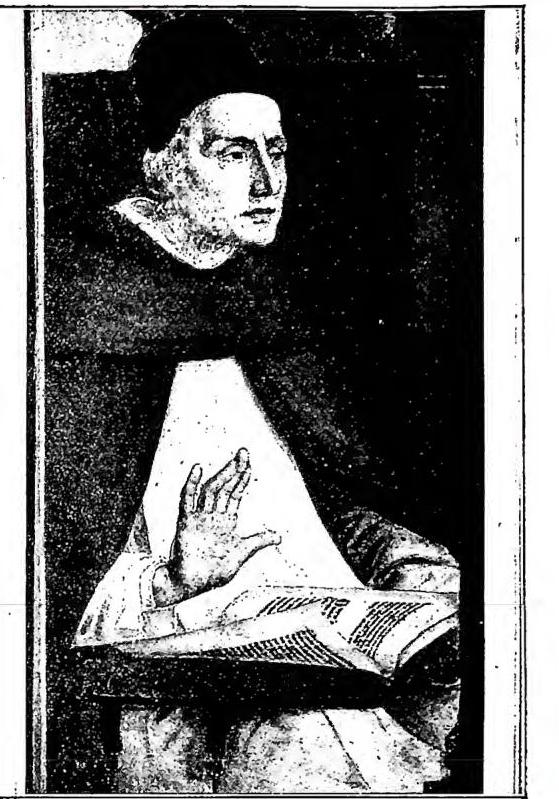
It has been said that A. is a slavish commentator of Aristotle. Certainly he follows him step by step, but he enriches his thought with new observations, new interpretations, and additions; nor does he hesitate to depart from him when necessary. In his work there are still gaps and at times naive credulities based on the accounts of those he consulted; and if he denies credence to Pliny, he lends it instead to persons he considers expert though they are not, for example in certain phenomena and facts of astronomy, hunting, fishing, and reproduction. Likewise, the “experimental method”
(photo Alinari)
ALBERTO MAGNO - Painting by Giovanni Santi (second half of the 15th century) - Urbino, Palazzo Ducale.
is to be understood in the light of the age; nonetheless, to A. must be granted the unquestionable merit of having proclaimed and put into practice, albeit with some errors, a sound method of inquiry and study. — See Plate LVI.