
CIRILLO D'ALESSANDRIA, saint. - Father and Doctor of the Church of the fifth century; born about 370, died 27 June 444; celebrated by the Byzantine Church
on 9 June and by the Latin Church on 9 February; proclaimed Doctor of the universal Church by Leone XIII on 28 July 1882.
SUMMARY:
I. Life
II. Works
III. Doctrine and influence.I. LIFE
The life of C. before his episcopate is almost wholly unknown to us; it is known only that he was the nephew of Teofilo, patriarch of Alexandria, and that he accompanied him in 403 to the “Synod of the Oak” near Chalcedon, where St. Giovanni Crisostomo was deposed. When he succeeded his uncle in the see of Alexandria, on 18 Oct. 412, the schism between East and West provoked by this deposition was still continuing. At first C. refused to bring it to an end, despite the insistence of Attico of Constantinople, by fulfilling the condition imposed by Rome of restoring Giovanni’s name to the diptychs. But from 418 onwards unity was restored, and everything leads one to believe that C. consented despite his reluctance. In one of his discourses, Nestorio clearly alludes to this reconciliation when he says that C. “now venerates, against his will, the ashes of Giovanni” (cf. F. Loofs, Nestoriana, Halle 1905, p. 300).If Socrate is to be believed, the beginnings of his episcopate were marked by continual riots and violence, in which the bishop himself was indirectly implicated, since his supporters, monks and parabolani, acted as genuine fanatics. The chief cause of these disturbances was his conflict with the prefect Oreste. In 415, during an affray, the celebrated Ipazia, highly learned in Neoplatonic philosophy, was killed by a parabolanus because of her alleged influence with the prefect. This murder cannot be imputed to C., despite the insinuations of Socrate, who is not impartial (Hist. eccl., VII, 13 and 14. Cf. F. Schafer, Cyril of Alexandria and the Murder of Hypatia, in The Cath. Univers. Bulletin, 8 [1902], pp. 441-53).
Nevertheless, it cannot be denied that Teofilo’s nephew somewhat resembled his uncle: that he was authoritarian and almost harsh in character, and that his orthodoxy knew no tolerance, as he showed by proceeding against the Novatians and the Jews, whose property and places of worship he confiscated.
With the same vehemence he threw himself against the Nestorian error from its very appearance. In fact, in 428, Nestorio, newly installed at Constantinople, began to challenge the legitimacy of the title Theotokos, Mother of God, which the Church had long bestowed upon the Virgin Mary. C., having been well informed by the representatives he had in the capital, did not delay in exposing the new heresy, at first without naming its author, then by addressing him directly. The first letter he wrote to him at the end of the summer of 429 merely irritated its recipient. An even worse outcome attended the second, sent in Feb. 430, in which the divine motherhood is masterfully expounded. C. then replied to Pope Celestino I (422-32), who had already asked him in 429 for information concerning the new controversy that had arisen at Constantinople. He sent to Rome a large dossier of his own writings intermingled with those of Nestorio, both translated into Latin. With great tact he greeted the Pope as “Father most beloved of God” and recalled the immemorial custom of the Churches of consulting him in all important affairs.
At the same time, he proclaimed him arbiter and regulator of ecclesiastical communion, something which he seemed to have forgotten at the beginning of his episcopate. “Deign to tell us,” he wrote, “whether we must remain in communion with Nestorio, or sever all relations” (Epist., 11: PG 77, 80 and 84). Celestino had already been informed concerning Nestorio’s doctrine both by the African Mario Mercatore, resident at Constantinople, and by Nestorio himself, who had sent him the text of his most controversial homilies. He could now settle the controversy with full knowledge of the facts. At the Roman Council of 11 Aug. 430, Nestorio’s doctrine was declared heterodox, and he was commanded to recant, under penalty of excommunication and
deposition, within the ten days following notification to him of the Roman decision. This notification was to be made by C. himself in the Pope’s name: “The authority of our See,” the latter said, “is communicated to you, and you will take our place in carrying out our decree” (PG 77, 93).
C. did not hasten to fulfil this delicate mission. Since the Pope had declared that Nestorio must abandon his errors and profess the same doctrine as C., the latter considered it expedient to set it forth in twelve anathemas which the innovator would have to subscribe. The anathemas were approved by a synod of Egyptian bishops, together with a long dogmatic letter, the third addressed to Nestorio, written in terms not especially agreeable (3 Nov. 430: PG 77, 105-21). As soon as they became known, the anathemas aroused a veritable storm among the theologians of the school of Antiochia, violently clashing with their terminology. In order to emphasize more strongly the personal unity of Christ and refute Nestorio’s hypostatic dualism, C. employed expressions hitherto unheard of and even spoke of a physical union, a union according to the hypostasis of the Word with the flesh, σαρκὶ καθ' ὑπόστασιν ἠνώσθαι, καθ' ἕνωσιν φυσικὴν.
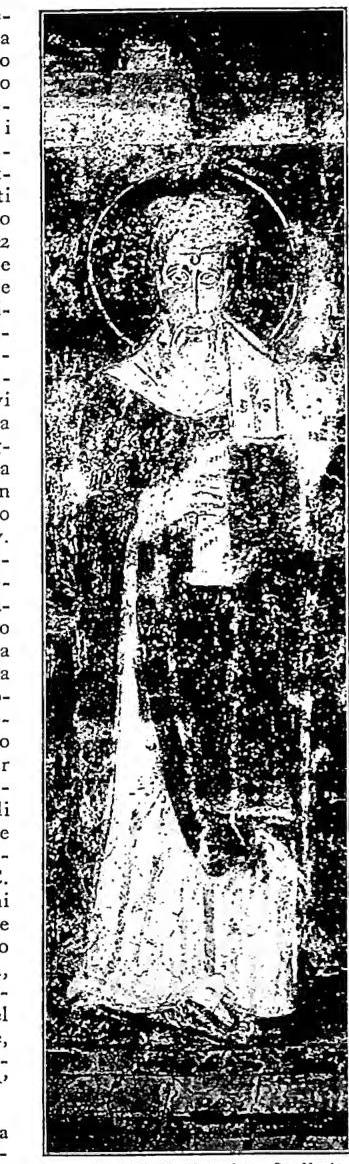
(from Wl. De Grünstein, Ste-Marie Antique, Rome 1911)
CIRILLO D'ALESSANDRIA, saint.
Fresco of S. Maria Antiqua (8th century).
to examine his case. When C.’s legates arrived at Constantinople, on 7 Dec. 430, to deliver to Nestorio the Pope’s ultimatum and the letter containing the anathemas, the Council had already been summoned to Efeso for Pentecost 431 by an imperial decree dated 19 Nov. Thus one of the most confused situations came about. Pope Celestino was able to resolve it by accepting the Council subject to certain conditions. The activity carried on by C. at the Council of Efeso (v. EFESO, CONCILIO di) was predominant, but it did not have a good outcome. By hastening the opening of the assembly, on 22 June 431, before the arrival of the bishops from the dioceses of the East, and especially before the arrival of the Pope’s legates, C. provoked a schism among the bishops. In a short time there were two Councils that anathematized one another. These anathemas were approved neither by the Emperor nor by the Pope. In order to reach an agreement, the two parties were invited to send legates to Calcedonia. When the attempt failed, the Emperor proclaimed the dissolution of the Council. C., who had remained at Efeso, set out again for Alexandria. The rescript of Teodosio II ordering him to remain at Efeso arrived after his departure.
The negotiations for union continued after the council between C. and Giovanni of Antioch, through the efforts of Acacius of Beroea, dean of the episcopate. C. loyally supported these efforts. Without sacrificing orthodoxy in any respect, he nevertheless made concessions concerning terminology. Finally, in 433, they reached an agreement on a text signed by both parties: the so-called “symbol of union,” extracted, except for one phrase, from a profession of faith sent by the Orientals to the Emperor Theodosius as early as August 431. This compromise did not please everyone. Among the Orientals there were some intransigent men who refused to enter into communion with C. There were also dissatisfied parties on the side of the Cyrillians themselves. C. had to explain the orthodoxy of the symbol of union to them at length. He did everything possible to preserve the union and moderated the zeal of Proclus of Constantinople, who wanted all the Eastern bishops to sign his Letter or Tome to the Armenians. He also refused to regard Diodore of Tarsus and Theodore of Mopsuestia, the true fathers of Nestorianism, as heretics, since they had died in the peace of the Church. He did not, however, conceal the harm caused by the translation of their works into Syriac and Armenian; he refuted them in two writings of which only a few passages remain.
In conclusion, during the course of the Nestorian controversy, C. had made several mistakes and had been in the wrong in various respects; but he sincerely endeavored to remedy everything. We cannot be sufficiently grateful to him for having sacrificed, for the union of the Church, some of his formulas, and for not stubbornly clinging to words, as the Monophysites would soon do when they sought to invoke his authority. For this reason the Church has always regarded him as one of her greatest doctors, and Pope Pius XII paid tribute to his memory in an encyclical (Orientalis Ecclesiae, 20 May 1944) on the occasion of the fifteenth centenary of his death.
II. WORKS
After s. John Chrysostom, s. C. is the Greek Father of the Church who has left the richest literary legacy. His writings, which occupy no fewer than 10 volumes of the Greek Patrology (68–77), may be divided into exegetical, dogmatic, and apologetic writings, homilies, and letters. This division is, however, superficial, since many letters constitute genuine brief dogmatic treatises. Many of these works have come down to us incomplete, at least as regards the original text, while others have been lost.1. Exegetical writings. – In extent, these surpass all his other works. Most predate the Nestorian controversy, and many are fragmentary. Among the Greek Fathers, C. is the principal representative of theological exegesis. This tendency, moreover, was in the spirit of the Alexandrian school. He undoubtedly belonged to this school, and was its last great figure. But just as Theodoret refrained from the excesses of Antiochene literalism, so he knew how to avoid the exaggerations of Alexandrian allegorism. Far from despising the literal and historical sense, he more than once proclaims its excellence and regards it as the necessary foundation of a higher sense. On the other hand, he was not the sort to dwell on grammatical minutiae. His commentaries concern the Old and New Testaments and take various forms. First of all, there is a kind of biblical introduction comprising two substantial works: the De adoratione in spiritu et veritate (PG 68, 133–1125), and a dialogue between C. and his friend Palladius, in which the author attempts to explain « what Our Lord meant by these words: I have not come to destroy the law and the prophets, but to perfect them, and what is signified by the worship in spirit and in truth which he made known to the Samaritan woman ». The two texts illuminate one another, for the Jewish observances were the shadow and figure of the new worship established by Jesus. The work is divided into 17 books, whose subject is indicated in the form of an index at the beginning by C. himself. Above all, it demonstrates the superiority of the new law over the old. A complement to this work is provided by the two Glaphyra (Γλαφυρά), that is, selected passages from the books of Moses in which the mystery of Christ is prefigured (PG 69, 9–679). It therefore studies the principal types of Christ and of his work that occur in the Pentateuch. Most of it is devoted to Genesis. All the patriarchs, from Adam to Jacob and his sons, are considered figures of Our Lord.
The proper commentaries on the Old Testament, all preceding the Nestorian controversy, provide a continuous explanation of the entire text of the prophet Isaiah (PG 70, 10–1449), the twelve minor prophets (PG 71, and 72, 9–364, and, preferably, Ph. E. Pusey, 2 vols., Oxford 1868), and the Psalms; but of the latter only fragments remain (PG 69, 717–1274), of doubtful authenticity (cf. R. Devreese, Chaines éxégétiques, in DBs, I, col. 134). But there is no evidence that C. worked on other books of the Old Testament, such as the four books of Kings, Proverbs, the Song of Songs, Jeremiah and Baruch, Ezekiel, and Daniel, of which the Catenae provide some fragments, collected in PG 69, 679–698, 1277–94; 70, 1451–62 (cf. R. Devreese, loc. cit., passim). It is known that the « catenists » very often draw their quotations from writings having no connection whatsoever with exegesis in the strict sense, and that these quotations must be subjected to criticism.
Of the New Testament, C. commented on: a) the Gospel of s. John, in 12 books, of which the seventh has survived only in fragments (PG 73 and 74, 9–756; the better edition by Ph. E. Pusey, 3 vols., Oxford 1872). J. Mahé demonstrated through internal criticism that this commentary predates the Nestorian controversy (La date du comment. de s. Cyrille d’Alex. sur l’évan. de st Jean, in Bulletin de littérature ecclésiastique, 1907, pp. 41–45). C. devotes lengthy theological developments to the divinity of the Word, the relations of the divine Persons with one another, and the Eucharist. He chiefly refutes Arianism, at times targeting the Christology of the Antiochenes, but does not mention Nestorius by name; b) the Gospel of s. Matthew, of which only insignificant passages remain (PG 72, 365–74, 471–74); c) the Gospel of s. Luke, in the form of homilies, of which we possess, in the original text, lengthy passages and three complete homilies (PG 72, 475–950; 77, 1009–16 and 1039–50). But a fairly faithful Syriac translation, from the sixth or seventh century, is almost complete (ed. R. Payne Smith, with English translation, 2 vols., Oxford 1858–59; new ed. begun in Corpus script. christ. or. by J.-B. Chabot: Scriptores Syri, 4th series, I [the first 80 homilies], Paris 1912). This is an oratorical commentary aimed chiefly at the edification of the people, and it does not explain the entire text. Entire passages, especially the whole of the first chapter, are omitted. Nestorius and his supporters are rebuked in it more than once.
The Catenae also provide fragments of commentaries on the Epistle to the Romans, the two epistles to the Corinthians, and that to the Hebrews (PG 74, 733–1006), which must nevertheless be subjected to serious scrutiny (R. Devreese, loc. cit., passim).
2. Dogmatic-apologetic or polemical writings. – This is the most important and best-known part of the works of our doctor, who is above all a theologian. Before the Nestorian controversy (428), he refuted the Arians in two works, the Thesaurus and the De consubstantiali Trinitate (PG 75, 9–1124). The first, divided into 35 chapters or λόγοι, summarizes in a didactic form the entire traditional teaching concerning the Trinity, drawing upon the three Cappadocian Fathers and especially s. Athanasius. The second, in the form of a dialogue, often cited under the title De Trinitate ad Hermiam (Hermias is C.’s interlocutor), treats in 7 dialogues the same subject, namely the consubstantiality of the divine Persons.
Of a work Adversus Synosias (extreme Apollinarists), only fragments remain in Greek and Syriac. Migne reproduces almost all of them in Mai’s Latin version (PG 76, 1427–35).
C. treats apologetics in the strict sense in the Contra Iulianum imperatorem, a substantial work in 30 books, of which only the first ten remain, composed in 433 and dedicated to Theodosius II (PG 76, 503–1064). But his activity as a theologian and polemicist was directed chiefly against the Nestorian heresy. In a series of brief treatises, sometimes written in the form of letters, he developed the dogma of the personal unity of Christ and that of Mary’s divine motherhood, which follows from the former. Here is the list of these treatises in chronological order:
1. Scholia de incarnatione Unigeniti; 2. De recta fide ad Theodosium imperatorem; 3. De recta fide ad principissas (the two sisters of Theodosius, Arcadia and Marina); 4. De recta fide ad Augustus (Pulcheria, sister of Theodosius, and Eudoxia, his wife); 5. Adversus Nestorii blasphemias; 6–9. XII capitum explanatio; XII capitum defensio utraque, Apologeticus pro XII capitibus contra Orientales (against Andrea di Samosata); Apologeticus contra Theodoricum; Explicatio XII capitum; 10. Apologeticus ad Theodosium, written at the end of 431 or the beginning of 432, a personal apologia against the accusations directed against him; 11. Adversus nolentes confiteri sanctam Virginem esse Deiparam; 12. Quod unus sit Christus, in dialogic form; 13. Libri adversus Diodorum Tarsensem et Theodorum Mopsuestenum (around 438), of which only fragments remain. To these treatises must be added many dogmatic letters, such as that Ad monachos Aegypti (429) on the legitimacy of the term θεοτέσος, The second to Nestorio (Feb. 430), approved by the Councils of Ephesus and Chalcedon, a true dogmatic document; that synodal letter of 3 November 430 (the third to Nestorio), which ends with the twelve anathemas; that to Giovanni d'Antiochia, which contains the symbol of union and the famous formula: « One is the incarnate nature of the Word of God » (μία φύσις τοῦ Θεοῦ Λόγου σεσαρχομένη); and finally the two To Successus, bishop of Diocesarea, on the same subject. All these are collected in vols. 75–77 of the PG.
The treatise Adversus anthropomorphitas, whose authenticity is disputed, is also attributed to C. (PG 76, 1065–1132). According to the edition of Pusey (Oxford 1872), it has come to be believed that the work, as we have it today, is a fusion made by an unknown author of C.’s two opuscula, De dogmatum solutione and Responsiones ad Tiberium. On the other hand, the two opuscula De incarnatione Domini and De Trinitate, printed among C.’s works (PG 75, 1419–78, and 1148–80), must be restored to Theodoret.
3. Homilies. — In addition to those on s. Luca, already mentioned, C. has left us two other series. Twenty-nine Homilies on Easter, festal letters for the years 414–42. Most of them are ascetic and parenetic in character. Some, however, are dogmatic, such as those of 420 and 429, which already refute the hypostatic dualism of Teodoro di Mopsuestia and Nestorio. The other homilies (Migne includes 17, together with five passages [77, 981–1116]) are not all authentic. Thus the Omelia in mysticam caenam must be restored to the patriarch Teofilo (cf. M. Richard, Une homélie de Théophile d’Alexandrie sur l’institution de l’Eucharistie, in Revue d’hist. ecclés., 33 [1937], pp. 46–56); the 11th, Eucomium in sanctam Mariam Desparam, is an elaboration of the 7th–9th century modeled on the fourth (cf. A. Ehrhard, Eine unechte Marienhomilie des hl. Cyrill V. Alexandrien, in Römische Quartalschrift, 3 [1889], pp. 97–113); the 12th consists of passages taken from the commentary on s. Luca. Homilies 1, 2, 4, 5, 6, 7, and 8 were preached at Ephesus.
4. Letters. — The printed collection (PG 77) comprises 88, 69 by him and 19 from correspondents. Of these, the 80th is by s. Basilio, and the 88th (by Ipatia) is spurious. We have already indicated the principal letters of a dogmatic nature. They all concern the Nestorian controversy. Some of them have come down to us only in Latin translation.
C. writes without great literary concern. Clear, precise, incisive, he concentrates his ideas in brief formulas when engaging in polemic; otherwise, he is somewhat prolix and redundant. The overloaded and cumbersome sentence is at times laborious to read. Often, because of the Nestorian controversy, he is obliged to repeat the same things, especially concerning the unity of Christ and the divine motherhood of Maria.
III. DOCTRINE AND INFLUENCE
C. is unquestionably one of the greatest figures of the Eastern Church in the patristic era. First of all, he is a theologian: a well-balanced theologian, both positive and speculative. A. Arnauld called him «le plus scolastique de tous les Pères» (Perpétuité de la foi, V, Paris 1672, p. 14). This judgment may be accepted, provided it is added that he is also most attentive to grounding his speculations in the sources of Revelation. In refuting heretics, he appeals not only to Sacred Scripture, like many earlier Fathers, but also to the writings of his predecessors, and his argumentation is accompanied by patristic florilegia (H. du Manoir, L'argumentation patristique dans la controverse nestorienne, in Recherches de science religieuse, 25 [1935], pp. 441–61, 531–59). His theological activity was conducted ex professo around the principal Christian mysteries, the Trinity and the Incarnation. He dealt with the other revealed truths only insofar as they were related to these fundamental dogmas. Concerning the Trinity, he masterfully condensed the teaching of his predecessors and brought the Arian controversy to an end in its doctrinal aspect. Anastasius the Sinaite calls him «the seal of the Fathers» (Hodegós, VII: PG 89, 113), and the title is well deserved with regard to Trinitarian doctrine. The procession of the Holy Spirit from the Father through the Son (διά τοῦ υἱοῦ), or from the Father and the Son (ἐκ τοῦ πατρὸς καὶ τοῦ υἱοῦ: ἐξ ἀμφῶν), is, without his making it the subject of a special study, one of the points he treats with the greatest clarity (cf. De adoratione in spiritus et veritate, I: PG 68, 148). In fact, among the Greek Fathers he is the great authority for refuting the Photian dogma of the procession a Patre solo.With regard to the mystery of the Incarnation and the manner of the union of divinity and humanity in Jesus Christ, C. does not resolve the controversy, but it may be said that he accentuates it by emphasizing the hypostatic dualism of certain Antiochene doctors who, in refuting Apollinarianism, had overstepped the bounds and compromised the personal unity of the incarnate Word. He is the great doctor of the unity of Christ and of the corollary of this unity: the divine motherhood of Mary. To the Antiochene dualism, represented by Nestorius and Theodore of Mopsuestia, he opposes the traditional faith in one Lord Jesus Christ, the incarnate Word, born from the Father ab aeterno, born
of the Virgin in time. The designation Θεοτόκος, conferred upon the Virgin for a long time, is for him the badge of orthodoxy against Nestorius, who was unable to grasp its meaning; and this term, in the Christological controversy, played the same role as ὁμοσύσιος had played in the Trinitarian controversy.
C.’s orthodoxy concerning the mystery of the union of the two natures in Jesus Christ has nevertheless been contested. His celebrated anathemas against Nestorius were violently attacked, as was also his preferred formula for expressing the mystery: «One is the incarnate nature of the Word of God» (μία φύσις τοῦ Θεοῦ Λόγου σεαρκωμένη), a formula which he believed belonged to St. Athanasius, whereas in reality it belonged to Apollinaris. The anathemas and the formulas «union according to the hypostasis, physical union, one incarnate φύσις» were explained by our doctor in a perfectly orthodox manner. He stated and repeated that these expressions were directed against Nestorius. For Nestorius, together with Apollinaris, Theodore of Mopsuestia, and others, understood the word φύσις in the sense of a concrete subject, a distinct subject of attribution, a nature-person. Theodore had said that φύσις, real impersonal nature, does not exist. By giving the word φύσις this meaning, one in fact makes it a synonym for person, ὑπόστασις, πρόσωπον. With this terminology, if one wishes to remain orthodox, one must necessarily say that in the incarnate Word there is only one φύσις, that is, one nature which is at the same time a person, namely, the person, the hypostasis of God the Word. The adjective σεαρκωμένη, incarnate, is added to indicate the individual and complete human nature assumed by the Word in the unity of his divine person. Likewise, the expressions ἕνωσις φυσική, ἕνωσις καθ' ὑπόστασιν mean «real union, substantial union, true union», κατ' ἀλήθειαν, as C. says, in opposition to the «moral union», the «relative and extrinsic union», the Nestorian συνάφεια, which left two subjects of attribution, two individuals, two persons subsisting: the man Jesus born of the Virgin and the Word born from the Father before all ages. The union in Jesus of the two natures terminates in a true «numerical union» of the subject, of the individual, in a «natural unity», ἐνότης φυσική, analogous, though not entirely similar, to the union of soul and body in the human individual. C. did not attempt to explain how this could occur, as Theodore had sought to do.
C.’s weak point is his terminology. He did not attempt to establish precisely the meaning of the words φύσις, ὑπόστασις, πρόσωπον in the theology of the Incarnation. Depending on the case, he assigned different meanings to the terms φύσις and ὑπόστασις, thus often using the language of the Monophysites. It is true that, in order to avoid every heterodox interpretation of his thought, he took all the necessary precautions. If, for example, he wished to give the word ὑπόστασις the meaning of person, he habitually joined it to the word πρόσωπον; if he gave it the meaning of a real thing, he followed it with the term πρῶμα; and if, finally, the word φύσις was taken in the sense of οὐσία, the context sufficiently indicated the synonymy. Nevertheless, this lack of uniformity caused serious difficulties in the subsequent Christological controversies and effectively contributed to the birth and prolongation of the long logomachy that was Severian, or verbal, Monophysitism—a logomachy that has not yet died out.
Indeed, the Monophysites invoked his name in order to stubbornly insist upon dangerous formulas which the Church was forced to proscribe. The Council of Chalcedon preferred the language of the two natures, whereas his adversaries obstinately persisted in maintaining and developing Monophysite terminology, at the risk of falling into Eutychianism. If they had been sincere disciples of C., they would have shown greater willingness to concede on matters of wording and would have sacrificed their formulas for the unity of the Church.
After the mysteries of the Trinity and the Incarnation, the
revealed truths which C. most strongly emphasizes and to which he
returns most frequently are the elevation of man to the supernatural
state, the doctrine of Grace and sanctification, and the sanctifying
effects of Baptism and the Eucharist. He adopts and develops in an
original manner the doctrine of the divinization of human nature
through the physical contact of the incarnate Word, of which the Greek
Fathers, his predecessors, had often spoken. But he also gives great
prominence to the action of the Holy Spirit in sanctification through
his indwelling in the holy soul, through his direct and, in a certain
sense, personal contact with it, because the sanctifying action in a
certain way deifies the soul, transforms it, and infuses it with a
certain quality that makes it conformable to Christ (8α τῆς ἐν ἁγιασμῷ
πούσῃτος, Homil. pasch., 10: PG 77, 617) and causes it to pass into
another state (εἰς ἐτέραν τινὰ μεθιστήσιν
ἔξιν, In Ioannem, 16, 6–7: PG 74, 433).
These expressions reveal what our theologians call sanctifying Grace, the created gift, the effect of the uncreated gift, which is the very person of the Holy Spirit. This created effect, this quality, this seal, as C. further says, is inseparable from the personal presence of the Holy Spirit. If the latter ceases, that deifying quality also disappears. C. therefore likes to consider divine Grace under this static aspect, and he may rightly be called the theologian of habitual Grace, just as St. Augustine is the theologian of actual Grace (cf. F. Cayré, Précis de patrologie, II, Paris 1930, p. 39).
Moreover, he does not at all exaggerate the theory of divinization through the physical contact of the Word with human nature; he teaches that every human being must cooperate, through personal action, in his own deification by faith, by receiving the Sacraments (especially Baptism and the Eucharist), and by good works. He insists greatly on the sanctifying effects of the Eucharist, of the so-called «mystical eulogy». The flesh of Christ, united to the Word, the source of life, gives life to our bodies and our souls through a real and in some sense physical contact. Through Communion we are united to Jesus Christ as two pieces of wax fused together (PG 73, 584).
After his death C. became the object of much controversy, and the reason lies in the lack of uniformity in his Christological terminology. Catholics and Monophysites bitterly disputed concerning his name. The Monophysites sought to appropriate him and made him their great doctor. The Catholics, opposing them with numerous testimonies drawn from his writings, were able to demonstrate that he often employed formulas sanctioned by the Council of Chalcedon and that he had always been of impeccable orthodoxy. The Council of Chalcedon and the Second Council of Constantinople attested to this orthodoxy and censured those who had contested II. His preferred formulas, however, those which express the dogma in Monophysite language, were abandoned long ago. After the dispute over the Three Chapters and the Monothelite controversy, only the formulas of Chalcedon remained in the common language of the Catholic Church.
In the Byzantine Church, after the Christological controversies, the influence of our doctor does not seem to have been predominant. Preference was given to St. Basil, St. Gregory of Nazianzus, and St. John Chrysostom, «the three hierarchs», celebrated in a common feast as early as the tenth century. The controversy over the Filioque undoubtedly played a part in this eclipse; indeed, as we have said, C. is, among the Greek Fathers, the great opponent of the procession of the Holy Spirit from the Father alone. His formulas had already refuted in advance the quibbles and subterfuges of those adhering to the Photian dogma. A doctor who supplied the Latins with such effective weapons could certainly not win the sympathy of the disciples of Photius.