
INSTITUTE OF CHARITY. - Religious congregation with simple and perpetual vows, founded by the priest Antonio Rosmini Serbati (v.) on 20 February 1828 at Domodossola, approved by Gregory XVI on 20 September 1839.
The impulse to the foundation came to Rosmini by Bl. Maddalena di Canossa (v.), who would have wanted him as a companion in starting a religious society for men similar to her Daughters of Charity. Rosmini then followed another design according to the lines of his asceticism. The purpose of the I. della C. is the widest possible realization of charity, meeting the various needs of places and times and following the call of one's neighbor, not anticipating it by one's own initiative. As for poverty, the I. della C. as such cannot own property, while individuals may hold property, a principle that Rosmini succeeded in having approved, not without opposition, in 1839.
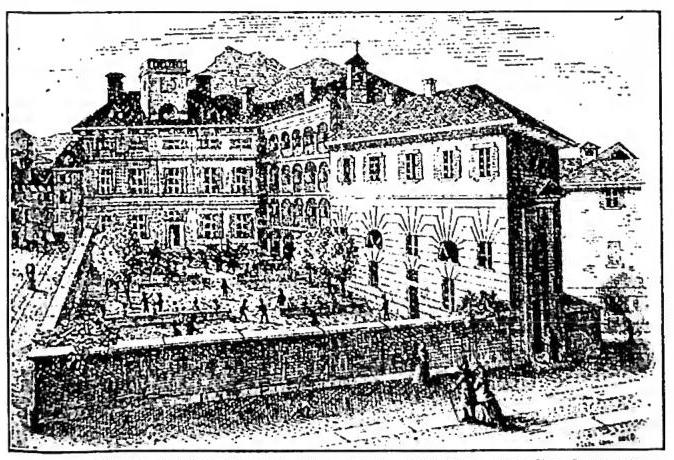
At present the religious, including priests, teachers and "brothers," number about 500, and are found in Italy, England, Ireland, North America, and Africa. In Italy the I. della C. at first devoted itself to teaching (elementary schools, reformatories and orphanages, boarding colleges, of which the best known is that of Domodossola, and others at Stresa and Turin): later it also took on parishes (Montecompatri, Milan, Trapani). In England it began with missions to the people, and especially through the work of Fr. Gentili took an active part in the revival of Catholicism in the early nineteenth century, then took on parishes and colleges of which the best known is Ratcliffe. In Ireland it has institutions for orphans and young offenders; in America, parishes. In Africa the missions began in Tanganyika in 1945.
Among the religious who brought distinction to the I. della C. one may recall Fr. Luigi Gentili, missionary in England (1801-48), Fr. Giovanni Battista Pagani (1806-70), author of the Anima divota del S.mo Sacramento, Fr. Giuseppe Calza, philosopher (1821-98), Fr. Luigi Perez, poet and Dante scholar (1822-79), Fr. Vincenzo De-Vit, Latinist (1811-92), Fr. Pietro Prada, historian (1837-1900), Fr. Luigi Lanzoni, ascetical writer (1835-1901).