
ESTETICA. – Science of the beautiful and of art.
CONTENTS:
I. Meaning of the term
II. Historical synthesis
III. The problems of aesthetics.I. MEANING OF THE TERM
The use of the word a. to denote philosophical reflection on art and beauty dates back to a student of Leibniz, Alexander Gottlieb Baumgarten, who in 1759 entitled Aesthetica, from αἰσθησις (= sensation), the science of those sensible facts that refer to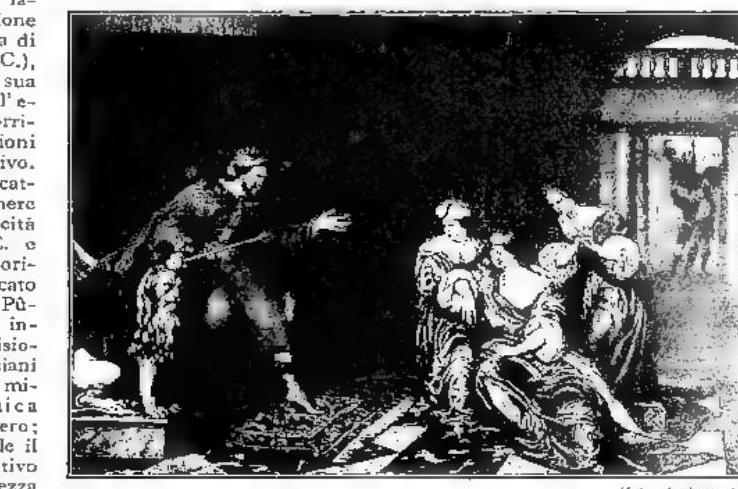
beauty and art. For Baumgarten, e. would in fact represent the «perfectio cognitionis sensitivae, qua talis», precluding a higher form of knowledge and constituting almost an «inferior gnoseology». There are also other designations for the same discipline, which some call «philosophy of art» and for which it would be desirable to revive the classical designation «poetics». In the German schools before the war, the distinction prevailed (to which, among others, C. Fiedler, H. Spitzer, M. Dessoir, W. Worringer, and E. Utitz adhered) between a. (Aesthetik) and the science of art (Kunstwissenschaft): a distinction adopted in the two sections of the Congrès international d'esthétique et de science de l'art (v. Atti, Parigi 1937); but it is to be hoped that a distinction will not gain currency which could deepen the divide between the artistic and the aesthetic, to the detriment of an understanding of both. Bound to expressive activity, art is bound to language; e., therefore, maintains close relations with the science of language, that is, linguistics. Indeed, for B. Croce the connection between the two disciplines is so close that it becomes an identity, consecrated from the very title of the work: E. as the science of expression and general linguistics.
II. HISTORICAL SYNTHESIS
The question arises whether a history of aesthetics can begin with classical antiquity, or whether, in the case of the Greeks, one ought to speak of the “prehistory of aesthetics,” according to the expression used by Zimmermann in vol. I of the Geschichte der Aesthetik als philosophischer Wissenschaft. For Croce, aesthetics, together with politics or economics, would be a “new diabolical science” or a science “of a new divinity” belonging to the modern world—a science that could not arise until value had been assigned to the sensuous and the imaginative, and until the new concept of spirituality as autonomy had been established. This would be tantamount to denying
But, to confine ourselves here to elementary observations, it should be recalled that the highest page of classical aesthetics is that of Plato’s Symposium in which the condition of Eros is described: fertilized by the longing for objective and absolute beauty, he becomes capable of generating and procreating in beauty (τῆς γεννήσεως καὶ τοῦ τόκου ἐν τῷ καλῷ: 206 e). In the being that is pregnant and swollen, the amorous impulse toward beauty is generated (206 d); when someone already longs to generate and procreate, only then does he set out in search of beauty (209 b), and, having found it, generates and procreates that with which he had long been pregnant (209 c). Poetry is this spiritual procreation, for which no particular qualification is required of “good poets,” except that they be generators and inventors (γεννήσεως, εὐρετικοί: 209 a). This is the highest page of classical aesthetics, because it engages expression from within in artistic reproduction and brings the making of art close to the objective contemplation of beauty, almost to the point of making the two dispositions coincide—those which the Greeks generally preferred to distinguish, and sometimes to oppose. The merit usually attributed to Plotinus, of having made beauty intrinsic to artistic production, must be traced back to the author of the Symposium. Other aesthetic concepts that would continue to nourish the entire philosophical tradition likewise go back to him. The Platonic concept that beauty is an idea translated into corporeality (τίνα σώματος ἰδέαν; Phaedrus, 251 a) has endured to Romanticism and to Hegel, and has not yet been definitively settled in our own day. Beauty is the only idea that was granted the privilege of becoming visible to mortals and of being ardently loved by them (230 d). That poetry constitutes an exceptional, alogical form of knowledge, similar to that of the priestesses of Lapith and of diviners; that the passionate rapture by which it is possessed has the character of fury and madness: this is repeated by Plato, especially in the Ion and the Phaedrus, and it sometimes serves to exalt, at other times to depreciate, poetry because of the dark and passionate element that it stirs in man. The Platonic theory of artistic mimesis likewise has a dual, pessimistic and optimistic, outcome. As an imitation of the sensible, art indeed removes us three degrees from the idea, from which the sensible is already distant, and for this reason art must be banished from the ideal republic. But insofar as artistic mimesis may be ascending—that is, may anticipate ideal rhythms in sensible harmonies, as happens especially in music (Republic, III, 401 d–402 a)—it is supremely educational, and it is precisely in music that the defenders of the city must establish their fortress.
Aristotle’s Poetics offers as its original contribution a direct consideration of that poetic genre which is tragedy, concerning which he develops an acute and meticulous analysis that nevertheless makes little progress with respect to Platonic aesthetics. For Aristotle too, art is imitation, although it is easier for him than for Plato to understand the intrinsic ideality of a sensible representation and thus to evaluate artistic imitation positively. In the Sophist Plato had distinguished a ἱστορική μίμησις from a δοξομμητική (267 d, e); and on this basis Aristotle’s distinction arises between history, which is a description of things that have happened, and poetry, which represents things that might happen.
Through this, poetry is brought close to the universal and necessary character of scientific knowledge, and it is difficult to see how it can be distinguished except by that concept of verisimilitude (νὰ τανὰ τὸ εἰκός: Poetics, IX, 1451 b), which is itself borrowed from Plato. The latter had spoken in the Symposium of the liberating release (ἀπόλυσις: 206 c) that follows the bloody effort of spiritual gestation, anticipating an understanding of the liberating virtue of art. Aristotle’s reference to tragic catharsis—that is, purification from the passions of terror and pity, achieved through their stage representation (Poetics, VI, 1449 b)—develops its aesthetic significance through a backward-looking reading that allows Aristotelian catharsis to be commented upon on the basis of Platonic ἀπόλυσις.
In the aesthetics of late classicism, besides Neoplatonism, which elaborates the concepts of the Platonic dialogues with an accentuated mystical tone, one notes a tension between Epicureans and Stoics: the former intent on emphasizing the hedonistic aspect, the latter the didactic aspect of poetry. The latter made extensive use of allegory in order to extract from the poetic fable allusions of doctrinal significance. In Horace’s epistle Ad Pisonem, the two tendencies are reconciled by making poetic pleasure serve moral and intellectual ends: omne tulit punctum qui miscuit utile dulci.
The contribution of the philosophy of Christianity to the history of aesthetics goes beyond the sporadic observations on art and beauty, for the most part of Neoplatonic inspiration, which recur in the Fathers and Doctors (v. ARTE), and far beyond the allegorism that informs, for example, Dante’s aesthetics. The effective and essential contribution is indirect: it consists in the new theological conception destined, by reflection, to reform the concept of man. The Platonic Demiurge, who looks to the Ideas and shapes formless matter in the image of the intellectual archetype, could not fail to condition an intellectualistic and mimetic aesthetics. But the Christian God, who inwardly generates his consubstantial Word, in whom he recognizes and loves himself, and through whom he creates being outside himself, could not fail to condition an aesthetics of expressiveness and creativity, such as would indeed emerge in modern times. The beauty of things, for St. Augustine and St. Thomas, continues to reveal itself in the unity, harmony, proportion, and suitability of the parts, but it is always implicit that these qualities of the created world are due to the things’ belonging to their spiritual source, that is, to the Creator Principle. No thing would be beautiful if it did not come from God: this is the theme that recurs from St. Augustine’s Confessions to St. Bonaventure’s Itinerarium. It is still a matter of divine art, rather than human art; it is a matter of cosmology, rather than psychology. But the theme of this aesthetic cosmology, to which Christian optimism is owed in such large part, was also destined to bear fruit in the conception of human art, which, rather than an imitation of nature, would have to prove an imitation of the act by which God creates nature. When a history of aesthetics is written from this point of view, it will appear that St. Augustine’s contribution to the aesthetics of modern times lies more in De Trinitate than in De musica, because while the latter work reasserts the Neoplatonic scheme, the former takes advantage of the likeness between the human word and the divine Word to illustrate the generative act by which speech detaches itself from the soul as an internal expression, warmed by the love that binds it to its generator. « Conceptam rerum veracem notitiam, tamquam verbum apud nos habemus, et dicendo intus gignimus » (De Trinit., IX, 7). In expressing itself to itself, the mind loves itself and loves its own interior word: « Cum itaque se mens novit et amat, iungitur ei amore verbum eius. Et quoniam amat notitiam et novit imorem, et verbum in amore est, et amor in verbo, et utrumque in amante atque dicente » (IX, 10). Poems originate in this internal expression, which is the basis of every word uttered externally: « Omnia... sonantium verba linguarum etiam in silentio cogitantur, et carmina praecurrunt animo, tacente ore corporis » (XV, 11). Here is the first page of modern linguistics and poetics; here one can measure the innovating force of Christian thought within the framework of Western culture.
The subsequent progress of aesthetics is measured by the slow affirmation of the expressive powers of the spirit, in contrast with the resurgent intellectualism and hedonism of classical aesthetics. The many fourteenth- and fifteenth-century treatises on beauty, love, and furor (Ficino, Equicola, Bembo, Leone Ebreo, Bruno), by linking the aesthetic to the emotional and the passionate, offer some indications of the intimate, spiritual sources of beauty. They delay the progress of aesthetics less than does the renewed cult of Aristotle’s Poetics (Fracastoro, Castelvetro, Scaligero, Piccolomini, Patrizzi), which brings reflection on poetry back into the channel of classical intellectualism, opening the way to the rationalism of Descartes that would find its faithful aesthetic expression in N. Boileau’s Art poétique (1674). In truth, Aristotle’s « verosimile » did not coincide exactly with the « vero », but left a margin for the poet’s activity in that « simile » which at once denotes proximity and distance. By widening this margin, the poetics of the seventeenth century were able to make room for the concepts of « ingegno », « argutezza », « gusto », « stile », « immaginazione », and « fantasia », through which poetic reality gradually freed itself from an objective and intellectual model and in some way drew closer to the free productivity of the subject. The separation became more pronounced in those sophistic poetics which, no longer concerned to make artistic delight serve as a corrective to the harshness of the real, regarded sensuous pleasure as an end in itself and the sole end of art.
Sensualistic and hedonistic aesthetics excluded poetry from the ranks of the serious activities of the spirit. In the first half of the eighteenth century, a movement arose aimed at recovering art as a form of knowledge, assigning it, albeit in its sensuous consistency, a function that anticipated the clear and distinct ideas perceived by the intellect. This movement, which, as was said at the beginning, had its German point of reference in Leibniz and Baumgarten, also includes the aesthetic contribution of G. B. Vico, who sees in « sapienza poetica » the early-morning phase of that « riflettere con mente pura » which characterizes the phase of intellectual maturity in individuals and peoples. But there is much more in Vico than the artistic auroralism that he shares with the theories of his time. In Leibniz and the Leibnizians, the aesthetic fact is still « percepito »; in Vico it is « productio ». Nourished by Augustinian and Platonic studies, he brings to light what was implicit, for the explanation of the true nature of beauty, in Plato’s « τόνος » and in St. Augustine’s « verbum mentis ». Vico’s « fantasia » is now the expressive power of the human spirit, fulfilled in the « corpulenta » image, a synthesis of matter and form, issuing directly from the incandescent life of feeling. « I primi uomini delle nazioni gentili, come fanciulli del nascente genera umano..., dalla loro idea criavan essi le cose, ma con infinita differenza però dal criare che fa Iddio. Fe-rocché Iddio, nel suo purissimo intendimento, conosce a conoscendole crea le cose; essi, per la loro robusta igno-ranza, il facseno in forza d'una corpulenta fantasia. E perch'era corpulentissima, il facseno con una maravi-gliosa sublimità; tal a tanta che perturbava all'eccesso essi medesimi, che fingendo le si criavano, onde furono detti "poeti", che lo stesso in greco siona che "criatori" (Seconda scienza nuova [1731], I, II). In the « ingente selva » of Vichian thought, where not everything is clear and disentangled, the breath of the new aesthetics opens up laboriously but soundly.
The creative powers of the human spirit that Vico had
which Vico had confined to the orbit of poetic fantasy, and the human productivity that Vico had examined in history, with German Romanticism exceed these limits and invent the whole of reality, touching the boundaries of the absolute. The history of the human becomes the history of being. “Genius” is the new Romantic god who bends rebellious forces, brings nature and spirit, thought and extension, the infinite and the finite back to the unity of form, and reveals the ultimate meaning of everything. Already in the Critique of Judgment (1790), Emanuele Kant had anticipated this outcome, attributing to beauty the power to establish the point of reconciliation between sensibility and the intellect, between the necessity of nature and the freedom of the spirit—the very terms between which the other two Critiques had discerned “an immense fracture.” Kant had also fleetingly suggested that the foundation of this unity must be embodied in the idea of an Intellect that was not the intellect of man, and through whose virtue the union would be effected of that which man’s pure reason discusses and opposes (Kritik der Critikkraft, Berlin 1912, pp. 244, 249). In Schelling’s System of Transcendental Idealism (1800), however, this supersensible intellect is wholly resolved into the genius of the artist who, as the organ of the absolute, unveils its innermost existence as the disposition of the ideal and the sensible, of thought and extension, of unreflective spontaneity and consciousness.
Aesthetic interest seems foreign to Fichte’s Doctrine of Science (1794); but the absolute power of the transcendental Ego, which creates the non-self in order to express its moral freedom therein, is translated into the magic of Novalis’s poetic inspiration, into the free creativity of the artist who, in F. Schlegel and Tieck, casts worlds forth from himself, only to annihilate them despotically, ironically rising above the finiteness of each of his works through a proud affirmation of infinity. Kant’s “thing in itself” is the veiled gift that reveals its mystery in the embrace of beauty. Romanticism, philosophy and literature, proceeds under the sign of the primacy of the aesthetic. In Hegel, to be sure, art is not the final stage in the dialectic of absolute spirit, but, as “sensible ideality” or “formed spirituality,” it imperfectly preludes the definitive moment in which the absolute possesses itself in the purity of the philosophical concept. Yet the Hegelian logos, in which art is destined to be resolved and die, itself realizes the Romantic-aestheticist design, because it concludes within the limits of the human and of historical dialectic the meaning of the absolute which, instead, exceeds and overflows them on every side. The Hegelian system, as V. Gioberti observed, possesses as much of the beauty of the work of art as it lacks of the truth that the philosopher seeks. Romanticism is a crucial point in modern e. because it recognizes and exalts the creative powers of the human spirit, accounting for poetic magic; but it leaves unresolved the problem of an excess of reality and truth, of the logical, the moral, and the metaphysical, beyond the boundaries of the aesthetic. Many Romantic souls experienced the problem tormentingly and dramatically.
The subsequent e. marks a decomposition of art into its formal values, on the one hand, and, on the other, its psychological-historical values. In extreme summary, the first category (Gestaltzaestheitik or e. of the teie, as opposed to Gehaltzaestheitik or e. of the ton) may be understood to include the current descending from Herbert, which, having its historian in Zimmermann, encompasses to a certain extent the important critical contribution of F. De Sascia, and descends to our own day through the work of Hanselck, Fiedler, Semper, Wölfflin, and the early Berenson. On the side of historical-psychological values stand movements of diverse inspiration, among them the e. of positivism, which with Taino reduces art to a problem of psychological mechanics linked to the three concurrent factors of race, environment, and moment; philological-biographical criticism, which lingers over scholarly investigations in order to reconstruct and interpret texts, establish dates and attributions, and reveal the authors’ environmental and psychological conditions; and the historicism of Dilthey’s epigones, who make particular use of art to identify and characterize historical epochs and spheres, or cycles of civilization, or, with Max Dvorak, identify the history of art with the history of culture (Kunstgeschichte als Geistesgeschichte), and so forth.
Inspiration and execution, feeling and form, psychological factors and stylistic factors are complementary elements whose value for the understanding of art depends upon their mutual integration. To save formal e. and psychological e. from the one-sidedness of their approach, there stands B. Croce’s aesthetic synthesis, which since the first decades of our century has been gaining ascendancy in contemporary thought. Vichian creativity, through the experience of idealistic Romanticism, bears fruit in Croce’s concept of art as expression, the externalization of the inner, the immediate apprehension of the sensible image in which matter and form merge into an inseparable reality. Fantastic expression-intuition, the first degree of the activity of absolute spirit, is bound to the individual concreteness of the image, distinguishing itself from logical conception, which at a further degree of the activity of the spirit apprehends the universal, and from the collateral forms—economic and moral—of practical activity. In writings subsequent to the Estetica (Bari 1903), the concept of the “circularity” of the forms of the spirit satisfies the demand for unity, correcting whatever might have been excessively rigid and mechanical in the doctrine of the degrees and of the autonomy of the initial degree with respect to the subsequent one; through the concept of “lyricism,” the color and warmth of the spiritual act are introduced into artistic expression, integrating its theoretical and cognitive aspect with feeling; through the concept of “cosmicity,” the particular concrete individuality of aesthetic intuition is diffused into universal and cosmic value. At the same time, in developing the system in relation to the other forms of spiritual activity, Croce was defining the character of philosophy as the methodology of historiography, specifying the individual character of the concrete concept and of historical judgment, now identified, without remainder, with philosophical judgment. While the particularity of intuition opened itself to a value of universality, the universality of philosophical judgment became concrete in the individuality of historical intuition, with the difficulty of marking a difference between artistic theory and historical-philosophical theory. In the first E., the autonomy of art and the distinction of the degrees were established at the expense of the idealistic presupposition of the unity and absoluteness of the spirit in every one of its moments and acts; in the later writings, the unity of absolute spirit is restored at the expense of the autonomy of the forms of cognitive activity, which seems unable to realize itself otherwise than in the cosmic concreteness of artistic intuition, so that, as Croce had done in one of his youthful essays, history or philosophy is reduced to the general concept of art (Storia ridotta al concetto generale dell’arte, 1893). The legacy of Romantic idealism remains in Croce too an unresolved problem.
The conclusion of the aesthetics of G. Gentile is not very different (Filosofia dell'arte, Florence 1931), although from the outset he intends not to create watertight compartments among the spiritual activities and sees in art nothing other than the aspect or moment of subjectivity that draws the object back into itself—an object born of its creative power—in order to burn it in the flame of the generating feeling. Just as the pure act of the subject then resolves every reality within itself, so the other moments in which the dialectic of the spirit is fulfilled, the religious and the philosophical, remain permeated by the form of art, in which, in turn, circulate the other practical, theoretical, and religious elements that constitute our entire humanity and that incessantly feed the flame of art. But if the subject in its actuality constitutes the totality of being, for what reason must the spirit transcend the moment of subjectivity, which is the moment of art, and attain itself, through religious objectification, in philosophical self-consciousness? Gentile replies that here lies the true actuality of consciousness, and that the aesthetic and religious moments are non-actual, because consciousness mediates the opposition between subject and object and resolves it in the clear awareness that the object belongs to the creative power of subjectivity. To this it seems obvious that one must reply that either philosophical self-consciousness, in order to distinguish itself in some way from aesthetic activity, is deprived of that emotional warmth which characterizes art, in which case the theoretical and the philosophical are obtained by devitalizing the aesthetic; or self-consciousness, as would seem necessary, preserves in the purity and fullness of the act the living actuality of pure feeling, in which case philosophy is wholly consumed in art. Within the frameworks of idealism or actualism—that is, of a doctrine that contains the absolute within the creative powers of the human spirit—life can be conceived only as art, and the other activities of the human spirit cannot be justified in any way.
III. THE PROBLEMS OF AESTHETICS
The conclusion of the preceding historical synthesis brings to light the first and most urgent problem: that of the relations between art and the other activities of the spirit. Modern philosophy, developing the intimacy of Augustine’s «verbum mentis» and Vichian creativity, has been able to exalt the expressive activity of the human spirit to the advantage of a one-sided understanding of existence. In the ancient world, through intellectualism, didacticism, and allegorism, the sense of the autonomy of art had been lost; in the modern and contemporary world, an absorbing autonomy has been reclaimed for art, one that contests autonomy with the other spiritual activities. Aestheticism (v.) is a feature to which so much of present-day philosophy, culture, and custom may be reduced. Yet the limits of the human are also the limits of the aesthetic. However much expression may be the essential act of the spirit, and however much man may recognize nothing beyond what he himself expresses, it must also be acknowledged that he is obliged to express his integral being himself, with its cosmic and metaphysical roots: rooted in the absolute that causes him to exist, man cannot constitute the absolute in his act, nor create himself or create, but can only signify in his expressive act the absolute upon whose infinite transcendence his existence depends. Reason, mediating the immediacy of intuition, binds the existent to itself and, reducing it to coherence and unity, reveals its limits to it, opening beyond the enchanting horizon of beauty the arduous path of truth. Art splendidly isolates the intuitive moment of expression, closing the image within itself as the goal of contemplative ecstasy, in a state that aestheticians unanimously call fascination, enchantment, dream, intoxication. This highly revelatory condition cannot be consolidated into a permanent and realistic state: it cannot be extended to the whole of existence without falsifying it through a presumption of divine infinitude and sufficiency. Conceptual thought unveils the incompleteness of existence, restoring transparency to the human act, so that man may recognize in himself what does not come from himself, and, beyond recognition, be disposed to adoration.The solution to the problem of the relations between art and language follows from the lyrical-expressive nature of art. But in order for the coincidence between art and language, between art and linguistics, to be perfect, extending even to identity, man would have to express himself only when he creates the imaginative, and not also when he thinks, conceives, or calculates. Yet both art and science belong to human expression: the human act, while always remaining expression, is at once constitutive and signifying, image and sign, end and means; and thus human speech combines the two qualities that make it capable of bearing feeling and idea, music and thought (Schlesermacher), poetry and prose (W. V. Humboldt). Therefore, the range of language extends beyond that of art: art and linguistics remain concentric, but are not coextensive.
The question is raised of the relations between the aesthetic and the artistic and, as was said at the beginning, there is a tendency to distinguish one from the other, because beauty would be the object of pure observation or contemplation, whereas art engages human productivity. This naïve distinction is overcome by a deeper conception of beauty, which is not a property of things except through their belonging to the generative act of the spirit that recognizes and loves itself in them; hence every vision of beauty involves the expressive act, just as, conversely, there is no artistic expression until the beautiful image has been seen or contemplated in its realized objectivity.
As for the classical concept of mimesis, it is observed that art is always the execution of the inner, not the imitation of the outer. Art does not copy nature, but creates a nature of its own. Even when artistic representation seems to adhere to a perceptual model, what has value in it as art is not the thing represented as such, but the tone, the style, the «how» of the representation. Thus even the most realistic art, if it has succeeded as art, is always transfiguration, always «pure» art, however much one may wish to designate by that adjective an art that rejects every realistic trace of emotionality or representation. Yet, however «pure», art cannot be «empty»: it must be executed within a coherent cosmos, organized according to its own internal rhythms; and in this sense a certain artistic realism is always essential to any successful execution, however abstractive and transfiguring it may be. Classicism and romanticism, objectivism and subjectivism, realistic execution and intimism, mark an accent that is intensified, not an indivisible substance split and halved. Art that knows only how to offend sensibility through its extravagance and irrationality is failed art, because it has not succeeded in creating its cosmos.
Implicit in the preceding problem is the other concerning the relations between form and content. If the analogy with divine creation is valid, artistic expression is not superficial or epidermal: it too is a «producere rem subsistentem totam, non solum rem inherentem, scilicet formam in materia» (C. Gent., II, 16). The so-called content is invested and resolved in the full form, so that no element remains in it that weighs by reason of its foreignness. Yet the resolution of content in form does not entail the exclusion of what we might call the «container». Form lives not by what it signifies, but by the spirituality that signifies itself in it; and therefore it is not possible to relive the beautiful work without re-expressing in it the «spiritual motive», the «fountainhead principle», the «generating nucleus», which is constituted by the artist’s personality and by the feeling that inspires him in the act of generation. The spiritual motive is, in place of the so-called content, the ideality that sustains the physicality of the form, transfiguring it into beauty.
A solution to the problem of feeling in art may be suggested by distinguishing the specific feeling of art from the other feelings found in everyday life. The specific feeling of art is the coloration of the generative act, the joy of creating, Augustine’s «amor in verbo». All the other feelings of our daily life are mingled with passivity and suffering: only this one is «pure», «innocent», as Plato saw it, because it controls the perfection of activity. Through it, art is catharsis, that is, liberation from inner heaviness and from the weight of impression in expression. As for the other everyday feelings, they do not enter art directly, because they are contrary in character to it, but indirectly, through the artist’s personality, which in them and through them—that is, through a life realistically experienced and endured—always finds the vigor that will make it capable of art’s sovereign gesture. Thus art is not an outlet, anger, invective, or confession: rather, everything that seethes within our mediocre humanity, through the metamorphosis of the generative feeling, becomes the tone or touch of the beautiful work. Art can never dehumanize itself, although it envelops everything human in its light, which brings it to life and purifies II.
The problem of the historicity of art can find an analogous solution. Art is exception and miracle, yet it lives in history, of which it bears the most faithful testimony. It lives in history not as an event in a conditioning succession of causes and effects, but as the singular and unrepeatable expression of a person who sinks the roots of his experience and passion into the soil of history. Through this process of osmosis, the élite of a people and its political, moral, and religious ideals filter into the autonomous substance of art and are transfigured into beauty. To educate art toward the good, one must not cut off the branches or tear out the flowers, but sow fertilizing substances in the humor of history, in order to find them later in renewed flowering. The meditations of philosophers and the torments of thought are also susceptible to artistic palingenesis. Art is the infancy of the spirit, not insofar as it grows childish in ingenuity and becomes primitive in its wildness, but insofar as it can rejuvenate every fruit of existence, even the most experienced and consummated.
The problem of technique arises from the collusion between the absolute spontaneity of creation and the complex of conditions to which artistic execution seems subject: skills to be acquired, the resistance of materials, the laws governing the mixing of colors, the balance of masses, and musical counterpoint. But everything outside art conditions the artist, not art; it concerns the workshop, not Olympus. Through the calvary of technique, creation is not conditioned; rather, an activity that must ultimately establish itself as the exclusive law of its own operation is progressively freed from friction and impediments. When the gesture of art has been completed, every external difficulty disappears, overwhelmed by the divine ease of creation. If the initial effort persists, if acquired expertise is displayed, skill, virtuosity, and manner emerge: industry emerges in place of art.
art (v.) is problematic because of the difficulty of understanding how something intimate and singular can be interpreted, judged, and translated into another language when it cannot be expressed in words other than those unique words that constitute all its worth and rarity. The difficulty can be overcome only by recognizing criticism as a circumscribed function that draws near to the core of the work, without presuming to coincide with that core or to render an equivalent of aesthetic emotion. The space in which criticism moves lies between inspiration and execution, between feeling and form, between the artist and the work: it penetrates the spiritual motive that animates the sensible and identifies the stylistic elements that obey an intimate necessity, avoiding a one-sided halt either at pure biographism or at pure sensibility or pure visibility. The relationship between judgment and taste in art criticism is also problematic: on the one hand, mere judgment—which, by applying the aesthetic category to a particular subject, involves only selection or condemnation (poetry or non-poetry)—appears too rigid, mechanical, and unsuited to the delicate nature of art; but, on the other hand, mere taste, that is, the purely emotional reliving of the work, is too subjective and open to every arbitrary appraisal when it is not disciplined by an aesthetic category, that is, by the precise concept of what art is. The difficulty is resolved on the basis of an aesthetic category that recognizes art as a singular and absolute expression, so that the critic, precisely in obeying the discipline of the aesthetic concept and in pronouncing a well-considered judgment, cannot fail to make his sensibility, which confronts the work and congenially relives it, serve as the standard of measurement, re-expressing in a singular way what, precisely, has value only through the singularity of the expression. The aesthetic universal stands at the summit of individuality; hence the aesthetic category that governs judicious criticism is the critic’s taste.