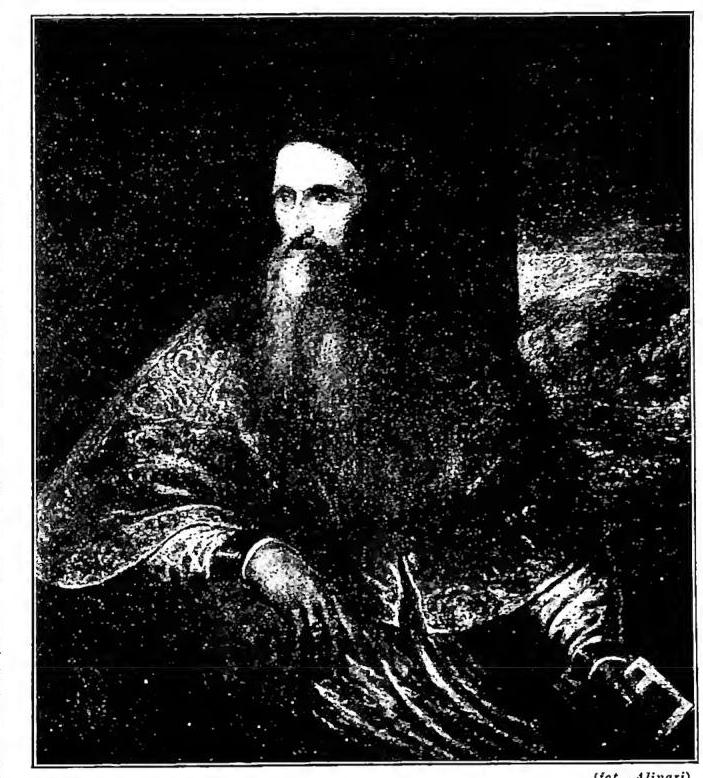
BEMBO, PIETRO. –
I. LIFE
Born in Venice on 20 May 1470 to Bernardo, a political figure of the Venetian Republic who knew how to appreciate sound learning and took his son with him on embassies to the courts and cities of Italy. Pietro became passionate about the literary life of his time and acquired an excellent knowledge of Latin; in order to learn Greek from Costantino Lascari, he went as far as Sicily. At the court of Ferrara he met Lucrezia Borgia, and at Urbino in 1507, at that court, he gave proof both of being an accomplished courtier and of being a skilled man of letters. Later, together with Iacopo Sadoleto, he became papal secretary to Leo X; and he subsequently published, revised in style, some of the letters he had written at that time in the collection of his Epistolae. In Rome he lived with a Roman woman whom he designated by the name Morosina; he later kept her with him, and she bore him children, among them Torquato, who was responsible for the edition of his father’s works. B. had obtained benefices in the Order of St John of Jerusalem, in which he was obliged, although reluctantly, to take religious vows. After leaving Rome in 1521, he retired to live in Padua and in a villa of his on the Brenta, which he called Noniano, with long stays in Venice, maintaining a literary circle with his friends and collecting precious manuscripts, mostly literary in character,and works of art. In 1530 his Republic elected him official historian; and in fact he composed in Latin, and then translated into Italian, the Historia Veneta, as a continuation of that of M. Ant. Sabellico, covering the period from 1487 to 1513. The high esteem that B. had acquired throughout the learned world of the time led Paul III, despite the opposition of the more austere men at his court, to create him a cardinal in the Consistory of 20 December 1538 and to publish his appointment on 19 March of the following year. B., who was 68 years old, greatly appreciated this long-awaited appointment; he went to Rome in October and also received sacred orders. He was given the diocese of Gubbio on 29 July 1541, and then, on 18 February 1544, that of Bergamo; he also entertained the possibility of becoming Pope. Instead, he died in Rome on 19 January 1547, equally admired for his Latin writings (epistles and poems) and for those in the vernacular.
Pio Paschini
II. THE MAN OF LETTERS
The question of how one ought to write represented for B. the “labor vitae” at that time, just as it would represent it three centuries later for Manzoni: and the two spent approximately the same number of years, the one constructing the theory of illustrious style, the other dismantling II. Prose della volgar linguais a treatise in dialogue form (as, indeed, were all the treatises of the time), imagined as having taken place in Venice over three successive evenings in December 1512; the interlocutors are Carlo B., the author’s brother and his interpreter, Giuliano de' Medici, and Ercole Strozzi. There is an extreme humanist right, represented by the latter, which unconditionally denies the vernacular the right and possibility of rising to the status of a literary language, since it is not a language but the detritus of a language; and there is an extreme left, still grosso modo faithful to the Dantesque theory of illustrious vernacular. Between the two extremes, B. asserts the rights of Tuscan, indeed of Florentine. This is a thesis that matters in the history of the Italian language, provided one does not deceive oneself about its meaning, or rather its scope; B. arrived at this theory, so Romantic and Manzonian, by arguments entirely different from those of the Romantics and Manzonians, and, instead of endorsing the rights of spoken Florentine or of the people, he endorsed those of written Florentine and of men of letters. But on the question of style, B.’s humanism regained the upper hand, in theory and in practice. After conceding so much to the dignity
of the vernacular word, to the genius of the vernacular word he conceded nothing; and thus, from the conviction that it too ought to harmonize with the forms of classical, that is, Latin, rhetoric, he derived a kind of vernacular Ciceronianism, that is, a Latinate or courtly manner of writing. The only one who, thanks to B.’s achievement, managed to escape the meshes of Bembism was the lyric Petrarch. The humanists had scorned him as Provençalizing and barbarous; but now, elevated by B.’s authority to the status of a classic of the vernacular language, the right—or obligation—to imitate him in place of Horace and Catullus arose of itself. The book of his apotheosis, and therefore of the full classicization, in spirit and form, of the great fourteenth-century vernacular literature, was the famous treatise on love in the form of a vernacular dialogue, Gli Asolani, written before 1502 and published in 1505. Caterina Cornaro, queen of Cyprus, holds court at Asolo for the marriage of one of her ladies-in-waiting, and, over the course of three days, three Venetian noblemen and three gentlewomen debate love, the source of every affliction for Perottino and of every blessing for Gismondo. But Lavinello recognizes in the former sensual love, and in the latter Platonic love; and to this is devoted the moving hymn of the epilogue. To this philosophizing ba-