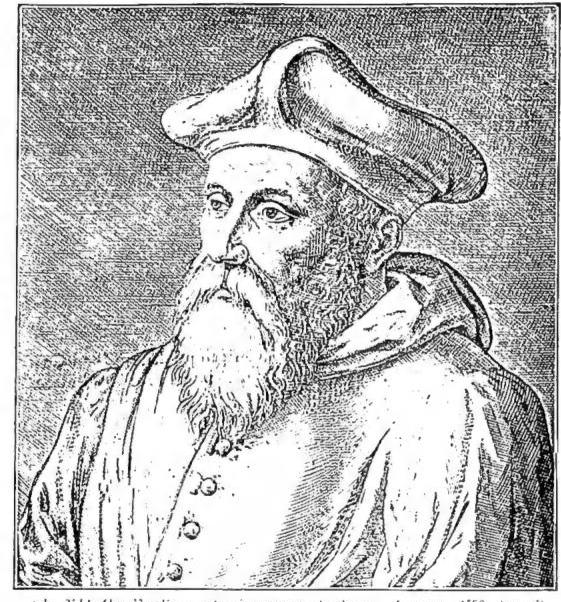
SADOLETO, GIACOMO. – Cardinal, born in Modena to Giovanni and Francesca Machiavelli on 12 July 1477; he devoted himself to the study of Latin and Greek at Ferrara under Niccolò Leoniceno; in 1503 he was in Rome at the court of Cardinal Oliviero Carafa, who obtained for him a canonry at S. Lorenzo in Damaso; by virtue of his learning and gentleness of character he was a friend of Bembo, Fregoso, and Filippo Beroaldo the Younger.
In 1513 Leo X chose him as his secretary together with Bembo, and on 24 April 1517 conferred on him the bishopric of Carpentras. He left Rome only during the pontificate of Adrian VI; but he resumed the office of secretary under Clement VII. In 1527, shortly before the sack of Rome, he went to his bishopric, from which Paul III recalled him in order to employ him in the planned reform of the Church in October 1536; on 22 December he created him cardinal together with Carafa, Rodolfo di Carpi, Polo, and Aleandro. Together with them he took part in the commission that drafted the celebrated consilium of reform and was charged with preparing the Council of Trent. In 1538 he accompanied Paul III on his journeys and returned to Carpentras. Recalled to Rome in 1542, he was sent to France as legate for the peace between that king and Charles V; he was again in Rome in 1545, from which he never again departed, and died on 18 October 1547.
His literary activity was varied: he was admired for his short poems (the most notable being that on Laocoön) and his Latin orations, and he was one of the most committed Ciceronians of his age, as can be seen from his extensive correspondence (Epistolarum libri XVI, 7 vols., Rome 1559–67; in addition to the other letters published subsequently). In 1533 he published in Venice the work De liberis recte instituendis, which gives him a distinguished place among the pedagogues of that age. Within a harmonious scheme of humanistic family education, he directs the study of the technical and liberal arts toward moral formation, which is achieved through the virtues of self-mastery and the mean, and through the orientation of all the intellectual faculties toward philosophy, the sole guide to the discovery of human dignity and likeness to God, and hence to happiness. The De laudibus philosophiae (Lyons 1538) was composed with the same humanistic purpose. S. was not only a notable humanist but also a theologian. He wrote an interpretation of Psalm 50 (Rome 1525) and another of Psalm 93 (Lyons 1530); then, with regard to the controversies of the time, a Commentarius