
DELFI, ORACOLO di. — The principal oracle of Greece, situated in Phocis, 573 m above sea level, on the southern slope of Parnassus, near the Cassotis spring, above a cleft in the ground (γάσμα γῆς).
The first divinity to occupy the site, destined for so great a mantic future, was Earth (Γῆ), represented by the serpent Python (Πύθων), a name also applied to the rocky locality; this is explained by the nature of the terrain, which communicated with the subsoil. The prehistoric sanctity of the site is documented by finds from the Minoan period. To this place, after the temporary dominion of Poseidon, who had succeeded Earth, came a Dorian tribe devoted to Apollo, which established its god there; after defeating the serpent, he became lord of the oracle.
At first, responses were given there through external signs: the song and flight of birds, pebbles; but subsequently this lower form of mantic practice was replaced by the intuitive kind, that is, through the inspiration of the divinity, who gave responses through his particular priestess, a young virgin, the Pythia.
This change seems to have been due to the influence of the Dionysian religion, which reached D. at a very early date and is characterized by the sacred frenzy that seized the female devotees of the Bacchic cult. The scholiast on Pindar (Pyth., 297) even regards Dionysus as earlier than Apollo in possessing D. Every two years the feast of Dionysus was celebrated there, and his tomb was venerated within the sanctuary; on the rear pediment of the temple a Dionysian thiasos was represented, and the three winter months during Apollo’s absence, when he departed for the Hyperborean regions, were consecrated to him. Aeschylus (frgm. 341) calls Apollo “the Bacchic one, awakener of mania, adorned with ivy.”
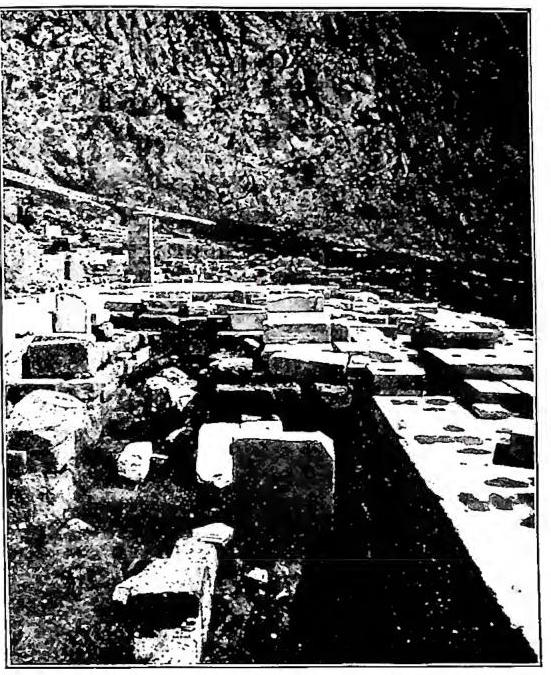
An essential part of the sanctuary was the subterranean chamber of the temple (ἄθυστος), where were found: 1) the omphalos (= navel), symbol of the ideal religious center of the earth, a cylindrical stone ending in an ovoid form and covered with bands
The oracle was presided over by a priesthood recruited from the Delphic aristocracy, consisting of two ἱερεῖς who assisted the Pythia, collected and interpreted the words and sounds uttered by her, often so ambiguous as to earn Apollo the title λοξίας, “the oblique one”; these were then formulated in hexameters or iambics, although prose was not excluded. There were also the five ὅσιοι, “pure ones,” assigned to the consultations, and the ἐξεγέται, “exegetes,” who explained the response received to those who had consulted the oracle, confirming it through divinatory procedures.
In earlier times, consultations took place once a year, on the seventh day of the month of Bysios (March–April); later they took place once a month, except during the three winter months sacred to Dionysus.
The maintenance of the sanctuary depended on contributions from the Greek states; consequently, at politically decisive moments the oracle always pursued a wavering policy: it “Medized” during the Persian Wars (Herodotus, VII, 140), and “Philipized” during the activities of Philip of Macedon (Dem., Or., 58, 37); in general, it opposed tyrants, given its eminently aristocratic and conservative spirit.
Its action was highly beneficial in directing the colonization of the Greeks, who asked the oracle for advice, since it was a first-rate center of observation owing to the influx of people from every region. It also exercised legislative activity indirectly, by choosing the legislators of a city or approving their work; it also provided for the manumission of slaves who, after paying a sum before witnesses, became free insofar as they were attached to the sanctuary, which guaranteed the freedom they had acquired.
Around the sanctuary an Amphictyony was constituted
(ἀμφι-κτίονες, “those who dwell nearby”), formed by representatives of the various Greek tribes (not cities): the Amphictyons exercised supervision over the sanctuary, organized the Pythian Games in honor of Apollo, judged disputes between the Amphictyonic cities, and thereby helped to give the Greeks a sense of their unity beyond civic barriers, and to make D. felt as the common hearth (κοινή, ἐστία: Plut. Arist., 20) of the Greek people.
In addition to these political merits, the oracle also contributed to refining customs, reserving to itself the judgment of blood vengeance (Orestes is guilty in the external court as a matricide, but is judged innocent in the internal court), and educating the individual’s moral conscience. The sayings are well known: “know yourself” (γνώβι σαυτόν), “avoid all excess” (μῆβεν ἄγαν), flee “insolent arrogance” (ὕβρις).
After the so-called Sacred War (600–590) between D. and the people of Crisa, in whose territory the sanctuary stood and from whom the Crisaeans demanded tribute, the latter acquired its autonomy, which opened for it an era of great prosperity, attested by the buildings that flourished around the sanctuary. Macedonian interference, which also extended to D., caused the sanctuary’s fame to decline; it furthermore suffered a double invasion by the Gauls (279 and 109 B.C.) and subsequently Roman occupation.
The emperors made efforts to restore the cult and the sanctuary. Augustus reorganized the Amphictyony; Domitian restored the sanctuary, stripped by Nero; Trajan increased the number of Amphictyons to thirty, with the aim of establishing an administrative council for the province of Macedonia and Achaea; Hadrian and the Antonines contributed to the city’s revival. During this period Plutarch was a priest of the sanctuary for twenty years, from 105 to 126, and left us three writings concerning II.