
WORSHIP (Lat. Cultus, from colere = to cultivate, to honor).
SUMMARY:
I. General notions
II. The various kinds of worship
III. The origin and development of Christian worship
IV. Worship in non-Christian religions
V. Popular worship.I. GENERAL NOTIONS
In its broadest meaning, it is the expression of the inner sentiment by which man recognizes the excellence of another being; it may therefore be called an act of esteem. To this fundamental expression of esteem, c., in the proper sense, also adds the sentiment of the inferiority and subjection of the man who performs an act of c. toward the being that is the object of c. itself. C. is therefore founded on the greatness of a being who is honored precisely on account of this greatness, and on the rights that it confers upon him.It is therefore immediately clear that, since the reason for c. is the excellence of a being, there must be as many forms of c. as there are types of formally distinct excellences that may exist. From this standpoint we can at once distinguish religious c. and profane c. By religious c. we mean the recognition of all those forms of greatness that either have God as their direct object or refer directly to God (God, Jesus Christ, the Saints, relics, ecclesiastical authorities...); by profane c. we mean the recognition of all those other forms of greatness that are neither God nor directly related to God (the fatherland, parents, national heroes, illustrious men, civil authorities...). Religious c. is therefore the concrete expression of the duties of the moral virtue of religion, whereas profane c. is the expression of the duties of the virtues of filial piety and observance (v. MALABARICI).
Ordinarily, when one speaks of c., the term is reserved for religious c., and the term c. is also commonly used, more briefly, to designate religion. Thus one speaks of admitted or tolerated c. (Statuto Albertino, art. 1; Law of 24 June 1929, no. 1159, arts. 1, 2); of legislation on c., of minister of c., etc. Catholic thought on religious c. may be set forth in its fundamental lines as follows.
II. THE VARIOUS SPECIES OF C
1. Latria. Since the ultimate foundation of worship is the greatness of a being, we, instructed by reason and faith, recognize in God the unshared and incommunicable greatness of the first principle and ultimate end of all things. God must therefore be the object of a worship that is exclusive to him, which since ancient times has been called latria. The Italian term adorazione does not exactly translate the term latria, because it is sometimes also used with regard to the Madonna, and is also used with regard to the pope (the triple adoration of the cardinals after the election).Worship of latria is due to the Most Holy Trinity, to the individual persons of the Most Holy Trinity, to Our Lord Jesus Christ, also under the sacramental species (can. 1255 § 1), and to the individual parts of his humanity, by reason of the hypostatic union (hence the Church has approved the sacred worship of the God-Man, of the Most Sacred Heart of Jesus, of the Most Precious Blood, and of the Five Wounds); whereas, for reasons that are not dogmatic but practical, over which the Church is judge, the worship of the Holy Face or of the Face of Christ has not been approved (Decree of the S. Congregation of the Holy Office, 4 May 1892), and the introduction of worship of the Head of Our Lord Jesus Christ has been prohibited (Holy Office, 18 June 1938: AAS, 30 [1938], pp. 226–27).
2. Hyperdulia. — Among all the saints, in Mary Most Holy, instructed by Revelation, we find a holiness possessed to a degree superior to that of any saint, and divine motherhood. The holiness of the Madonna, as the grace of Christ, differs from that of all the other saints only quantitatively, not qualitatively; divine motherhood belongs to her exclusively. The Blessed Virgin will therefore be the object of a particular worship, called hyperdulia, both on account of her singular holiness and on account of her divine motherhood (can. 1255, § 1, 1276).
3. Dulia. — In the saints there is holiness, that is, martyrdom or the heroic practice of all the Christian virtues, the fruit of supernatural grace, so that in them the essential holiness of God the Creator is reflected in a particular way. The saints will therefore, on account of this divine life that is especially revealed in them, be the object of a worship whose reason for being is found in the worship of latria, because the greatness venerated in the saints is the particular manifestation of divine perfection and is therefore a worship subordinate to the worship of latria, which was called the worship of dulia (can. 1255 § 1, 1276).
The worship of hyperdulia and dulia offered to the Madonna and to the saints is, so to speak, a special form of religious worship, both because worship, as religion, is due only to God, and because the Blessed Virgin and the saints are venerated only insofar as they are united to God, and God manifests his virtue in them. Therefore, it is a worship that does not ultimately terminate in the saints or in the Madonna but in God, exactly as the liturgy expresses it: «Sanctorum memoriam colimus, Domine, Te magnificamus...».
4. Absolute and relative C. — This worship of latria, hyperdulia, and dulia, when it terminates directly in God, the Blessed Virgin, or the saints, is called absolute; when it terminates in a representation (image) of God, the Blessed Virgin, or the saints, or in a relic, it is relative (can. 1255 § 2).
Thus, for example, relative worship of latria is due to the Holy Cross and to the instruments of the Passion, and to images of God and of Christ (Council of Trent, sess. XXV, de invoc. Sanct. et s. imag.: Denz-U, nn. 984–86). The same relative worship of latria is perhaps due to relics that may remain of the Blood of Christ no longer pertaining to the hypostatic union, and to blood that may have flowed miraculously from consecrated hosts, since it is only a sign of the true blood of Jesus Christ.
The legitimacy of the worship of images and also of relics was already defined by the Second Ecumenical Council of Nicaea in 787 (Denz-U, nn. 302–305; V. ICONOCLASTI). Particular worship directed to certain images, for example of the Blessed Virgin (miraculous, wonder-working image, etc.), was defended by Pius VI in his condemnation of the errors of the Synod of Pistoia, and is justified both by the practice of the Church and by the liberality of Divine Providence, which, as s. Augustine affirms, «nec in omnibus memoriis Sanctorum ista fieri voluit, qui dividit propria unicuique prout vult» (Denz-U, n. 1570; CIC 1255, § 2).
For the various objects to which worship is directed (the Virgin Mary, the Cross, a relic, the saints, etc.) V. the corresponding entries.
5. Internal and external C. — Since worship, in its most intimate meaning, is an act of esteem, it must, as sincerity requires, lest it become an act of hypocrisy, be an act of the internal faculties of man, of the intellect and the will; that is, it must be internal. But since man is soul and body, and everything that truly exists in man is also reflected in the external faculties, not only as a manifestation but also insofar as it receives from the external faculties an increase in strength, worship must also be external; this is further justified by the fact that God is the creator of the soul and also of the body.
6. Private and public C. — Man, considered as an individual, being a creature of God, is obliged to offer internal and external worship; this worship, which each individual offers to God, is private worship.
Human society, which derives its reason for being from the demands of social life that God has placed in man, is likewise obliged to offer worship, which will be public and social. By the nature of things, this worship must be authoritative (that is, offered to God by one who is legitimately appointed to represent the whole of society and who, as such, can stand before God in the name and on behalf of society itself) and external, precisely because it concerns a society of human beings. Interior worship—which has already been said to be essential to the worship of God—cannot be sought in society, which in itself is an abstraction; we must seek it in individuals, since one of society’s duties is also to foster the development of the virtue of religion in its citizens. When man and society are raised to an order superior to the demands of their own nature, their worship becomes supernatural. In concrete terms, from the very origins of humanity God established a religious worship corresponding to the plan of Grace, which attained its definitive form in the public worship of the Church.
«Worship, when rendered in the name of the Church by persons legitimately deputed for this purpose and through acts which, by institution of the Church, are to be rendered only to God, to the saints, and to the blessed, is called public; otherwise, private» (can. 1256).
Public worship with regard to canonized saints is authorized everywhere and without restriction; with regard to the blessed, it is permitted only with limitations relating both to places and to acts (can. 1277 §§ 1–2), whereas with regard to the servants of God, even those already declared venerable, it is prohibited. Private worship (not necessarily occult) may be offered to anyone who enjoys a reputation for holiness or is regarded as a martyr.
By necessity, public worship, as well as external worship, remains under the authority of the Church. The Holy See has reserved to itself, as a matter of greater importance, the regulation of the liturgy and the approval of liturgical books (can. 1257), the approval of new litanies (can. 1259 § 2), the confirmation of patron saints (can. 1278), the canonization of the blessed and the beatification
of the servants of God (can. 1999 § 1). Above all, vigilance over abuses belongs to II. The most recent interventions of the Holy See in this area are the prohibition of the Devotion to the Annihilated Love of Jesus and the Rosary of the Most Holy Wounds of Our Lord Jesus Christ (Holy Office, 12 Dec. 1939: AAS, 32 [1940], p. 24), and the prohibition of the association the Marian Crusade (Holy Office, 8 March 1941: AAS, 33 [1941], p. 69).
In canons 1255–1321, Ordinaries are granted very broad powers both of supervision and of regulation.
The worship of God, that is, the recognition and homage paid to God’s greatness, is expressed first of all in adoration, almost a contemplation of God’s greatness in relation to the limitations of the creature, and in thanksgiving. To these sentiments is added impetration (that is, the request for favors), which springs from the conviction of one’s own limitations, and, after sin, propitiation, that is, the request for forgiveness. The various acts of worship, necessarily (though not all with equal intensity), must express all four of these sentiments; each of them, however, emphasizes one in particular: thus, while praise stresses adoration more, prayer stresses impetration to a greater degree. Only sacrifice by its nature expresses all four sentiments of divine worship equally, although the particular intentions of the one who celebrates or has Mass celebrated may be directed toward thanksgiving (Missa pro gratiarum actione) or propitiation (Missa pro remissione peccatorum), etc.
The principal acts of worship are: sacrifice, prayer, praise, oath, adjuration, vow, offerings, and tithes. Almsgiving or acts of other virtues may also become acts of worship if, in the intentions of those who perform them, they are directed toward the worship of God.
External worship is embodied in formulas, acts, and gestures whose complete classification is difficult to provide. Among the principal ones are: building churches or altars, placing images in a church, depicting a servant of God in a particular attitude (with rays or a halo), genuflection, bowing, standing with arms extended in the form of a cross, incensation, processions, blessings, consecrations, lighting lamps, carrying votive offerings, etc...
The system of the various formulas, acts, and gestures by which the worship of God is given concrete expression in the Catholic Church, considered not externally—that is, in the ordering of rites and ceremonies—but internally, that is, as the worship of God by the mystical body of Christ, which is the Church, is the liturgy (Pio XII, encyclical Mediator Dei, 20 Nov. 1947: AAS, 39 [1947], pp. 528-29).
In the CIC, Part 3 of Book III, entitled de culto divino, contains various other juridical norms concerning worship: these, which constitute canons 1255-1321, are discussed under the entries relating to the matters regulated therein (v. ALTARE; CHIESA; COMUNICAZIONE NELLE COSE SACRE; EUCARISTIA; GIURAMENTO; LITANIE; LITURGIA; MUSICA SACRA; PROCESSIONE; QUARANTORE; RELIGIE; SUPPELLETTILE SACRA; TABERNACOLO; VOTO).
néral, in DThC, III, cols. 2404-28. In particular, on the canonical norms concerning worship, cf. M. Lecler, De cultu divino, in Collationes Namurcentes, 10 (1924-25), pp. 48-61; G. Voyvod, Law of the code on divine Worship, in The homiletic and pastoral review, 26 (1926), pp. 1165-73, 1278-90; 27 (1927), pp. 830-38, 954-64, 1082-91; E. Jombart, s. V. in DDC, IV, 861-883; J. Brys, Juris canonici compendium, 10th ed., Bruges 1949, pp. 111-45, nn. 781-90.
III. ORIGIN AND DEVELOPMENT OF CHRISTIAN C
Just as the kingdom of Israel had a social order and a liturgical ceremonial, so too the Kingdom of God, that is, the Church, which besides being a mystical body is also a social body, required its own liturgical order. Unlike the Old Testament, in the New the Divine Master was content with a few essential elements, leaving the details to be established according to the times, places, and different peoples: “Pray together, preach, baptize, celebrate my memory,” along with a few other injunctions, which the Church itself adapted according to the particular needs of individuals and the requirements of social life.Although the Apostles still went to the Temple and took occasion there to preach, they held the assemblies of the first believers in private homes, where they renewed the Lord’s Supper by distributing the Eucharistic bread, read the Scriptures, imparted the necessary teachings, and presided over common prayer.
Sacrifices were no longer offered there; moreover, these ceased among the Jews, like the other ceremonies, when the Temple was destroyed in A.D. 70. Furthermore, unlike the Jews, for whom the day consecrated to God was the Sabbath, the faithful observed as a feast day the following day, Sunday (v.), in remembrance of the Resurrection of Christ. Just as the Jews celebrated their Passover in spring in remembrance of their deliverance from slavery in Egypt, and continued to celebrate it even after their dispersion, so too in the assemblies that were established, Passover was celebrated in the same season in remembrance of the Passion and Resurrection of Christ, the liberator of humanity from slavery to sin.
In this way the first nucleus of the ecclesiastical year was established, and, after certain difficulties caused by particular customs that had arisen in the province of Asia (v. QUARTODECIMANI) had been overcome, a uniform and constant observance was established in this regard.
Despite the persecutions, in the 2nd and 3rd centuries there was gradual progress in the external forms of worship, which was already being conducted for the most part in buildings specifically intended for this purpose. The Didaché (90–100), Clement of Rome in the final chapters of the Epistle to the Corinthians (96–98), and St. Ignatius (107) in his letters provide important details concerning the sacred assembly and the hierarchy that succeeded the apostolic order. Even Pliny, propraetor in Bithynia, left us a few brief indications in his famous letter to Trajan. Gradually there followed St. Irenaeus, St. Hippolytus, Tertullian, St. Cyprian, and the authors cited by Eusebius in his history, who offer further details corresponding precisely to the constant development of missionary activity and internal life, and shed light on the progressive organization of the catechumenate and baptismal rites, as well as on the organization and development of the hierarchical orders and their functions. Veneration was already beginning to be shown for the memory and tombs of those who had most greatly distinguished the individual churches through learning and martyrdom.
But all this underwent broader development after the peace granted to the Church by the Edict of Constantine in 313; the large and magnificent churches, the ever-increasing ranks of the faithful, and the increasingly complex hierarchical organization required not only more precise regulations but also more developed external forms. The ecclesiastical year was by then enriched by the feast of Pentecost and by the commemoration of the appearance of Jesus
Christ in the world (Christmas and Epiphany), while the c. of the Virgin, although included in the commemoration of the mysteries of the Savior, acquired an entirely distinctive prominence, which was to lead to the institution of special feasts. Psalmody, processions, and various ceremonies were added to make primitive simplicity more solemn, provoking criticism not only from pagan intellectuals but also from Christians who, like Vigilantius, incurred the condemnation of St. Jerome and St. Augustine.
When it became clear that there was no longer any danger of confusion with the Jews and pagans, terms such as pontiff, priest, altar, and so forth entered common usage, since they could no longer give rise to misunderstandings, and incense, sprinkling with water, and anointing with oils were adopted for worship—gestures that already possessed a sacred significance and could very well contribute to rendering their symbolic meaning more august. Customs that might serve superstitious practices, however, were prohibited; and it certainly cannot be said that the struggle against certain heterodox forms of worship cost the leaders of the Church little effort. Thus not only wall paintings or mosaics of symbolic and historical significance were admitted into the Christian temple, but also the veneration of images of the Redeemer, the Virgin, and the saints. Sacred singing was likewise introduced into the Church, at least in the 4th century, precisely because of the appeal it exerted, although it had been used in Jewish and pagan ceremonies. It succeeded in clothing Christian thoughts and assuming an ecclesiastical tone that found its perfection in Gregorian chant—a perfection that, like the figurative arts, was destined for constant advancement. Nor should this be taken, as a certain school has done, to indicate a formal dependence of Christianity on Judaism and idolatry, or a contamination of Christianity itself produced by them; rather, it reflects a coincidence due to the fact that certain forms of worship present themselves spontaneously to the religious mind of humanity and, as such, are transmitted through the generations. In Christianity, in fact, these forms were accepted more by force of circumstances than through any special prescriptions; and since it was impossible to vary endlessly around the primitive and essential nucleus, they passed from church to church through reciprocal exchanges, until they attained such maturity of plastic expression as subsequently to permit only very limited modifications and additions.
1. C. and magic. — The resemblance observed in more than one case between certain religious ceremonies and some magical practices must not lead to the conclusion that religion and magic are initially identical, because they are distinguished from one another by virtue of two fundamental criteria: a) a social one: religion performs its rites in the interest of and for the benefit of the social group, and performs them by addressing, through the person invested with the social authority of that group (king, priest, etc.), the higher Power capable of granting the requests addressed to it; whereas magic, through the sorcerer, magician, or witch, operates by virtue of the powers possessed by that individual, in the service of private interests and often to the detriment of others; b) an individual one, inasmuch as the religious man bends his knees and folds his hands because, conscious of his own weakness, he turns toward the Being whom he knows to be powerful and capable of being appeased; whereas the magician feels himself in possession of a force capable of dominating that of nature and therefore commands rather than prays.
2. C. and myth. — Since man is endowed with reason, the act of c. always has an intellectual justification that legitimizes it, suggested by fanciful motives based on external associations, not due to rational arguments, learned inquiry, or scientific observation. Myth is therefore a necessary complement to c., inasmuch as it justifies its ceremonial, explains its rationale to the mind of the individual and of the group whose action it unifies, and periodically renews its efficacy by making it living and current whenever, in coincidence with the seasonal rhythms or the various circumstances of social life, it is necessary to renew the sacred action once experienced as effective (v. MITO).
3. C. and symbol. — The ceremonies of c. possess a value that is not merely realistic but above all symbolic, relating to the supernatural Powers with which one wishes to enter into relationship. An immersion in the Ganges is not a bath for cleansing but aims, through those sacred waters, at attaining a spiritual end; the ritual meal of the totemic kangaroo among the Arunta (central Australia) is not intended as the cheerful conclusion of an excursion in the forest, but aims, through the ingestion of the sacred animal, at renewing the group’s store of holiness and at recalling, through allusive dances and songs, the mythical history of the tribe. This fundamental symbolic value of the rite must be kept in mind, lest it be reduced to a strange and inconclusive imitation of reality.
The cultic elements of a religion may be grouped around four points: a) the places of c., that is, in its broadest sense, the sanctuary, ranging from a clearing bounded by trees in the depths of a forest or an open space enclosed by rough stones, up to the most sumptuous temple; b) the persons, that is, the priesthood in its most varied categories and functions, from the medicine-man capable of meeting all the needs of the community to the priest invested with the specific functions of sacrificer, diviner, exorcist, doctor, and so forth; c) the times, that is, the sacred calendar that gives a religious rhythm to the life of the group and enables it to renew, on a fixed date—which in natural religions coincides with the rhythm of the seasons—its store of religious energy; d) the rites, that is, all those gestures, movements, and formulas by which the group or individual enters into contact with the higher powers.
a) The places. — The place where the deity manifests itself to the social group must be a special place, withdrawn from profane use and sharing in the sacredness proper to the god, so that whoever approaches it without the proper dispositions is punished, whereas whoever enters it in a state of ritual purity receives an increase of blessing. The choice of place is generally determined by its natural appearance: the evocative clearing of a wood, the proximity of a spring, the isolated presence of a tree, a mound or elevation of ground, a rock, or a cave; an appearance that suggests not only the presence but also the nature of the god. The first type of sanctuary will therefore be a sacred enclosure, made of stones or trees, delimiting the space reserved for the deity and separating it from profane use. It is found everywhere under various names: it is the cromlech of prehistoric peoples, the various palisades of primitive peoples, the haram of the Arabs, the hērem of the Hebrews, the témenos or peribolos of the Greeks, the sacellum of the Romans, and the so-called “cemetery” of rural Christian churches. Strict regulations govern access to this enclosure: no hunting or gathering of firewood may take place there because it is reserved for the deity; nor may human justice be administered or anyone seeking refuge there be captured, because whoever enters it comes into the possession of the deity and is therefore sacred (sacer, tābu) and inviolable.
In the middle of the sacred enclosure there is generally a more or less square or conical stone, regarded as the embodiment of the deity; oil from libations or the blood of victims is therefore poured over II. But more often the sacred place is not limited to an open-air enclosure. In its midst stands a roofed and enclosed building, in which the deity, represented by a sacred object or an image portraying it, dwells as in its own house. Only the priests may enter, since they are the special servants of the god; the people remain excluded and watch from outside as the ritual is carried out. In the great monarchies of the East, where political centralization corresponds to a similar religious centralization, temples acquire great economic importance: many buildings are attached to them for the administration of property and for housing the personnel assigned to the various services; among the Greeks and Romans, on the other hand, the temple is isolated, since it is solely the dwelling of the god and has no administrative buildings, owing to the smaller number of attendants and the different organization of the priesthood.
Exceptions to this rule are the mystery religions, because in them the sacred place is not only the dwelling of the god but also the meeting place of the faithful who have devoted themselves to him; and the historical religions deriving from a founder or reformer, because the sacred place becomes a gathering center for the adherents who assemble there to hear the founder’s teaching explained and to perform those acts of c. that he has imposed on the community. The temple of Mahāyāna Buddhism, which developed especially in China and Tibet, the Muslim mosque, and the Christian church are places where the faithful gather and not merely the exclusive dwelling of the deity.
Once the sacred building has been constructed, before being put to its use it requires a special ceremony, namely dedication, which, while separating it from profane use, expressly dedicates and consecrates it to the deity. Thus, the Roman magistrate dedicated the temple by holding one of its doorposts with one hand throughout the time during which he pronounced the formula of dedication; in the Christian liturgy, the dedication of the church is performed by making an external and internal circumambulation of it and placing beneath the high altar the relics of a holy martyr, as sacred protection of the building.
b) The persons. — Like the sanctuary, the priesthood has a social value, inasmuch as the priest is the in-
the official intermediary between the group and the divinity. In primitive communities, his functions merge with those of the group’s leader (priest-king, sorcerer-king), since it is above all his magical powers and his ability to interpret the will of the gods that serve the group, which is concerned to ensure a good hunt, a good harvest, the safety of its livestock, immunity from epidemics, and success in war. The functions of king and priest begin to separate as, with the development of the group’s cultic life, its needs and sacred ceremonial also develop, together with a greater differentiation of the various functions. Thus, in natural religions there are three fundamental types of priests: the sacrificer, the exorcist, and the diviner (v. SACERDOZIO).
c) Times. — Sacred times are those established by the religious calendar and commonly called feasts. In every human group the importance of feasts is great, because they serve to renew the cohesion of the group by directing its thought and action toward a single aim, and to recall to memory the ideas and events from which the group recognizes the benefit of its existence.
Given the two elements—cultic and ideational—of which every religion consists, the celebration of feasts will likewise include: 1) a set of rites (dances, processions, banquets, formulas) through which the group expresses its unity of sentiment and actually experiences it; 2) a series of ideas or notions (beliefs, myths, legends) that explain the meaning of the feast and justify, in the eyes of the group, the reason for its cohesion and its sacred action.
The feast entails the suspension of ordinary occupations, a suspension made more conspicuous by changes of clothing, preparatory rites (fasts, purifications, truces of God), and the holding of contests, games, fairs, and markets.
And since the life of human groups is regulated by the succession of the seasons, which determine the times of the hunt and the rhythm of agricultural activities, the series of feasts in natural religions, both tribal and national, follows the course of the agricultural year. Seasonal calendars always incorporate feasts and commemorations relating to events in the history of the group and to the great figures who guided them. Such are, in the Athenian calendar, the Panathenaea and the Apaturia, and in the Roman calendar the Regifugium and the Poplifugia, as well as the Palilia, in which a civic meaning—the founding of Rome—was added to the pastoral one. The same may be said of the lunar calendar of the Jews, in which the memory of the Jews’ exodus from Egypt was added to the agricultural feast of Passover, and of the likewise lunar calendar of the Muslims, which commemorates the birth of Muhammad, his ascension, and so forth. In Christianity, the religious calendar is independent of the civil one and is entirely regulated by the life of the divine Founder, from Advent, which prepares for his birth, to the Sundays after Pentecost, which recall the expansion throughout the world of the Church founded by him. For all these matters V. CALENDARIO.
d) The rites. — For the definition and classification of rites V. PREGHIERA; RITO; SACRIFIZIO.
V. CULTO POPOLARE
This is the complex of traditional forms through which the people express their sentiments and their innate artistic taste in participating in the rites of the Church and in religious life in general. These forms range from the simplest to the most grandiose and complex. In many Catholic countries, a little wooden cross may be seen on the doors of country houses; in the midst of fields of soft wheat or atop sheaves of grain, a cross made of simple reeds or intertwined ears of grain is placed. Around the sacred images placed at the head of the bed (or sometimes in the kitchen), peasants customarily set branches of blessed olive. Shepherds paint the monogram of Mary in red ochre on the fleece of their sheep. On the doors of, or inside, the stables, the image of s. Antonio abate is never absent. In some regions, the principal agricultural tasks are not carried out without traditional rites and sacred songs, with invocations to the Madonna and to the patron saints, varying according to the locality. Images of the Madonna del Fuoco, s. Giorgio, and s. Antonio are painted on the great agricultural carts of Romagna and other regions. The same is true of maritime life: from the ceremony of baptizing a boat to that of blessing the sea, there are countless circumstances and forms in which popular worship is manifested. Images of saints, of the Madonna, and of the S. Famiglia are painted on the sides of the boats, which are often given the names of sacred personages as a protective invocation.Of particular interest and significance is the offering of ex-voto, especially of the painted tablets on which the miraculous event is depicted for which the donor gives thanks to the Virgin or to the saint invoked. Thus the people, alongside the prayers taught them by the Church, also know and repeat prayers of their own, which present the concepts and teachings of Christian doctrine in a plain form that is easy to remember and understand, or recall episodes from the life of Christ and the saints, or express the sentiments and faith of humble people through particular forms of devotion. Moving and significant is the offering of flowers, wax candles, and lamps to the Madonna on the façades of houses, at street corners, and so forth.
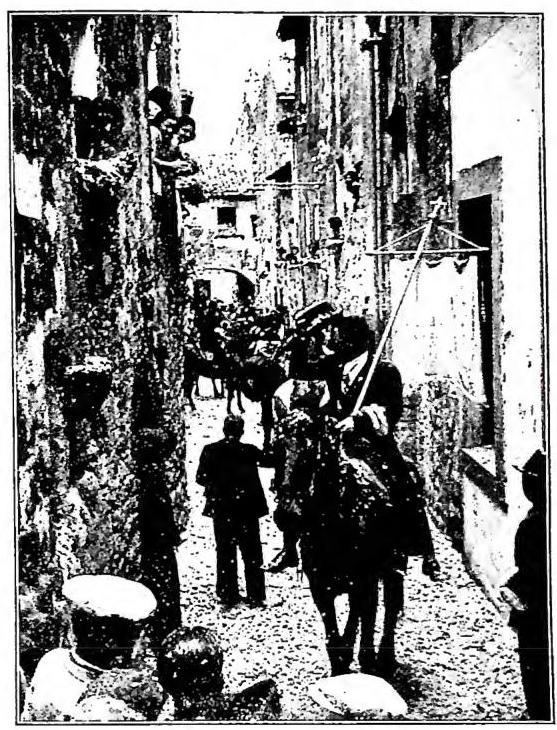
Original and expressive manifestations of popular worship are also found on the occasion of pilgrimages to shrines: pilgrims adorn with flowers and holy pictures the staffs used for the long journey, walk stretches of road or climb the shrine’s steps on their knees, and sing songs and hymns, along with other expressions of faith that at times reach the heights of fervent mysticism or even overmastering enthusiasm. Important in this regard are patronal festivals, with the competition among the faithful or members of confraternities for the honor of carrying the statue of the saint, together with illuminations, bands, fireworks, and so forth. Yet the most original and grandiose forms may be observed on the occasion of the various calendar festivals according to the circulum anni. Full of poetry is the custom of strewing the roads with flowers or throwing flowers from the windows when the procession passes, as at Marta (Bolsena) on the occasion of the «Barabbata» festival. In certain places, such as Genzano and Torre del Greco, the flower carpet has acquired the character of a genuine work of art, through the creation of a floral carpet occupying an entire street and producing admirable chromatic and decorative effects. Elements of popular worship are also manifested in the course of processions, by dressing children as angels, adorning the statue of the saint or the Madonna with flowers, ribbons, little medals, and offerings, and through other simple practices varying according to local customs.
The same may be said of all those manifestations known as «living relics of sacred drama». Very ancient manifestations also include the bonfires for s. Giovanni Battista, s. Giuseppe, and the Ascension; the fires lit for s. Antonio abate; the torchlight processions for the Assumption; and the like. Some of these manifestations attain spectacular grandeur, especially with the sacred floats
Van Gennep asserts that “popular worship and official worship move on two different planes.” But in the majority of cases it is found that these are rather complementary and integrative elements through which the humbler classes manifest their participation, through their feelings and faith, in the rites of the Church. This is not to say that one does not sometimes observe some excess or some distorted survival of pre-Christian ritual forms; but the Church precisely takes care to regulate these manifestations, allowing them to express themselves when they serve to keep the faith alive and secure in the hearts of the people, without exceeding the limits established by the liturgical norms.
BIBLI: F. Polese, Le feste popolari cristiane in Italia, in Atti del I Congresso di etnografia italiana, Perugia 1912, pp. 91–114; D. Provenzal, Usanze e feste del popolo italiano, Bologna 1912; P. Toschi, La poesia popolare religiosa in Italia, Firenze 1935; A. Van Gennep, Manuel de folklore français contemporain, Parigi 1938 onwards (5 volumes published to date); R. Corso, I popoli dell’Europa: usi e costumi, Napoli [1947]. Paolo Toschi