
SALMODIA. —
I. DEFINITION
The singing of the psalms and canticles of the Church is called s. The liturgical tradition indicates three ways of singing the psalms, hence three psalmody systems: direct or continuous, responsorial, and antiphonal. The psalm is made up of verses, each of which in turn consists of two members, separated in our books by an asterisk and corresponding according to the parallelism characteristic of Hebrew poetry. The first member is sometimes divided into two clauses because of its length. Each verse is clothed in a musical formula, as in strophic song, composed of two parts corresponding to those of the verse. Their structure consists of three elements: intonation, tenor, cadence.The intonation is a brief melodic design serving to join the tenor to the antiphon that preceded it or, in the absence of the antiphon, to give it a more or less solemn intonation. Sometimes it is omitted; in the simple s. of the Office, for example, there is an introduction only for the first member of the first verse. The tenor is formed by all the unison notes lying between the introduction and the cadence. It is also called the dominant. Sometimes it is ornamented with an accented podatus. The cadence consists of the melody with which the verse ends. It begins at the precise moment when the voice departs from the tenor. The cadence with which the first part of the verse ends is called the mediant and has only a suspensive function; that with which the verse ends is called the final, generally has a conclusive character, and is almost always more developed. In the case of the subdivision of the first member, the new cadence thereby introduced is called the flexa. These three elements are found in all psalmody formulas, whatever their melodic development, whether simple, neumatic, or ornate.
1. Direct system
All the verses of the psalm are sung successively without interruption and by the same singers. The psalm is then called directus, indirectus, tractus. This is the simplest and most convenient manner of all: s. Benedetto proposes it for the minor hours and when the community is small; but he does not specify how it is to be performed. Is the psalm sung by a soloist or by the choir? The system varies. Among the Egyptian monks, one person sings the psalm or the series of psalms, while the others listen in silence.In the Ambrosian liturgy the inner choir sings with a collective voice, whereas at Rome Ordo Romanus I mentions only a single cantor, as does Amalarius at Metz. The absence of alternation and of the antiphon is therefore proper to direct s.: sine antiphona in directum, says s. Benedetto. In present usage, simple direct s. is reduced to a recitation on a single pitch, with a slight inflection at the cadence. The ornate form is found in the Tractus of the Mass. There are only two melodic types of the Tractus: in G and in D; the former, perhaps the older, is the simpler and more frequently used, since it offers the soloist a simple melody, easy to sing and memorize. The following common features are found in the tractus: a special intonation formula for the first verse; a much broader cadence on the final syllables of the last verse; a double tenor; and, finally, the presence of several mediant cadences in each verse.
2. Responsorial system
The other two systems belong to alternated s., in which the voices answer one another. Here the alternation takes place between a soloist and the choir: the soloist sings the verses and the choir inserts a response, generally brief and with a simple melody. This system was common in the early centuries and enabled the faithful to participate in liturgical singing even without a perfect knowledge of the psalter. Responsories are distinguished by the richness of their melody. With the exception of simple melodies such as the short responsories or the Incettatorio, most of them are ornate: such are our Graduals and Alleluias; this is explained by the fact that these melodies were reserved for the soloist.3. Antiphonal system
This system, perhaps less ancient, soon underwent rapid development, especially in monastic communities. In the West it was introduced principally by s. Damaso and s. Ambrogio. By the time of s. Benedetto it had already been definitively established. It consists in the alternation of the two parts of the choir in the singing of the verses of the psalm and in their joining together for the singing of the antiphon at the beginning and end, and sometimes also during the singing of the verses. The formulas are simpler than in the preceding system, and this is the system that properly bears the name s.The Gregorian repertory comprises eight psalmody formulas classified in the eight Gregorian modes (v. CANTO) (with the addition of the « tonus peregrinus » and the « tonus irregularis », both outside the series and extraneous). These tones are determined chiefly by their reciting tone.
In s. the antiphon determines the mode, and the psalm is sung in the corresponding tone. The elements are identical with those of the other systems, although simpler. They are subject to strict laws. a) In the intonation as in the cadences, the neumatic groups are indivisible: one group per syllable. b) The tenor is single, except in the « tonus peregrinus », which has two tenors. c) Only the cadences present some difficulty in adapting the words to the melodic formula. The mechanism is nevertheless simple.
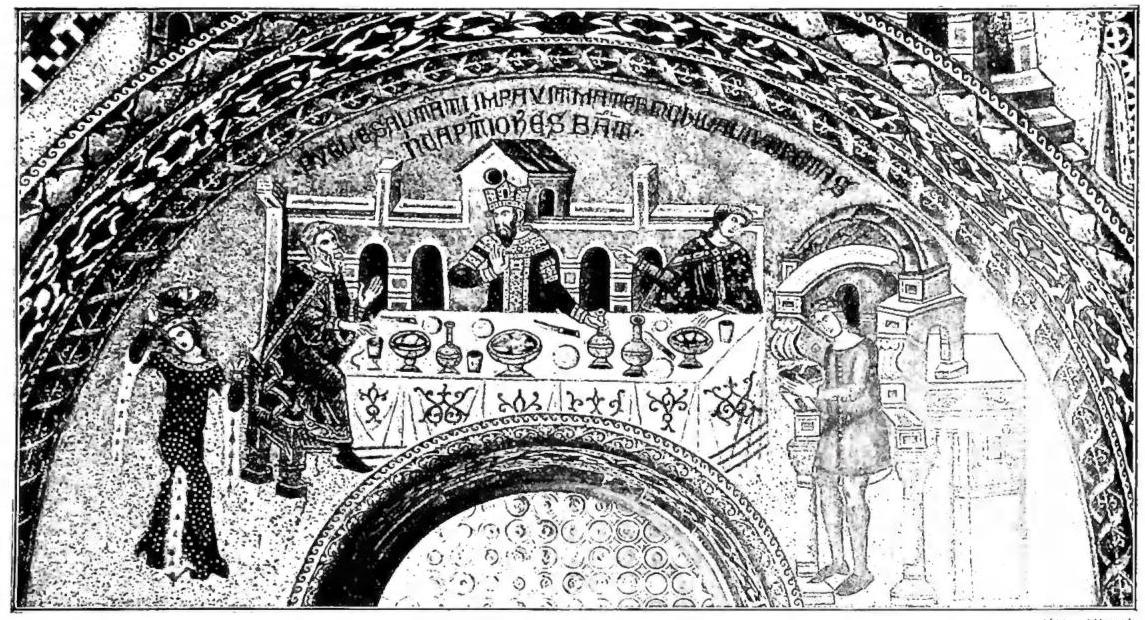
II. USE IN THE LITURGY
Direct psalmody is used in its simple form at the Minor Hours of the Office ofSALOMÈ — S. presents to Erode and Erodiade the head of S. Giovanni, mosaics executed under Doge A. Dandolo (1343–54) — Venice, basilica of S. Marco, baptistery.
The Sacred Triduum, Easter and its octave, 2 November, and on particular occasions: at the litanies of the saints, at the Rogations, etc. S. Benedetto prescribes it in the psalms of waiting for Matins and Lauds and at Compline every day. All these psalms are sung, as has been said, without an antiphon.
At Mass it is used in the singing of the Tractus in an ornate form. The Tractus follows a reading or the singing of the Gradual (following the suppression of the intermediate reading). It is sung between Septuagesima and Easter on all Sundays, on the feasts of the Saints, and on the ferias of Lent; during the year it is found on the Saturday of the Ember Days and in Masses for the dead. Today the Tractus is no longer sung by a soloist, but alternately, as in the other systems. It is not lawful to suppress or abbreviate it, nor is it permitted simply to recite it, unless the organ accompanies it throughout.
III. RESPONSORIAL PSALMODY
Its simplest form is found in the Minor Hours of the Office, after the Chapter: it is the short responsory, very brief and almost syllabic. The cantor sings the responsory, and the choir repeats it; then the cantor says the verse and the choir repeats the second part of the responsory; the cantor says the verse, and the choir repeats the entire responsory.The Roman Antiphonary has preserved different melodies for the various seasons of the year. S. Benedetto established the short responsory not at the Minor Hours, but at the Major Hours: Lauds and Vespers. The same system, somewhat more ornate, is found in the invitatory and in the hymn Benedictus es of the Saturday of the Ember Days.
The ornate form is found in the great responsories of Matins, composed like the short responsories, but with a longer text and a much more ornate melody. These responsories are sung after each lesson. Some monastic liturgies also have a great responsory of this kind at Vespers of solemn feasts, at the Gradual, the Offertory, and the Alleluja of solemn Masses. Today these pieces have lost almost all of their responsorial form. The Gradual is intoned by the soloist and continued by the choir; then the soloist sings the verse, and the choir joins him in singing the end of the verse as a refrain. The Alleluja follows the singing of the Gradual, except during the penitential season. The soloist intones the Alleluja, which is taken up by the choir and prolonged by a long melisma or jubilus, expressing joy; the verse is then sung by the soloist and ends with a
jubilus sung by all: then the soloist again sings Alleluja, and the choir continues the jubilus. In ancient times, the singing of the Offertory accompanied the offering of bread and wine by the faithful; today, of this psalm, only an antiphon remains. Only the Offertory of the Requiem Mass has preserved the responsorial form.
IV. ANTIPHONAL PSALMODY
It constitutes the most important part of the Divine Office. The simplest form is used for the psalms of the different Hours. Once the antiphon has been sung or simply announced, the cantor intones the first verse of the psalm, which is then continued by the first choir; the second choir then sings the second verse, and so on alternately until the end. Only the first verse has an intonation; the others begin with the tenor. In the Gospel canticles, however, the intonation is made at every verse. In the eight tones there is a more ornate modulation for the first part of the verse, which may be used in the canticles of solemn feasts.This system is also found in the Introit and the Communion of the Mass. Of the Introit, today only the antiphon, the first verse of the psalm, and the Gloria remain. The tones are more ornate than those of the simple psalmody of the Office; they are also the best preserved in the manuscripts. An intonation is found for every verse and also for each part of the verse; the cadences have a more complex melodic design, while the final cadence of the Gloria Patri is even more ornate in order to prepare for the repetition of the antiphon.
The final cadences also have the peculiarity of being not tonic but syllabic, adapting to the number of syllables rather than to the accents, as in the verses of the responsories. The psalm of the Communion, sung to the same tone as the Introitus, has now completely disappeared, except in the Mass for the dead.
V. S. IN POLYPHONY. — The singing of the psalms also inspired polyphonists. We are not speaking of the great compositions in the form of cantatas or oratorios, which do not form part of the liturgical Office. “Psalmi igitur symphoniaci (di concerto) excluduntur prorsus ac vetantur” (motu proprio of Pius X of 22 November 1903). Responsorial psalmody gave rise to the magnificent responsories of Palestrina, Ingegneri, and Vittoria, to mention only some of the earlier composers. Antiphonal psalmody likewise inspired musicians who harmonized the psalmic formulas in fauxbourdon. Polyphonic singing is permitted on solemn feasts: the Roman basilicas provide a fine example of II. Pius X, in his motu proprio,
permits the alternation of the Gregorian singing of the choir with fauxbourdons, of which numerous formulas exist adapted to the various psalm tones. The same Pope also permits the whole of the s. to be sung in music, provided that the alternation of the choirs is preserved.