
TRIDUO, OTTAVARIO (OTTIDUO), NOVENA. — These are popular forms of devotion associated with a certain number of days, during which, through various exercises of piety, one continues to implore particular graces with greater insistence, to give thanks for those received, or simply to solemnize certain events or feasts. The official liturgy does not recognize these devotional forms; but the Church has approved them and encourages them with indulgences. The most common form is the Triduo; the Novena is a threefold extension of it, whereas the Ottiduo is less well known and used.
I. TRIDUUM
A period of three consecutive days, or also an action extending over three days (from the adjective triduus, from which the noun triduum derives); it is the transposition into time of the universal popular predilection for the number three. It is an established fact, confirmed by numerous investigations into the primitive culture of peoples, that the number three, in its countless relationships, is universally preferred and almost consecrated. Certainly, not as the “prime number” that comes after one, but because of a certain idea of completeness or perfection associated with it: life, folklore, superstition, and religion as well—in fact, all religions—present many examples of the “cult” of the number three.It is known through divine revelation that, within the unity of the divine nature, there lives the mystery of the Trinity of persons; and it is not unreasonable to deduce from this the supreme supernatural reason that explains in human beings a certain natural inclination to regard in the ternary number a kind of perfection and completeness: these are the reflections of the Creator in the rational creature. It is neither necessary nor right to push that particular “divine exemplarism,” which is certainly willed and intended by God, to excess. In any case, limiting ourselves to the religious sphere, triads of divinities, major and minor, are found in primitive and classical religions; in addition to very widespread triduan funerary rites, they also knew other forms of devotions, rites, and prayers based on the number three.
In the Old Testament, the period of three days already appears as something of particular importance, especially in the later periods. Sara, daughter of Raguel, after the death of her seven husbands, fasts for three days and three nights, and the angel Raphael invites the young Tobiah, before the wedding, to refrain from the bride for three days, praying (Tob. 3, 10; 6, 16-22; 8); Judith, in the camp of the Assyrians, before the great stroke she had planned against Holofernes, asks to be allowed to leave the camp for three nights in order to adore God (Iud. 12, 6); Queen Esther, together with the entire Jewish people, fasts for three days and three nights to avert the danger of extermination (Esth. 4, 16); Daniel undertakes a fast, with prayers, for three weeks (Dan. 10, 2-3); Judas Maccabaeus imposes upon himself and his men a fast with prayers for three consecutive days (II Mach. 13, 12); all practices demonstrating, among the Jewish people, a preference for these penitential tridua, with the aim of obtaining special graces. In the New Testament, it is especially noteworthy that our Lord himself makes use of this pious practice, relating the three days spent by the prophet Jonah in the belly of the sea monster to his own stay in the tomb (Iou. 2, 1; Act. 12, 38-40). Another celebrated Gospel passage is that in which Jesus, speaking of the destruction of the Temple that he would rebuild within three days, alludes to his resurrection three days after burial (Io. 2, 19-20; Mt. 26, 61; 27, 40; Mc. 14, 40; Mt. 27, 63; 17, 22; Mc. 8, 31; 9, 30). Saul also, the future Paul, after the blinding scene, remained in Damascus for three days fasting and completely distraught.
In memory of Christ’s presence in the tomb, Christians soon adopted the practice of a penitential fast lasting two or three days, according to the interpretation given to the duration of Christ’s burial. Here too we find the beginning of the practice of the Lenten fast, and the biduanu and triduum ieiuni remained a pious practice throughout the year. St Jerome, it is true, was not overly enthusiastic about it; in some of his letters he in fact dissuades people from this custom, defending the more reasonable practice of a moderate, continuous use of food instead of these almost excessive tridua (cf., for example, Ep. ad Furiam: PL 22, 555: « parcus cibus et venter semper esuriens triduanis ieiuni praefetur »). St Augustine, on the other hand, brought back from Rome a profound impression of the many Christians—men, women, widows, and virgins—whom he had seen practicing this devotion of the “continuum triduum” of prayer and abstinence (De moribus ecclesiae catholicae et de moribus manichaeorum, I, 33: PL 32, 1340).
Along these lines is what the Acts of St Cecilia report, namely, that the Saint « biduanis vel triduanis ieiuni » se commendabat Domino « (cf. Antiphon 5 of the Lauds of the feast). But the most solemn confirmation of this pious practice of the triduum of penance and prayer as a universal custom is found in the institution of the Rogations (v.), that is, the minor litanies. St Mamertus, to whom this institution is attributed, in prescribing for his people a three-day fast with a solemn litany, did nothing other than transform a customary private practice into a public practice, which was subsequently preserved and spread throughout the Church (v. , for example, the historical description given by Amalarius in the Liber officialis, I, 37, in Opera liturgica, ed. J. M. Hanssens, II, Vatican City 1938, pp. 178-80). This also explains the widespread medieval practice whereby an adult preparing for Baptism was required beforehand to observe a three-day fast.
A similar triduum of prayer and fasting was also widely practiced in preparation for the election of the Pope and the coronation of the Emperor. (E. Eichmann, Die Kaiserkrönung im Abendland, I, Würzburg 1942, p. 38; id., Weihe V. Krönung des Papstes im Mittelalter, Munich 1951, p. 6). From the penitential triduum, whose principal purpose was supplication, the transition to the simple devotional triduum was easy: without fasting, with private or public prayer alone, or with certain popular rites and customs.
As early as the Middle Ages, the triduum of preparation for a particular feast was known, in honor of a particularly venerated saint and also to obtain a grace. These devotional tridua did not win everyone’s approval; Gerson was already opposed to them, and in the modern age the Jansenist movement, the Enlightenment, and Josephinism sought to discredit these devotions. The faithful, however, remained steadfast in the ancient devotion of the devotional triduum, and even today tridua, both private and public, with greater or lesser solemnity, are a universally widespread and accepted form of Christian piety. In the most recent Enchiridion indulgentiarum (Rome 1952), indulgences are expressly granted for tridua during the octave of Corpus Domini, in honor of Christ the King, Our Lady of the Rosary of Pompeii, and St John the Baptist.
II. PARTICULAR TRIDUUMS
The “Sacred Triduum” is the ternary of Holy Thursday, Good Friday, and Holy Saturday; this is a purely philological designation (three days), which does not indicate a unified devotional form, since each day of this triduum has its own character. In addition to the liturgical triduum of the Rogation Days, a special Eucharistic triduum is widespread on the final three days of Carnival, celebrated with great solemnity and popular attendance in many regions.Another type of triduum is the one customarily celebrated on the occasion of beatifications and canonizations. The celebration takes place first of all in Rome, generally in the national or religious church of the person who has been raised to the honors of the altars, or in another church, after the official ceremony in the Vatican Basilica. The practice arose after the end of the Middle Ages in canonizations, when the first permissions for a provisional cult were introduced in anticipation of canonization as nearly determined (early sixteenth century); this permission was celebrated with a solemn
triduum in a Roman church, until Alexander VII ordered that in this case too the official act of beatification in S. Pietro should precede II. These triduuums were soon, and by then as a rule, also celebrated outside Rome, in the respective dioceses or religious churches of the new Blessed or Saint. The S. Congregation of Rites issued precise regulations for the celebration of Masses and other liturgical solemnities, as well as for the prescribed indulgences.
Not a triduum in the proper sense, but related to the idea of the ternary, is the “third” day in the funeral celebration. It was in fact an ancient belief that the soul left the body definitively only on the third day after death; the third day therefore came to be solemnized in a particular manner, a practice continued also by Christians and sanctioned by the liturgy.
III. NOVENA
The novena is nothing other than a tripled triduum, that is, intensified and thereby endowed with much greater efficacy, and consequently reserved for more solemn occasions.As a Christian observance, the novena is prefigured by the nine days which the Apostles, together with the first disciples, according to the express command of the Lord, had to spend in recollection and prayer, awaiting the coming of the Holy Spirit. But the novena, or rather, according to classical terminology, the more common “novendial,” was associated with funerary worship. Indeed, the Romans, as well as other peoples, used to prolong funeral rites for nine days, a practice that passed directly to the Christians. However, already in the time of s. Agostino, a strong protest arose against this pagan custom, and the novena for the dead was replaced by a septena (seven days), taking its inspiration from the Christian week and from the number seven, considered more sacred than nine. In fact, after various hesitations, the septena prevailed, that is, the celebration of the seventh day; strangely, however, the pagan novendials, as daily funeral observances, were retained for the death of the Supreme Pontiff.
The devotional novena, intended to obtain favors, and also to lend greater solemnity to a feast or an extraordinary event (jubilee, centenary, etc.), was already known in the Middle Ages. Famous in Italy was the novena of Gubbio, in honor of its patron s. Ubaldo, and in France (Paris), the novena of the king s. Luigi IX.
The various novenas in honor of popular saints or of the Madonna increased in number during the Baroque period, often celebrated publicly, with great external splendor and broad participation by the faithful. Particular mention should be made of the novena of the Immaculate Conception, which underwent very considerable development during the seventeenth and eighteenth centuries, often celebrated in fulfillment of a vow or by foundation (for example, the solemn vow of Carlo VI, emperor, for the entire House of Austria). The Christmas novena, in preparation for this feast, has likewise become extremely popular in many regions. A celebrated novena is the one called “of grace,” in honor of s. Francesco Saverio, which originated with the miraculous healing, obtained through invocation of the Saint, of the Jesuit Fr. Marcello Mastrilli (Naples, 3 January 1634), who later died a martyr in the Indian mission (17 October 1637). The event aroused universal enthusiasm and gave occasion for the annual celebration of a solemn novena to the Saint (celebrated, for example, officially at the courts of Madrid and Vienna), fixed for 4–12 March, since the 12th was the anniversary of the date of the canonization of s. Francesco Saverio (1622).
The Enchiridion indulgentiarum (Rome 1952) gives, on p. 692 (index), the list of novenas endowed with indulgences.
(propr. Enc. Catt.)
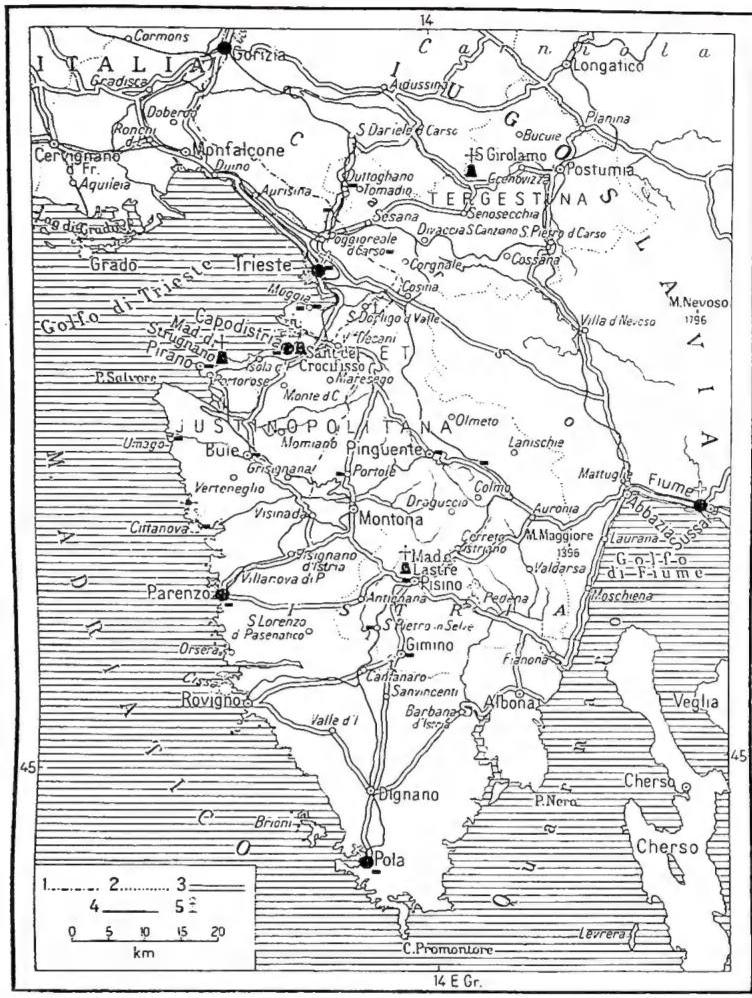
TRIESTE E CAPODISTRIA, DIOCESI di — 1) State boundaries; 2) ecclesiastical district boundaries; 3) roads; 4) railways; 5) oratories.