
Enciclopedia Cattolica Vol. IX, 1952 Sacred Scripture

Holofernes

OLOFERNE

Italian original Cite

HOLOFERNES. - Commander-in-chief, the highest personage after the king (Jdt. 2:4; cf. I Chron. 16:5; II Chron. 28:7; Esth. 13:3; 16:11), to whom Nebuchadnezzar (= Artaxerxes III Ochus, 358-338 B.C.; v. JUDITH) entrusts the execution of the plan for the occupation and devastation of the rebellious West (Jdt. 2:4-13). H. assembles his general staff, gathers a numerous army, with 120,000 foot soldiers and 12,000 horsemen of picked troops; he assails and devastates Asia Minor and Syria; the coastal region, as far as Gaza, surrenders to him in terror (ibid. 2:4-13); Judah, however, prepares its defense (ibid. 4). H. scornfully rejects the speech of Achior the Ammonite (v.) and besieges Bethulia. He remains captivated by the beauty of Judith who, invited to the banquet, cuts off his head while he lies in a deep drunken sleep (ibid. 5-7; 12-13).

The name of H. is "of a purely Persian stamp; it means in that language 'fortunate'"; it is written, even more correctly, as Orofernes" (A. Vaccari [v. bibl.], p. 309), as appears from the comparison with other Persian men, such as Tissaphernes, Dataphernes, Artaphernes. There is known a king of Cappadocia whose name was Orofernes (Polybius, III, 5, 2). Diodorus Siculus (Bibliotheca historica, XXXI, 19, 2-3) relates that the king of Cappadocia Ariarathes, a contemporary of Artaxerxes III, had a brother named H. who was at the side of the Persians to fight with them against Egypt (353 or 351 ca.). It is entirely in accordance with Eastern custom to entrust to foreign nobles, especially from subjected or allied countries, very important posts (cf. Gen. 41:33-46; Esth. 8:2; 16:11; L. Soubigou [v. bibl.], p. 512 f.).
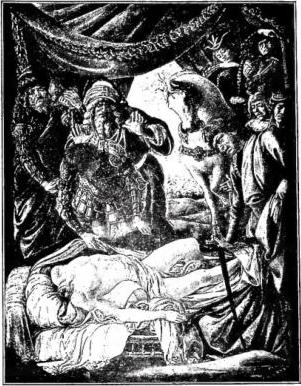
HOLOFERNES - Discovery of the body of H. in his tent. Painting by Sandro Botticelli (ca. 1465) - Florence, Uffizi Gallery.
HOLOFERNES - Discovery of the body of H. in his tent. Painting by Sandro Botticelli (ca. 1465) - Florence, Uffizi Gallery.(phot. Alinari)

What is noted here about H. confirms the identification Nebuchadnezzar-Artaxerxes III, today commonly admitted for the book of Judith.

Bibliography2 works
BIBL.: A. Vaccari, La S. Bibbia, III, Florence 1948, pp. 303 f., 309-21, 329-35; L. Soubigou, Judith (La Ste Bible, ed. L. Pirot, 4), Paris 1949, pp. 491 f., 511-21, 523-37, 548-564.

Francesco Spadafora

About this entry

By Francesco Spadafora

How we know signed in print

Translated from the Enciclopedia Cattolica, vol. IX (1952), coll. 108–109.

Printed pages Open in the page viewer
Page 94
vol. 9, coll. 107–108
Page 95
vol. 9, coll. 109–110

More by Francesco Spadafora: Oolla and Ooliba · Osee · Othoniel (Heb. 'Othniel') · Earthly Paradise · Parthians

Cite this article

Chicago

Spadafora, Francesco. “Oloferne.” In Enciclopedia Cattolica, vol. IX, coll. 108–109. Città del Vaticano: Ente per l’Enciclopedia Cattolica e per il Libro Cattolico, 1952. https://azioneromana.com/article/oloferne.

MLA

Spadafora, Francesco. “Oloferne.” Enciclopedia Cattolica, vol. IX, Ente per l’Enciclopedia Cattolica e per il Libro Cattolico, 1952, coll. 108–109. Azione Romana, https://azioneromana.com/article/oloferne.

BibTeX

@incollection{ec9_oloferne,
  author    = {Spadafora, Francesco},
  title     = {Oloferne},
  booktitle = {Enciclopedia Cattolica},
  volume    = {IX},
  pages     = {108--109},
  note      = {Cited by column},
  publisher = {Ente per l’Enciclopedia Cattolica e per il Libro Cattolico},
  address   = {Città del Vaticano},
  year      = {1952},
  url       = {https://azioneromana.com/article/oloferne}
}

One of some 20,000 entries brought back from the twelve printed volumes (1948–54). Spotted something? Help us improve it.

Save for later

Enter your email and we will send you a sign-in link. No password. What you save (articles, verses, chapters, documents) follows you to any device.