
CARNEVALE. — A period of revelry and amusements before the beginning of Lent. The most common etymology derives the term c. from carnem levare, “to remove meat,” referring precisely to the abstinence from meat imposed during Lent. The date on which c. begins varies, according to the tradition of the different countries. In some parts of France it is Christmas, in others New Year’s Day, and in still others, as also in Sicily, Epiphany (“doppu li Tri-Re, tutti olè”); among us, more frequently, 17 January (s. Antonio), but in various localities also Candlemas (2 February). The festivities generally become more intense, however, on Shrove Thursday (“berlingaccio”), the last Sunday of carnival, and Shrove Monday and Tuesday. At midnight on that day a
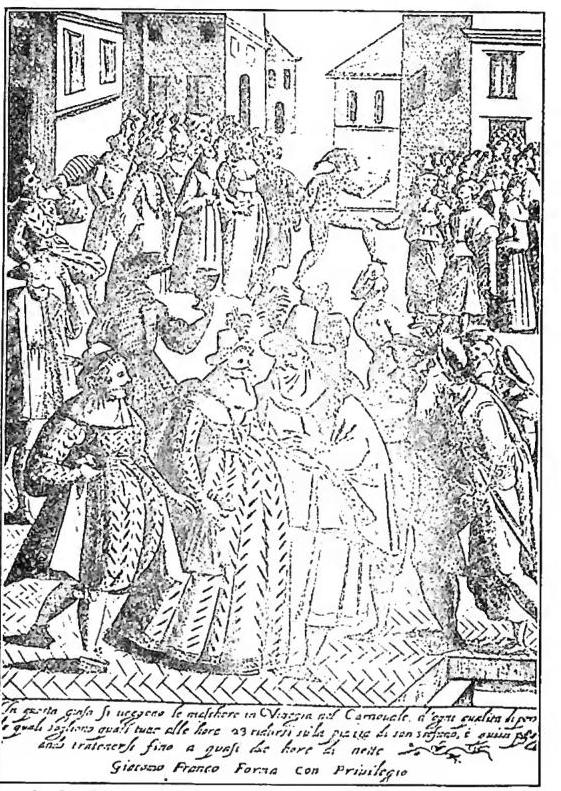
It is easy to recognize in it ancient propitiatory ritual forms for the products of the earth and for the well-being of the community. The revelry to which carnival gives rise is not merely a momentary relaxation of certain social bonds; it also has a protreptic value, so that a new seasonal period may begin in the joy of all. Thus, the death of carnival—that is, of an effigy which, after making its will and undergoing a parody of a funeral procession, is burned, drowned, or otherwise destroyed—may be placed within the broad circle of expiatory rites for New Year’s celebrations. The same may be said of customs such as the killing of a turkey (Picmonte), a cock (Abruzzo), or a goose (France, Roma, Sicily, etc.); in Monferrato, for example, before dying the «pitò» (turkey) reveals, through the mouth of a reveler, the misdeeds of the people of the town. The practice of publicly denouncing the vices and failings of the community, even in a jocular or parodic form, is widespread and takes various forms. At times it is Arlecchino who, before being killed, confesses his own sins and those of others. The king of carnival also belongs to this same sphere of customs and beliefs: for three days he assumes command of the city, ordering celebrations and revelry, and is finally deposed. The custom is still preserved particularly well, for example, in the valleys of the Bormio area; but reminiscences and reflections of it are found almost everywhere in figures such as the general of carnival, the abbot of the companies of fools—that is, of young people who organize and direct the carnival celebrations.
The hunt for the «Salvanel», which takes place in the mountains of Trentino, must likewise be traced back to ancient ritual customs. Beside the carnival effigy one often finds that of Lent, an ugly, old, and gaunt woman, since the two symbolic figures are closely connected with the very idea that gave rise to the name carnival. One of the forms of popular drama is precisely the contest between carnival and Lent, of which a representation in ottava stanzas dating from the 15th century is already known. Carnival is of great importance for the origins of our comic theatre. Carnival performances include the «farse» of carnival, the «bruscelli», and the «mariazi» or «mogliazzi», whose fundamental theme is the rivalry of two young men for a girl’s hand, which is ultimately awarded to one of the two suitors. Also during carnival there is a representation of the months, symbolized by twelve figures, to which a thirteenth is sometimes added to represent New Year’s Day. But the masks are of even greater importance. Some of them have demonic origins, such as Arlecchino in France and Zanni in Italy; a reflection of this origin may be seen in the «moresche», armed dances formerly performed during carnival. Masks representing animals and female disguises also go back to ancient times. Later, however, each period and each country introduced its own particular masks into the tradition. The «corsi» with floats, and the throwing of oranges and confetti, must likewise originally have had a propitiatory character. In Sicily and Puglia, oranges are offered to ladies by masked companies using folding ladders.
Carnival songs and dances are an indispensable complement to the festival. So too are contests, jousts, races, and horse races; begging customs and bonfires are also characteristic. In those centers where urban life attained greater splendor over the centuries, all these manifestations assumed a sumptuous and picturesque character. In former times, the carnivals of Venezia, Milano, Torino, Ivrea, Firenze, and Roma were famous.