
ABRUZZO (ABRUZZI). -
1. GEOGRAPHY
Region of central Italy bordered by the Marches, Umbria, Latium, and Molise, which faces the Adriatic between the mouths of the Tronto and Trigno rivers and extends westward as far as the Simbruini and Ernici mountains, which separate the Marsica (western Abruzzo) from the Ciociaria (southeastern Latium). From the narrow coastal strip made up of modest tertiary hills (clays, marls, sands), one ascends abruptly to a broad region of highlands (about 80 km wide and 150 km long on average), entirely encircled by mountains (Monti della Laga, Gran Sasso, Maiella, Meta, Ernici, Simbruini, Sabini) that reach or exceed 2000 m in several places (2914 m at Monte Corno, the highest peak of the entire Apennines). Other mountain barriers cross the interior in several ordered ranges, generally from northwest to southeast and nearly parallel, creating numerous longitudinal valleys (upper Velino, upper Tronto, Aterno, Salto, Turano, Liri, upper Aniene, Sangro), residual lake basins (Fucino), karst depressions (campi), and more or less extensive remnants of high-level erosion surfaces.The climate shows considerable variations not only between the coastal margin and the interior but also within the interior between enclosed basins or valley floors and summit areas. In general, the plateau has long, harsh winters with abundant snowfall; rainfall is rather scarce everywhere and typically decreases from west to east. Aridity and continentality of the climate, accentuated and rugged relief (and the resulting communication difficulties), and the prevalence of calcareous soils explain the pastoral vocation of Abruzzo, the modest development of agriculture there, and even more so of modern industry, as well as the conservative character of its economy. The population is concentrated especially in the coastal region and in intermontane basins, the most important of which are the largest: Sul-
ABRUZZO
Here are the statistical data for the four Abruzzese provinces:
| Province (and population of the chief town) | Number of communes | Area (sq. km.) | Population (1936 census) | Density |
|---|---|---|---|---|
| L’AQUILA (54,722) | 104 | 5,032 | 365,716 | 73 |
| CHIETI (30,266) | 99 | 2,582 | 374,727 | 145 |
| PESCARA (51,808) | 43 | 1,225 | 211,561 | 173 |
| TERAMO (33,796) | 24 | 1,948 | 249,352 | 128 |
| Totals | 270 | 10,787 | 1,201,356 | 111 |
The Molise (v.) to form a single historical region.
2. HISTORY
In Roman times the Abruzzo comprised the Fourth Region of Italy, inhabited by the Sabines in the area of Rieti, Antrodoco and Amiternum; by the Aequi and the Marsi along the valley of the Salto and the highlands of the Fucino; by the Vestini, who extended from Aveia and Forcona, near L’Aquila, as far as Ofena, Penne, Atri and Teramo, the ancient Praetutium, later Aprutium, from which the name Abruzzo derives; by the Peligni, dwellers of the ancient cities of Sulmona, Valva, Pentima, Corfinio; by the Marrucini, whose chief towns were Chieti (Teate) and Pescara (Amiternum); by the Frentani in the area of Ortona, Lanciano and Histonium, between the Maiella and the Adriatic; by the Samnites, who stretched from Alfedena (Aufidena) and Castel di Sangro through the towns of the Molise, Isernia, Trivento and Boiano.Given the proximity of Latium to the Abruzzo, the evangelical message certainly reached these peoples early, especially the cities along the consular roads of the Salaria, Valeria and Claudia Nova. In S. Vittorino d’Amiterno and in S. Giusta di Bazzano there are Christian cemeteries dating back to the 4th century. Angelo Silvagni has collected about ten Christian inscriptions from the Abruzzo, ranging from the 4th to the 6th century. Popular fantasy and the whimsy of writers would have it that the earliest episcopal sees in the region were founded by the apostles’ disciples; modern criticism, however, with F. Lanzoni (Le diocesi d’Italia, I, pp. 344-80) and others, does not consider them older than the 4th century. Also in the Abruzzo, with the dawn of the Middle Ages, various Passiones, i.e. hagiographic legends, flourished, such as those of St Anatolia the martyr, St Maximus the deacon, St Vittorino of Amiternum, St Cetteus of Pescara, the Celanese martyrs Simplicius, Costanzo and Vittoriano, Rufinus and Cesidius in Trasacco, St Justin the bishop of Chieti, St Giusta in Bazzano, St Eusanius and companions in Forcona, St Pelinus in Corfinio. All these legends have been examined and judged by the Bollandists in their Acta SS. and listed in the BHL under the respective names and feast days.
The medieval history of the Abruzzo, besides being attested by contemporary diplomatic documents, is transmitted to us by the monastic chronicles of Farfa, S. Vincenzo al Volturno, S. Clemente a Casauria and S. Bartolomeo a Carpineto. The Abruzzese polymath, Antinori, published almost all the Aquilan chronicles in the Antiquitates Italiae of Muratori; in our own time F. Savini illustrated with very many unpublished documents the entire Church of Teramo. On the Abruzzese Aquilano Santo (L’Aquila 1849) and its Santuari, the Franciscan D. Casciola da S. Eusanio wrote extensively, later imitated by his confrere G. Obletter for the dioceses of Chieti and Vasto (Teramo 1924). In 1900, in Atri, the second edition of the Calendario dei Santi Abruzzesi, compiled by a layman according to the day of their feast, was published by the De Arcangelis press.
Aniceto Chiappini
3. SACRED ART
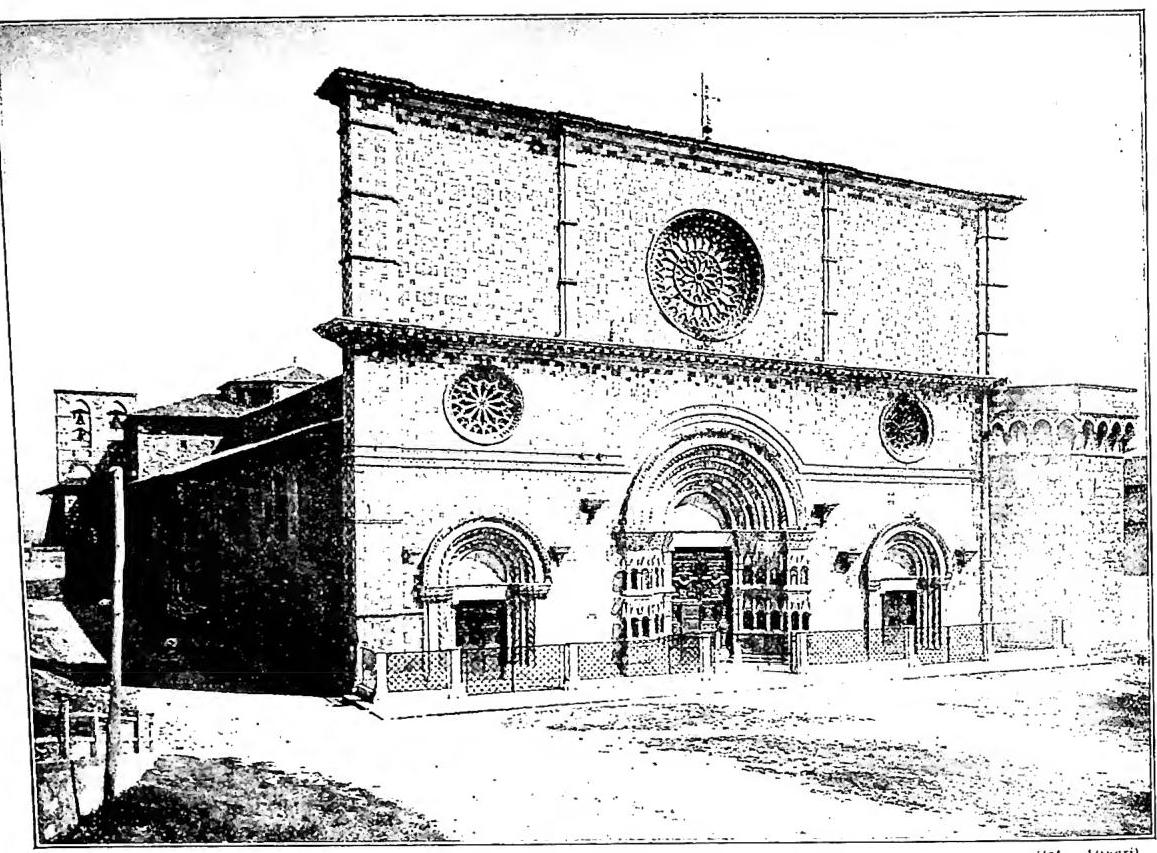
Art in the Abruzzo was almost exclusively religious in character, and ecclesiastical architecture in the Middle Ages was its highest and most original expression. Traces of monuments prior to the year 1000 are scarce and insignificant. The first revival of artistic activity in the region was promoted during the 11th century by the immigration of monastic craftsmen from Montecassino: in the abbatial church of S. Liberatore alla Maiella they established, from the very early years of the 11th century, a type of basilican construction with three naves divided by square-plan piers and semicircular arches, with apses and exposed roofing, from which the Abruzzese sacred architecture long derived its salient features.To this first great architectural movement, known as the “S. Liberatore” school, of solemnly classicizing imprint albeit with Lombard elements, are linked the ancient oratory of S. Alessandro annexed to the Valvense cathedral, of singular plan; the churches of S. Pietro ad Oratorium of Capestrano, of S. Clemente al Vomano and that of S. Maria di Bominaco (early 12th century), in whose façade there begins to appear timidly that horizontal-crowning scheme which would become one of the most typical and constant characteristics of Abruzzese churches, continuing to enjoy success even into the mature Renaissance (façade of S. Bernardino in L’Aquila, by Cola dell’Amatrice, 1540). “Heir and continuer of the methods of S. Liberatore” (Gavini) was the “Valvense School,” whose founding monument was the cathedral of S. Pelino ad Valvas near Pentima, today Corfinio (consecrated in 1124), with an apsed transept and an octagonal tower-dome at the crossing, on which were modelled the cathedrals of Sulmona, Teramo and Chieti. The ornamental sumptuousness of the Valvense School was, however, surpassed by the stylistic refinements of the “Casauriense School,” which, originally assimilating forms of Burgundian architecture (v. art), already seen in the reconstruction of the abbatial church of S. Giovanni in Venere at Fossacesia (begun 1165), created in S. Clemente a Casauria (1176-82) the masterpiece of Romanesque architecture in the region.
(Phot. Gab. Nas.)
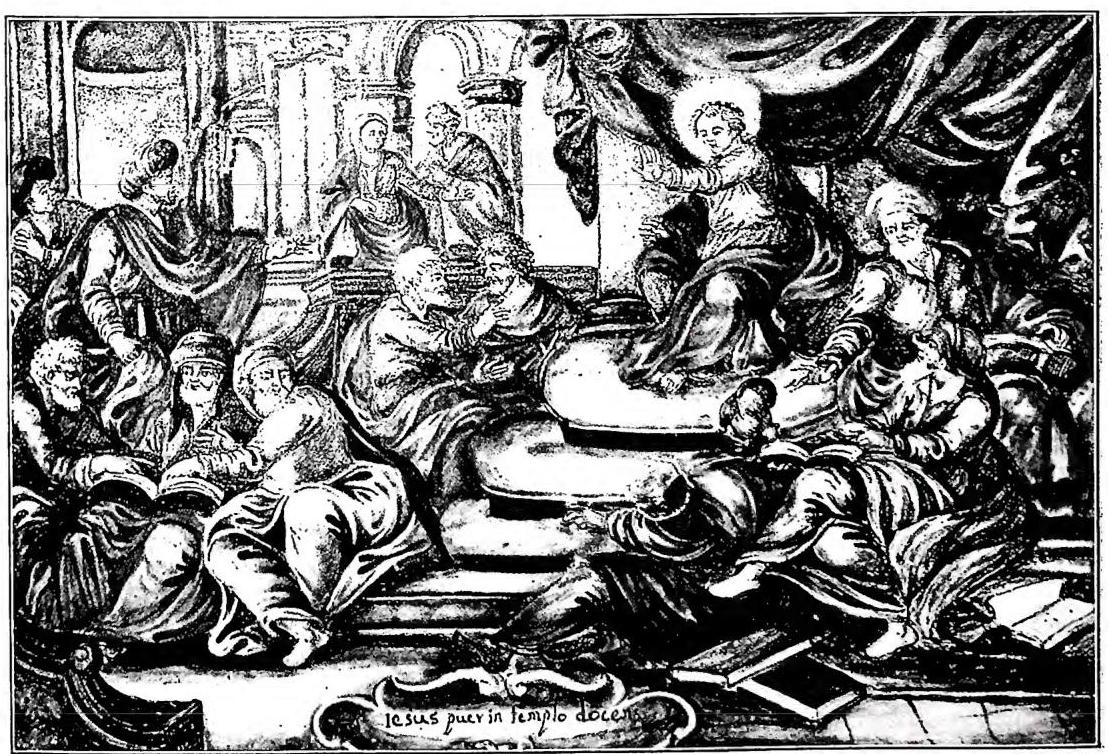
ABRUZZO - Gesù tra i dottori. Ceramic tile from the 17th century - L'Aquila, Cicchetti Collection.
(Nat. Phot. Off.)
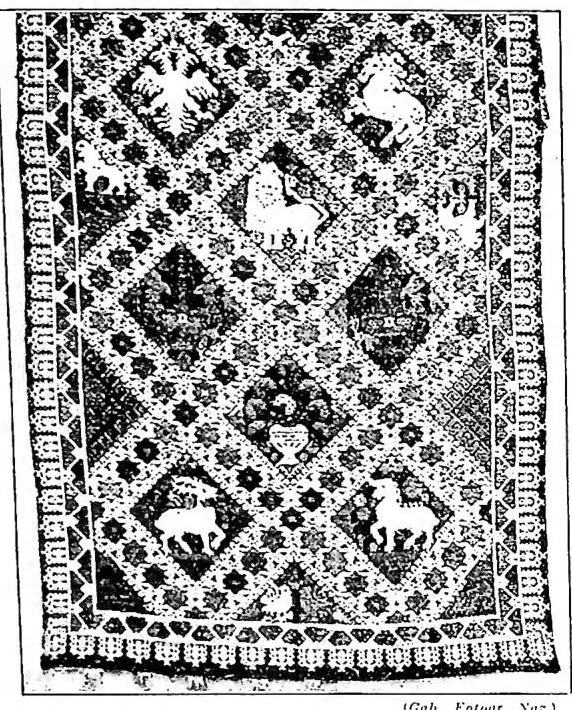
ABRUZZO - Tappeto of Pescocostanzo from the 17th century. - Castel del Sangro, Del Zio Collection.
The aquilan style of S. Maria di Collemaggio attests, towards the end of the 14th century, the vitality and capacity for renewal of a taste that was still partly inspired by the typical features of the ancient local schools.
Painting developed to a limited extent, except for various cycles of frescoes from the 12th and 13th centuries, with Benedictine imprint, in the churches of the Aquilan mountains (S. Pietro ad Oratorium at Capestrano, S. Maria ad Cryptas at Fossa, S. Pellegrino at Bominaco), and, in the full Quattrocento, the lively decoration of the choir of the cathedral of Atri, the work of the eclectic Andrea Delitio: in compensation, among the minor arts, which were at all times intensively practiced to meet
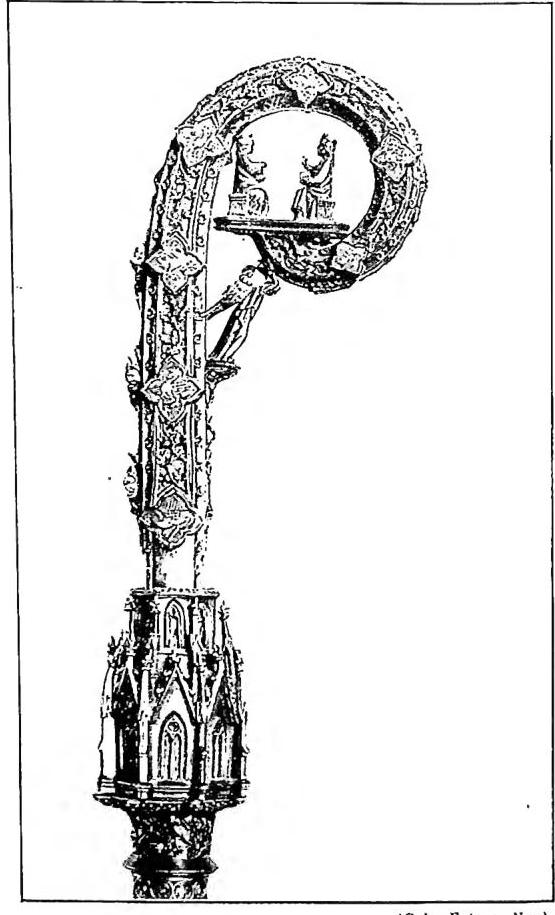
ABRUZZO - Pastoral staff in silver from the Sulmona school, late 14th century - Atri.
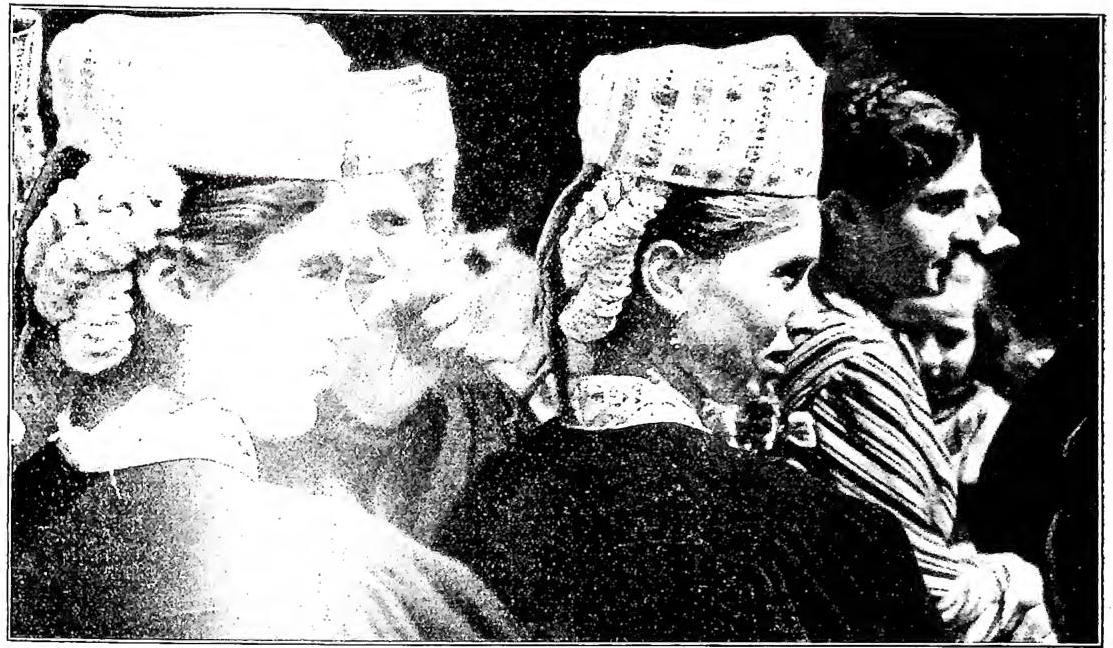
The goldsmith’s art, which from the Middle Ages to the 17th century produced reliquaries, monstrances, chalices, croziers and a great many processional crosses in embossed silver with figurative scenes, attained considerable prominence in meeting the needs of worship; its most celebrated examples are owed to Nicola da Guardiagrele (first half of the 15th century).
4. RELIGIOUS FOLKLORE
The traditional life of the Abruzzese people is steeped in a lively religious feeling. As in neighboring Umbria, the treasure of popular religious poetry is exceedingly rich, consisting especially of narrative songs inspired by episodes in the life of Christ, hagiographic legends, short prayers against illnesses, invocations and lyric chants in which sincere and fervent religious feeling is expressed in an original and moving language.Also of interest is a group of short legends in prose that have grown up around the Holy Family, Christ and the Apostles. Notable, moreover, is the fact that Abruzzo is the site of legends relating to various Gospel figures. There are also many living relics of sacred drama and dramatic processions, in which the spectacular element consists of tableaux vivants evoking scenes from the Old or New Testament. This is the case, for example, with the feast of the “talami” of Orsogna (also called the feast of the mad or of the Madonna del Rifugio), which takes place on the second day of Easter. Of the same kind is the representation held at Capistrello on Good Friday, which re-enacts episodes of the Passion, from the capture of Jesus to his crucifixion. In other towns, such as Lanciano, during Holy Week the dramatic element of the procession consists of the scene of Mary searching for her Son, a motif that finds parallels in many places in central and southern Italy. In this case, however, it involves statues rather than costumed persons, and the use of sacred and symbolic statues is the most widespread in these Easter processions. Also highly characteristic is the feast of the Madonna dei Turchi at Tollo (Chieti), during which the faithful, divided into two factions and armed with pikes, arrows, lances and halberds, stage a battle scene between Christians and Saracens. A particular sense of rustic poetry, innocence and religious fervor animates the procession of the ox of St Zopito, held at Loreto Aprutino on the Monday after Pentecost. Behind the statue of the patron saint, carried in procession, follows a majestic ox, kept without being put to field work, its horns and tail adorned with brightly colored ribbons; it is covered with a red cloth and ridden by a boy dressed in white. When the procession returns, the ox kneels on the threshold of the church and follows the statue even into the interior of the temple.
Processions with a predominantly rustic character are also held at Bugnara (L’Aquila) and Bisenti (Teramo), where a garlanded donkey parades through the town to the sound of music, followed by a procession of girls carrying baskets of grain on their heads. But perhaps the most typical festival of Abruzzo is the procession of the snake-handlers, held in honor of St Dominic at Cocullo (between Avezzano and Sulmona) on the first Thursday in May. A week beforehand, the villagers go to nearby Monte Luparo to hunt snakes, which they then keep in cloth bags; on the day of the festival, the snake-handlers who precede and follow the statue of the saint wear live snakes coiled around their necks and arms, while other snakes entwine the statue itself. Since the place where the saint is venerated is believed to have once been the site of a temple dedicated to Angizia, these manifestations have been linked to the cult of that goddess. Thus in some aspects of the rustic processions just described, connections have been sought with the festivals of Demeter. Yet even if tradition may in some cases suggest a pre-Christian substratum, it is certain that the festivities now unfold entirely within the forms regulated by the Church.
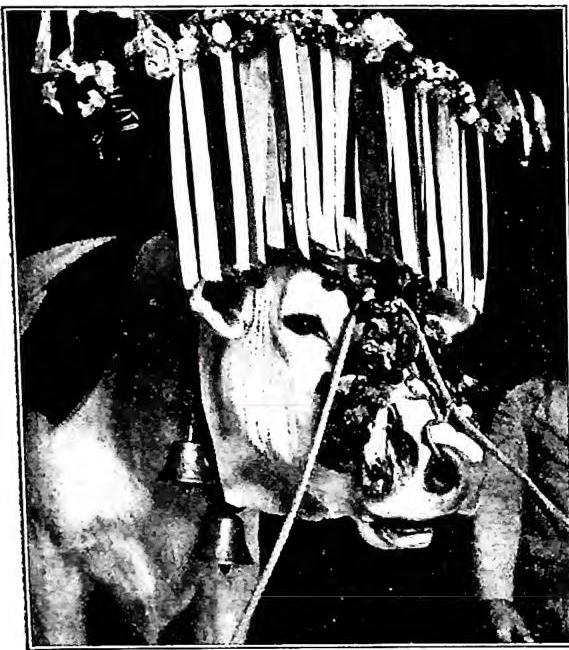
ABRUZZO — “The Ox of San Zopito”
by S. Michele Arcangelo near Civitella del Tronto, by S. Angelo near Balsorano, by S. Colomba on Gran Sasso and others. Some destinations lie beyond the borders of Abruzzo, such as the Holy House of Loreto and the sanctuary of the Archangel S. Michele on Monte Gargano. — See Plates IX–X.