
ALASCA. – Territory of northwestern America, belonging to the United States, which bought it from Russia in 1867.
1. GEOGRAPHY
It covers 1.5 million sq. km, five times the area of Italy; it comprises the northwestern tip of North America and is still imperfectly known. It became famous toward the end of the last century for its gold deposits, which attracted a large immigration of whites, soon brought to an end. More important today than minerals (including copper, tin, and platinum) is fishing: canned salmon (7–8 million cans a year) alone accounts for more than half of exports (cod fishing and whaling are also carried on there). The forest reserves are imposing (one third of the territory’s area); agricultural possibilities, on the other hand, are limited because of climatic conditions (subpolar or polar regimes). The raising of reindeer and fur-bearing animals is another reliable source of income.A. is a territory of the U.S. It is administered by a governor assisted by two Chambers. The population
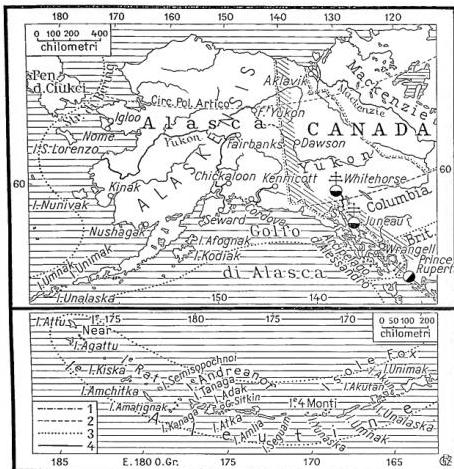
The capital is Juneau (5,700 inhabitants); the principal port is Ketchikan (4,700). Communications are still sparse (2,050 km. of railways) and are conducted chiefly by sea.
The Aleutian Islands (v.) and the small Pribilof Archipelago (4 islands, 160 sq. km., 440 inhabitants) depend on A.; these are reserved for the preservation of animal species (seals, reindeer, foxes, and birdlife).
2. MISSIONS
Christianity was first introduced into A. in 1764 by the archimandrite Ivassof, accompanied by 10 Orthodox priests, by order of Catherine II. Some attempts had already been made by other Russian missionaries, but without any notable results. Ivassof established himself on the island of Kadak, headquarters of the Russian-American fur company, and from there his priests, under the protection of the merchants, spread out in various directions. The man who earned the title of «Enlightener of the Aleutians» was the archimandrite Ivan Veniaminof, an educated, zealous, courageous man, who spent almost thirty years of his life there.Catholic missionaries, however, could not enter until A. passed under the rule of the United States (1867). Then, in the autumn of 1871, the Oblates of Mary Immaculate arrived there from the neighboring district of Athabasca-Mackenzie under the leadership of Msgr. Clut, and devoted themselves chiefly to the southern region. Meanwhile, after A. had come under the jurisdiction of the bishop of Victoria, Msgr. Carlo Giov. Seghers, he made a first exploratory journey there, advancing north as far as Nulato (1877). On a second journey (1886), he was accompanied by two men to whom he could then entrust the mission, Fathers Pasquale Tosi and Luigi Robaut; but having reached Ysseelatch, 10 miles from Nulato, he was killed by his servant. The mission, taken over by the Jesuits under such painful circumstances, was pursued with methodical perseverance and with an ever-increasing number of priests and nuns; the first school was opened in 1888, and one for the Eskimos in 1894. The apostolate continued to develop ever more successfully, despite the unavoidable and serious difficulties caused by deep-rooted superstitions, the extremely cold climate, the distance between the villages, various economic crises, and contact with whites. A. was detached from the diocese of Vancouver and erected as an apostolic prefecture on 27 July 1894; its first apostolic prefect was Fr. Tosi. On 22 December 1916 it became an apostolic vicariate. Principal residence: Juneau.
The apostolic vicariate numbers (1947) 48 churches, of which 20 are parishes. The Jesuits of the Oregon province (U. S.) number 35 (some of them indigenous), including 25 priests, 2 scholastics, and 8 coadjutor brothers. There are 19 male religious houses with 36 members, and 10 female houses with 79 members. The male religious educational institutes number 9, with 338 pupils; the female institutes number 9, with 305 pupils. There are also 7 charitable institutions (hospitals with dispensaries and orphanages), with 300 persons accommodated.
Catholic Action has been established in the Ladies Instruction League and in the Catholic Youth Organization. There is also a periodical defending the interests of Catholics: the Alaskas Catholic, with approximately 1,500–1,600 copies.