
OBLATI e OBLATE, CONGREGAZIONI di. - Religious institutes of men and women, with or without religious vows. Those still in existence are:
I. O. OF SS. AMBROSE AND CHARLES. - Founded by St. Charles Borromeo, who had the first idea
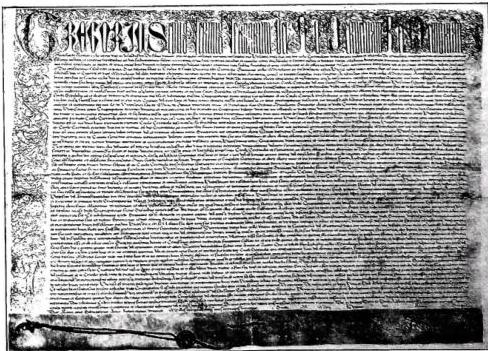
OBLATI E OBLATE - Bull by which Gregory XIII erects the Congregation of the O. of SS. Ambrose and Charles (26 Apr. 1578) - Milan, Archive of the Congregation, box XVIII, no. 319.
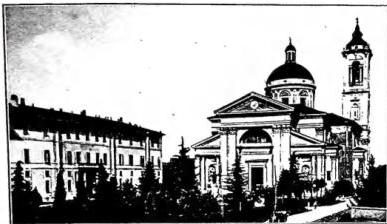
OBLATI E OBLATE - College of the Oblate Missionaries of Rho, rebuilt in 1912, and sanctuary of the Beata Vergine Addolorata, work of the architect Pellegrini (1583-88) - Rho (Milan).
of secular priests living under the obedience of the bishop at his full disposal for the service of the diocese, around 1570, perhaps suggested to him by the Oratory of St. Philip in Rome, and in March 1578 he implemented it with a "college of priests and ecclesiastical persons under the title of o. of St. A." (in 1611 "and of St. Charles" was added).
Gregory XIII with the bull of April 26 of the same year approved the Constitution; in the following August the formal erection took place at the church of S. Sepolcro (which remained the motherhouse until 1928) and the detailed study of the Rules began, which, tested from Feb. 29, 1579, drafted by Card. A. Valerio, appeared in their definitive form around Oct. 1581 (Acta Eccl. Mediolan., III, Milan 1892, coll. 49-90). In them, the vow of obedience and permanence was mandated; the vow of poverty in practice resulted (and is the present rule) in a transfer, in favor of the Congregation, of all material income attached to office and employment and of Mass offerings, freely accepting a modest annual allowance sufficient for clothing and eventual personal needs.
St. Charles intended common life as the basis, but already from the end of 1579 he did not make residence at the motherhouse obligatory. The O. subsequently began to group themselves according to their activity, chosen as a preferential title, subject to obedience to the archbishop. The O. worked and worked even outside the Milanese diocese. Suppressed by Napoleon, they were restored by Archbishop Msgr. Romilli in 1854.
The purpose of the O. M. is to preach missions and spiritual exercises to the clergy and to women religious without receiving any remuneration other than travel expenses. To the vow of obedience to the archbishop pro tempore, they add that of perpetual permanence in the College, which they renew every year on July 22. The rules are those of the O. of SS. Ambrose and Charles, adapted to their particular way of life according to the Norma tenuta dal p. Martinelli e primi Padri del Collegio di Ro nell'osservare le Regole della Congregazione degli O. drawn up in 1735 by the o. G. B. Raineri and published for the use of the College in Milan in 1893. The College, governed by a provost and a vicar who remain in office for two years, is independent of the General Congregation in the administration of its assets; however, it depends morally and disciplinarily on the provost general of the O.
The College was suppressed by the Cisalpine Republic on October 13, 1798, reopened on July 26, 1799, suppressed again on April 25, 1810 by Napoleon, and re-established on October 24, 1814. It was sold to private individuals following the subversive laws of 1866; bought back and registered in the name of private individuals, it was completely rebuilt in 1912. Despite all these suppressions, the O. M. of R. never desisted from their work, always conforming to the spirit of their founder.
A. Pietro Frutaz
V. OBLATI DI MARIA IMMACOLATA
A religious congregation founded in 1816 in Aix-en-Provence by Eugène de Mazenod, later Bishop of Marseille, and approved in 1826 by Leo XII.De Mazenod, who as a nobleman had to leave France as a child and come to Italy with his family (1791-1802), upon returning to his homeland was deeply struck by the ruins that the Revolution had accumulated in the religious sphere, and resolved to devote himself to rural populations living in absolute abandonment. Having been ordained a priest, he associated himself with several other zealous priests, laid the foundations of the new Institute, and dedicated himself to the systematic evangelization of country parishes through the preaching of missions, taking St. Alphonsus as his model. He desired that preaching to the people be persuasive and entirely imbued with the desire to bring God back into souls profaned by impiety.
Having secured the preaching of missions to the people, De Mazenod agreed to send missionaries overseas. In 1841 he sent the first six missionaries to North America, a modest beginning to a gigantic enterprise, considering that, a century later, there are 1,930 O. M. I. in Canada and the northern territories organized into five large provinces and eight apostolic vicariates, two of which, Mackenzie and Hudson Bay, extend beyond the shores of the Arctic Ocean and reach the extreme limit of human habitation in two sectors
toward the Pole. In this slow and painful march from the southern provinces of Canada to the farthest confines of the earth, the O. M. I. wrote glorious pages in the apostolate of the polar lands: two of them were massacred by Eskimo shamans, others disappeared into the depths of frozen lakes or were suffocated by blizzards in the immense snow desert. In 1847 De Mazenod sent the first group of missionaries to the island of Ceylon, where 260 O. M. I. with 4 of their bishops (3 of whom are indigenous) currently work in the dioceses of Colombo, Jaffna, and Chilaw. In 1851 he sent them to South Africa, where now ca. 500 O. M. I., divided into five apostolic vicariates, carry out their apostolate among the Bantu populations. Subsequently, the Institute has accepted missions in Australia, Indochina, the Philippines, the Belgian Congo, Cameroon, Japan, and Latin America (Argentina, Brazil, Chile, Paraguay, Uruguay).
Another purpose of the Congregation is the direction of seminaries, education, and teaching in colleges. In this field too, De Mazenod was an innovator: he adopted and had his followers adopt the moral theology of St. Alphonsus against the semi-Jansenist rigorism then dominant in the theological schools of France, drawing criticism, hostility, and the accusation of "ultramontanism" for his attachment to Rome. In 1848 the O. M. I. founded the University of Ottawa (Canada [v.]). On the island of Ceylon they direct the major higher education colleges of Colombo and Jaffna and control a large part of the periodical press in the two indigenous languages (Tamil and Sinhalese). In Basutoland (South Africa) a major university college is rising under their direction, a sort of Catholic university for South Africa.

From there and from other houses in Carignano, Pinerolo, and Livorno Vercellese, they fanned out over thirty years of intense missions through the Piedmontese and neighboring regions. Simultaneously (1837) they initiated two vast foreign missions in Ava and Pegu (India). Its first apostolic vicar was Msgr. G. D. Ceretti, bishop of Antinoöpolis: having subsequently returned to Turin due to broken health, he assisted in episcopal functions for the exiled archbishop Msgr. Franzoni (1847-56). He also proved to be a brilliant polemicist in the two (anonymous) volumes La libertà della Chiesa and Vera e falsa libertà. Other O. di M. V. directed the combative Armonia alongside D. Margotti. Msgr. Ceretti was succeeded in India by Msgr. G. Balma, who also soon returned to Turin due to illness and served as substitute for the same Msgr. Franzoni (1856-69), later becoming archbishop of Cagliari (1871-81). As early as 1835 the O. di M. V. had established a flourishing ecclesiastical boarding school in Nice, which they directed until around 1890.
The period from 1863 to 1900 was a succession of continuous persecutions and ruins. Stripped of their property and suppressed three times in Italy and twice in France, the Congregation saw its attempts at reconstruction continually thwarted: Milan and Como (1856-59), Rocca Priora in Rome (1863-70), Turin, Pinerolo, Carignano, Giaveno (1871-1903). Nevertheless, even in this period, in the dioceses where it managed to sustain itself, it did not cease to carry out vast missionary work (Fr. G. Ferrero alone gave more than 800 popular missions) and exercises for the clergy, alongside a broad contribution of serious religious propaganda through numerous ascetic, hagiographic, and propagandistic works by Frs. G. Giordano, G. B.
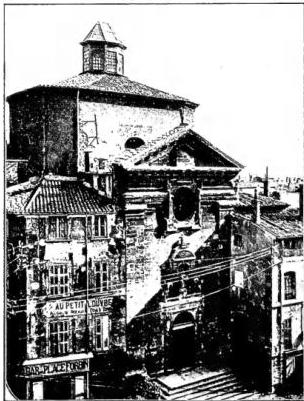
OBLATI E OBLATE - Cradle of the Congregation of the O. of Mary Immaculate. Mission Church with the annexed convent - Aix-en-Provence.
OBLATI E OBLATE - OBLAZIONARI DI S. AMBROGIO
Isnardi, P. Gastaldi (the first biographer of Cottolengo) and the conspicuous mass of various works by Msgr. G. Berchialla, Archbishop of Cagliari (1881-92).
Since 1900, connected initially with the last major persecution by Combes and the return of the religious from France to Italy, a period of slow but lasting reconstitution began. The Congregation now has about thirty communities in Italy, France, Austria, Argentina, Uruguay, Brazil, Colombia. It directs various seminaries in Italy and America; through religious culture circles and circulating libraries in all its houses, it oversees the dissemination of the Catholic press; it attends especially to the religious organization of the people through parish apostolates and worker apostolates in factories.
VII. OBLATES OF SAINT FRANCIS OF DE SALES
They were founded in the spirit of St. Francis de Sales, under the impetus of the Ven. Maria di Sales Chappuis, in the Visitation monastery of Troyes by the monastery's chaplain, Luigi Brisson, in 1871.The Congregation is dedicated to various works of priestly and parochial ministry; to the instruction and education of youth; and to missions. The vows taken are simple, annual for the first three years, and then perpetual. At present the Congregation, approved by the Holy See in 1890, numbers over 850 religious with houses in France, Italy, Greece, Austria, Switzerland, America, and two vicariates in South Africa.
VIII. OBLATES OF SAINT JOSEPH OF ASTI
Institute founded in Asti by the priest Giuseppe Marello, later Bishop of Acqui, in 1878.The beginnings were extremely humble, characterized by extreme poverty and strong opposition, partly because the new institution lacked a distinct identity. At first, in fact, the religious engaged in manual labor, taught catechism in parishes, and attended to the upkeep of churches. But later the nature of the Congregation became more clearly defined, and its members devoted themselves to studies, undertook the exercise of the ministry in parishes and missions, and the education of youth in schools, festive oratories, boarding schools, patronage houses, orphanages, and vocational schools. On March 18, 1901, it was erected as a congregation of diocesan right, and on April 11, 1909, came the decree of praise and the approval of the Constitutions. The O. of St. Joseph are today widespread not only in Italy, but have flourishing missions in the Americas and the Philippines, and number 350 religious with about 80 houses.
They adopted the Rule of St. Augustine. Other independent houses later arose in various cities of Italy, which in 1917 were united under a single superior general. They run kindergartens, nursery schools, and schools, and number over 200 sisters in 18 houses.
X. OBLATE DEL CUORE DI GESÙ
An institute derived from a small community called "Victims of the Sacred Heart," dedicated especially to reparation, near Grottaferrata, by the impulse of the Abbot of the Basilians.In 1894 the new foundation was inaugurated, and on April 1, 1896, it was approved by Card. Vannutelli. On November 1, 1916, Card. Cassetta, Bishop of Frascati, canonically erected the Institute, had its title changed to that of O. del C. di G., and approved its Constitutions. On December 5, 1947, the S. Congr. of Religious elevated the Institute to the rank of a congregation of pontifical right and revised its Constitutions.
The sisters consecrate themselves to a life of reparation to the
Heart of Jesus, of prayer for the sanctification of the clergy, and of labor in the work of vocations, with boarding schools for boys and retreat houses for priests in need of help and rest. The generalate is in Grottaferrata.
Agostino Pugliese
XI. OBLATE OF THE ASSUMPTION
An institute founded in 1865 by Fr. E. d'Alzon, who was also the founder of the Priests of the Assumption. In 1890 it divided into two distinct groups.The first, with its general motherhouse in Nîmes, received the decree of praise in 1892, but developed little; in 1927 it had barely 60 religious distributed across six houses. The second, with its general motherhouse in Paris, experienced a more flourishing development; in 1927 it numbered approximately 400 subjects and 34 houses, but it had always remained of diocesan right. The reunification of the two groups was carried out by a decree of the S. Congr. of Religious on June 22, 1926. The Institute thus reunited was declared to be of pontifical right and had its Constitutions approved for the first time for a seven-year period on July 3, 1934, and then definitively on October 27, 1947.
The special purpose of the Institute is the apostolate, especially among dissidents and the "orthodox". To this end, it maintains schools and other missionary works, above all in the East. In 1950 the sisters numbered 567, with 32 novices, distributed across 56 houses.
Agostino Pugliese
XII. OBLATE DEL S.MO REDENTORE. - A female religious institute founded by Antonia de Oviedo y Schontal della Misericordia at Ciempozuelos (Spain), in 1864, for the instruction and re-education of fallen young women. It was approved by the Holy See in 1895 and is widespread in Spain with 29 houses and more than 500 religious.