
CHILE. -
I. GEOGRAPHY
State of South America consisting of the narrow western slope of the Andes, and therefore enclosed between them and the Pacific in a strip between 150 and 200 km wide and extending for 4,300 km from N. to S. The great latitudinal extent determines different climatic conditions in the various sections. As a rule, the following are distinguished: a dry northern region (the Atacama Desert), but rich in mineral resources; a southern region, humid and relatively cold, with good pastures, extensive forests, and a sea area suitable for fishing; and, between the two, central Chile, with a warm temperate climate, moderate rainfall, and extensive flat surfaces that are irrigated or can be irrigated. The result is a country with broad economic possibilities, both in agriculture (cereals, tobacco, hemp, and especially vines), livestock farming (6,100,000 sheep; 2,500,000 cattle, etc., with the consequent meat and wool industries), and forestry (one fifth of the country’s area is covered with forests, but almost all of them are in southern Chile and are still little exploited), and in mining, which, alongside the enormous resources of sodium nitrate in northern Chile (and of by-products such as borax and iodine), includes copper (second place in world production), iron, gold, coal, rock salt, etc. Industry, of recent origin, is inadequate to the country’s possibilities and needs, but has made considerable progress in recent years (especially in the textile, food, and iron and steel sectors). Trade is predominantly maritime and relies on numerous ports, the principal one being Valparaiso, which alone handles half of the import traffic.The population of Chile is fairly homogeneous from the ethnic point of view, consisting in its great majority of people of Spanish origin. The Amerindians (Changos, Fuegians, and Araucanians) now represent barely 2%, and scarcely as many are foreigners (of whom 11,000 are Italians; 35,000 if children born in Chile are also included). Density (7 inhabitants per sq. km.) varies greatly from one area to another: 86% of the total population is concentrated in the central region, which accounts for 28% of the territory. The capital, Santiago, is now a large metropolis (1,300,000 inhabitants in 1947), but only one other city, Valparaiso, exceeds 100,000 inhabitants. The Catholic religion is professed by 95% of the inhabitants; but a large part of the Amerindians are still pagan; there are also small groups of Protestants and Israelites.
Chile is a unitary republic with bicameral representation. Its current administrative division is as follows:
| Provinces | Area in sq. km. | Population 1-1-1947 | Density per sq. km. | Provincial capitals (Population in thousands, 1940 census) |
|---|---|---|---|---|
| Tarapacá | 55 287 | 107 279 | 2 | Iquique (38) |
| Antofagasta | 123 063 | 164 468 | 1 | Antofag. (50) |
| Atacama | 79 883 | 81 573 | 1 | Copiapó (16) |
| Coquimbo | 39 889 | 236 527 | 6 | La Serena (21) |
| Aconcagua | 10 204 | 117 548 | 12 | S. Felipe (16) |
| Valparaiso | 4 818 | 507 567 | 505 | Valpar. (212) |
| Santiago | 16 988 | 666 680 | 98 | Santiago (949) |
| O'Higgins | 7 112 | 208 608 | 29 | Rancagua (22) |
| Colchagua | 8 865 | 130 630 | 15 | S. Fern. (13) |
| Curicó | 5 735 | 85 412 | 15 | Curicó (20) |
| Talca | 9 640 | 159 914 | 17 | Talca (45) |
| Maule | 5 626 | 62 113 | 11 | Cauquenes (11) |
| Linares | 9 820 | 128 572 | 13 | Linares (17) |
| Nuble | 14 211 | 219 511 | 15 | Chillán (39) |
| Arauco | 5 756 | 72 934 | 13 | Lebú (8) |
| Concepción | 5 701 | 344 970 | 61 | Concepc. (86) |
| Bio-Bío | 11 248 | 126 627 | 11 | Los Ang. (11) |
| Malleco | 14 277 | 156 505 | 11 | Angol (12) |
| Cautín | 17 370 | 318 655 | 18 | Temuco (39) |
| Valdivia | 20 002 | 195 805 | 10 | Valdivia (35) |
| Osorno | 10 015 | 106 760 | 11 | Osorno (27) |
| Llanquihue | 18 407 | 116 664 | 6 | Puerto M. (13) |
| Chiloé | 23 446 | 92 823 | 4 | Ancud (4) |
| Aysén | 88 984 | 19 094 | 0,2 | Aysén (2) |
| Magallanes | 135 418 | 51 863 | 0,4 | Punta Ar. (30) |
TOTAL 741 767 5 479 202 7
de la structure économique du Chile, in Rev. économ. intern., 27 (1935), pp. 495-510; G. MacBride, Chile: Land and Society, New York 1936; E. P. Hanson, Chile, there 1941; E. Fergusson, Chile, there 1943; P. T. Euworth, Chile: an Economy in Transition, there 1945.
Giuseppe Caraci
II. EVANGELIZATION OF C
After Pedro de Valdivia opened the northern part of C. to Spanish colonization in 1540, the evangelization of the Indians began through the work of the Mercedarians (1548), followed shortly afterward by the Dominicans (1552) and the Franciscans (1553), and toward the end of the sixteenth century by the Jesuits (1593) and the Augustinians (1595). In 1561 the diocese of Santiago del C. was erected, and in 1563 that of La Imperial. The Araucanians south of the Bio-Bio River, however, resisted colonization and missionary activity, destroying La Imperial in 1598 (the episcopal see was subsequently transferred to Concepción) and the few missions of the Mercedarians and Franciscans. In the seventeenth century, despite the continual rebellions of the Araucanians, who repeatedly attacked the Spaniards and the missions, the Jesuits pushed southward as far as the Chonos Archipelago and founded reductions among the Araucanians themselves.After the expulsion of the Jesuits in 1767, these reductions were taken over by the Franciscans, who, having founded the missionary college of Chillán (1756), resumed the mission among the Indians. The disturbances caused by the wars of independence managed to disrupt it but not to destroy it; indeed, in 1832, with the arrival of Italian Franciscans, it gained new impetus. In 1848 the Italian Capuchins came to their aid, followed in 1894 by the Bavarian Capuchins. The apostolic prefecture of Araucania, erected in 1901 and raised to an apostolic vicariate in 1928, was entrusted to them. Among the Indians of Tierra del Fuego, the Salesians of Don Bosco had been active since 1882, founding several stations on Dawson Island. The success of the mission was interrupted around 1911 by widespread mortality caused by tuberculosis; few Indians survived. In 1916, after the prefecture of Southern Patagonia had been suppressed, the vicariate was erected in the Chilean part
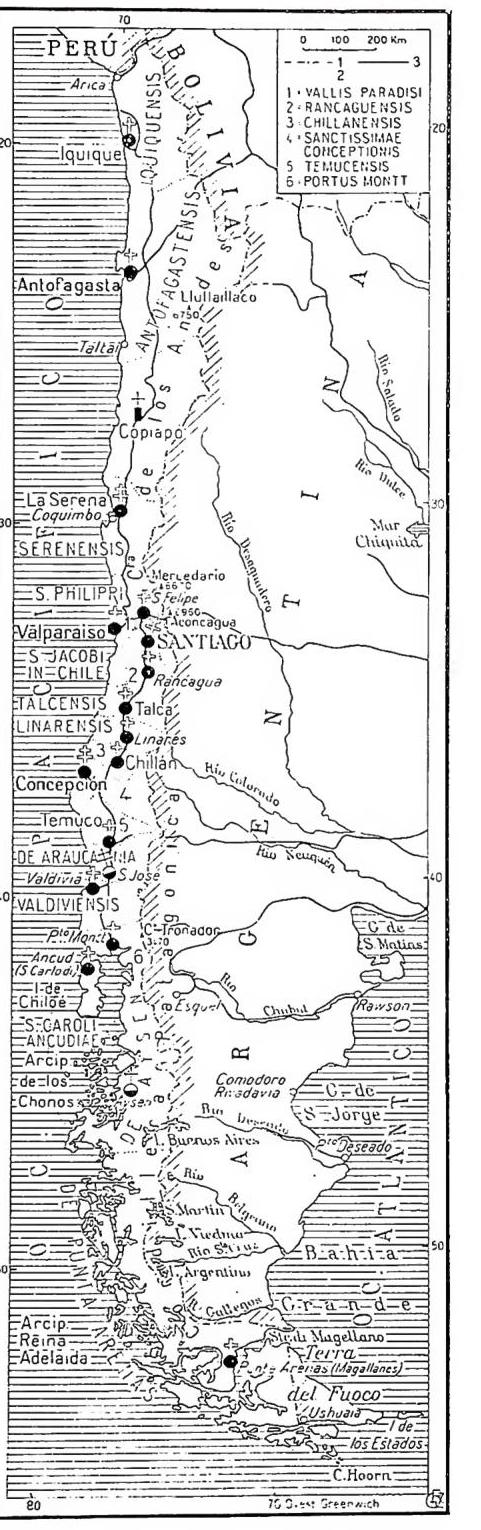
Since 1939, C. has been divided into 3 ecclesiastical provinces: Santiago, with the suffragan sees of: Linares (erected in 1925), Rancagua (1925), S. Filippo (1925), Talca (1925), Valparaiso (1925); La Serena, with the suffragan sees of: Antofagasta (1928), Iquique (1929), and Copiapó (erected as an apostolic administration in 1946); Concepción, with the suffragan sees of: S. Carlo de Ancud (1840), Chillán (1925), Temuco (1925), Puerto Montt (1939), Valdivia (1944), Punta Arenas (1947). In addition, there are the apostolic vicariate of Araucania and the apostolic prefecture of Aysén, erected in 1940 with territory detached from the diocese of Puerto Montt.
BIBLI: F. Eurich, Historia de la Compañía de Jesús en Chile, 2 vols., Barcellona 1891; R. Ghi-gliazza, Historia de la provincia dominicana de Chile, Concepción 1898; R. Lagos, Historia de las Misiones del colegio de Chillán, Barcellona 1908; Ignacio de Pamplona, Historia de las Misiones de los pp. Capuchinos en Chile y Argentina (1848-1911), Santiago 1911; P. Gazulla, Los primeros Mercedarios en Chile, Santiago 1918; B. Calvi, La civiltà nelle regioni magellaniche e i missionari salesiani, Torino 1925; G. Arcila Robledo, La Orden franciscana en la América meridional, Roma 1948, pp. 233-73.
Giovanni Rommerskirchen
III. ECCLESIASTICAL HISTORY OF C
18 September 1810 marks the end of Spanish rule, although the struggle for independence continued for several more years, and the existence of the new State was secured only after the Battle of Maipo (8 April 1818) and the expedition to Peru; it also marks, as in the other States of Spanish America, the beginning of a difficult period in relations with the Holy See. The King of Spain, according to the bull Universalis Ecclesiae of 28 July 1508, had the right of nomination to the episcopal sees of those lands, and Ferdinand VII did not intend to relinquish II. The Holy See, for its part, was concerned about the grave situation that gradually arose with the death of the bishops, since the Chileans were unwilling to accept those appointed by the king. The Holy See could not consider the right of patronage of the King of Spain null de iure, and it
The mission itself, presided over by Mons. Muzi and also including Canon Mastai, the future Pius IX, embarked at Genoa on 5 October 1823 and remained in C. for seven months. It was not, however, able to reach an agreement with the government because of certain claims of State interference in ecclesiastical affairs. After the entry into force of the constitution of 25 May 1833, which in art. 2 recognized the Catholic religion as the religion of the State, it became possible in 1840 to provide for the episcopal sees. Gregory XVI in fact elevated Santiago to an archbishopric in May of that year, with the suffragan dioceses of S. Carlos de Ancud, La Serena and Concepción. Under the subsequent pontificates, relations between the State and the Church experienced ups and downs determined by the frequent internal political crises, although no radical measures were taken against Catholicism, which constituted the country’s fundamental religion. Ecclesiastical tribunals were, however, abolished, lay cemeteries were established, and the practice of any form of worship was permitted. The separation of Church and State, sanctioned in the new constitution of 1925, was the logical consequence of Chilean policy in the preceding decades, although it did not intend to assume oppressive forms toward Catholicism; and Pius XI, in the address delivered at the Consistory of 14 December 1925, acknowledged that «this is a separation so friendly that it may be called friendly coexistence, in which the Catholic Church will be able, we trust, to continue its beneficial work in every field among that dear people». In 1939 a new arrangement of the dioceses was undertaken, with the elevation of La Serena and Concepción to metropolitan sees. At the Consistory of 18 February
1946 Pius XII conferred the cardinalatial purple for the first time on the archbishop of Santiago, Caro Rodriguez. Santiago has the Pontifical Metropolitan Seminary of the Guardian Angels.
IV. ART OF C
Because of its turbulent political history, the Chilean nation was, among the regions of South America, the most resistant to an artistic affirmation. Only in the mid-19th century did sculpture and painting there produce their first noteworthy manifestations. Great merit was then acquired by the Italian Alessandro Cicarelli, who in 1849 was entrusted with founding the Academy of Fine Arts and teaching painting, which he did for many years. Later, in 1876, another Italian, Giovanni Mochi, continued the educational tradition, bringing Chilean painting even more fully into the European taste. Among Chilean painters are Nicola Guzmán Bustamante, Pasquale Ortega, and Cosimo San Martín. Among the sculptors, a notable personality was revealed by Rebecca Matte de Iñiguez, a pupil of Leonardo Bistolfi; her Derelitta is preserved in the Gallery of Modern Art in Florence. Italian influence was also decisive in architecture. The first architect entrusted with public buildings in Santiago was Gioacchino Toesca, whose works for a long time constituted the sole example for local builders. — Vedi Tav. CII.For the literature of C.: V. ISPANO-AMERICANA, LETTERATURA.