
CEYLON. — The name C. means “island of lions,” after the warriors who accompanied its Indian conqueror in the sixth century B.C. It is the ancient Taprobane, well known to classical writers for its commercial importance, but rarely mentioned in their literary sources. An insular appendage of the Indian peninsula (Deccan), it is connected to it by the piers of a bridge that has only partly collapsed (Adam’s Bridge, with the islet of Rameswaram in the middle, one of the preferred destinations of Indian pilgrimages).
C. consists of a block of crystalline formations, rising in terraces toward the central-southern part of the island,
where high peaks (Adam’s Peak, 2243 m; Piduruta-
lagala, 2527 m) overlook a broad plateau. The block
is surrounded along the entire typically ovoid
perimeter of the island by wide coastal plains, which
border to the north a flat zone of recent sediments and
coral limestones. Accompanied as they are by a narrow
strip of sea, the coasts are generally low, but at times,
where the basement comes to the surface, they open
into excellent bays, such as that of Trin-
comalee, easily
transformed by the
English into a formida-
ble naval station.
The southern po-
sition of the island
(approximately from
6° to 10° N.)
and its limited ex-
tent (65.6 thousand
sq km) cause an equa-
torial-monsoon climate
to predominate there,
hot and humid,
even in its mountainous interior. The aver-
age temperatures fluctuate
throughout the year between
26° and 28° along
the coastal margin and
between 23° and 26° in the
regions farther from
the sea; precipitation, on the other
hand, more abundant in the south-
western sector, exposed
to the monsoon
(2 to 6 m annually),
becomes less copious
and regular in the N. and
E. The equatorial vegetation
forms a dense jungle in the
plains and magnificent
forests on the slopes
of the plateau. Among the
crops that occupy
approximately one quarter of the island’s
surface, those of tea,
the coconut palm,
rice, and rubber hevea
predominate. Livestock
breeding is of little im-
portance; mineral resources
are limited to graphite
and kaolin. Industries are
practically non-existent
(87% of the popula-
tion is rural).
The administrative division of the island is as follows:
| Provinces | Area in sq km (1000) | Population in 1000 (1946) | Density per sq km | Provincial capital (population in 1000) |
|---|---|---|---|---|
| Western | 3.8 | 1876.6 | 506 | Colombo (316) |
| Central | 5.6 | 1134.6 | 191 | Kandy (52) |
| Southern | 5.6 | 982.0 | 173 | Galle (49) |
| Northern | 8.9 | 479.6 | 54 | Jaffna (63) |
| Eastern | 9.9 | 279.2 | 28 | Trincomalee (10) |
| North-Western | 7.8 | 668.2 | 85 | Puttalam (8) |
| North Central | 10.4 | 139.6 | 13 | Ameradhapura (9) |
| Uva | 8.5 | 373.1 | 43 | Badulla (10) |
| Sabaragamuwa | 4.9 | 746.1 | 153 | Ratnapura (8) |
| TOTAL | 65.4 | 6679.0 | 102 |
Of the 6.7 million inhabitants (1946; there were 890,000 in 1827),
almost two thirds are Sinhalese, of Indo-European language and
Buddhist religion; one fifth are Tamils, who speak Dravidian dialects,
and are of Brahmanical religion (Hindus); the remainder are Muslims
(6%), Malays, Vedda, and Europeans, the latter numbering little more
than 5,000 and being almost all English. Approximately 70% of the popu-
lation professes Buddhism, 24% Hinduism, and 7%
Islam. Catholics number more than 450,000.
The capital, and the island’s most important city and port, is
Colombo (361,000 inhabitants), on the western coast, on the route
of the great maritime communications between Europe and
the Far East or
Australia; no other
centre reaches
100,000 inhabitants.
Giuseppe Caraci
EVANGELIZZA-
EVANGELIZATION OF C. – In 1518 the Portuguese had built a small fort at Colombo and made the king of Cotte, “the emperor of C.,” tributary. Missionary activity on the island began in 1543 through the efforts of the Franciscans, who, under the Catholic king Dharmapala, achieved great results on the coast of Colombo among the Kadayan fishing caste. In the northern part,
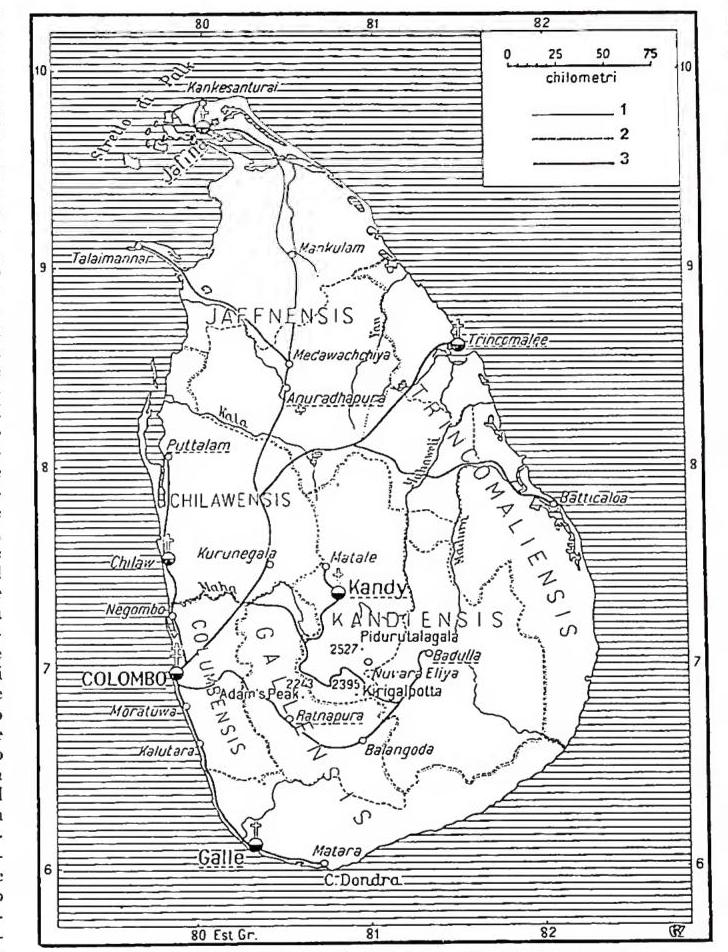
CEYLON – Ecclesiastical circumscriptions: 1. Boundaries of ecclesiastical circumscriptions; 2. Regional boundaries; 3. Railways.
Vaz, who from 1687 worked in disguise among the Catholics and in 1691 found refuge in the independent kingdom of Kandy in the interior of the island: from this centre, the Oratorians ministered to the Catholics until 1746. Fr. Jacome Gonçalves created a rich Christian literature in the Singhalese and Tamil languages. Expelled from Kandy in 1746, the Oratorians withdrew to Vanni and took advantage of the greater freedom granted by the Dutch.
The English occupied C. in 1796, declaring it a Crown colony in 1802, and proclaimed religious freedom in 1806. The mission was then able to develop and organize itself freely. In 1834, and again in 1836, the island, until then under the diocese of Cochin, was established as an apostolic vicariate. The Goan Oratorians, whose convent at Goa was suppressed in 1834, were gradually replaced by European priests, principally Oblates of Mary Immaculate and Silvestrines. The apostolic vicariates of Colombo and Jaffna, erected in 1847, passed in 1857 into the hands of the Silvestrines (Colombo) and the Oblates (Jaffna). The latter worked with excellent results to renew the Christian communities, reorganize Christian life, establish schools, and train an indigenous clergy. The great driving force behind this work was Mgr. Ernesto Cristoforo Bonjean, in Jaffna from 1868 to 1883 and in Colombo from 1883 to 1892. In 1883 Colombo too was entrusted to the Oblates; the Silvestrines received the apostolic vicariate of Kandy, erected that year. In 1886 the hierarchy was established: Colombo was elevated to an archdiocese, with Jaffna and Kandy as suffragans. In 1893 the dioceses of Galle and Trincomalee were added and entrusted to the Jesuits, who were also entrusted with the central seminary for India at Kandy. In 1939 the diocese of Chilaw was erected and entrusted to the Ceylonese secular clergy. Since 1947 the archbishop of Colombo has likewise been indigenous. – Vedi Tav. LXXXIV.