
LAVANDA DEI PIEDI. — This is a ceremony performed on Holy Thursday. In ancient times it followed Baptism, but it was soon abandoned in several Churches. St. Ambrose (De Sacramentis, 3, 1) discusses it extensively, providing all the elements necessary for understanding the criticism and development of the rite. St. Augustine did not follow the Milanese practice and, in a letter (Epist. LV, 18, 33; CSEL, XXXIV, II, pp. 207–208), states that the l. dei p. should have no connection with Baptism and seems to recommend it for Holy Thursday, although Malvy believes he is indicating Good Friday. St. Caesarius of Arles (PL 39, 2071) accepts it for the newly baptized. The Sinodus Illiberitana (can. 48 in Hefele-Leclercq, I, 1, p. 249) of 303, however, had prohibited II.
In fact, the ceremony, already recommended by St. Paul (I Tim. 5, 10) for widows, was later practiced for guests in monasteries, in commemoration of Jesus’ humility, at the end of the Holy Thursday services. It then spread to cathedrals, at first divided into two parts: the bishop washed the feet of the canons and then those of the poor; but soon, for the sake of brevity, the two ceremonies were combined, and the bishop washed the feet of thirteen poor people. The reason for this number, however, is not very clear. The oldest testimony is found in the Mozarabic Liber Ordinum (ed. Ferotin, Paris 1904, p. 190 ff.), reflecting the practices of the fifth and sixth centuries. For Rome, the earliest testimonies are found in Ordines X and XII of the twelfth to fourteenth centuries. A. Wilmart published the texts of the chants used in the ceremony, in which the concept of charity predominates, Jesus’ new «mandatum» (whence the name given to the entire ceremony). In Milan the l. dei p. was preserved throughout the Middle Ages on Holy Saturday, and already in the oldest manuscripts (eleventh century) it is also prescribed for Holy Thursday: today only the latter is observed, for twelve poor people representing the Apostles, including Judas, who is given a compensation
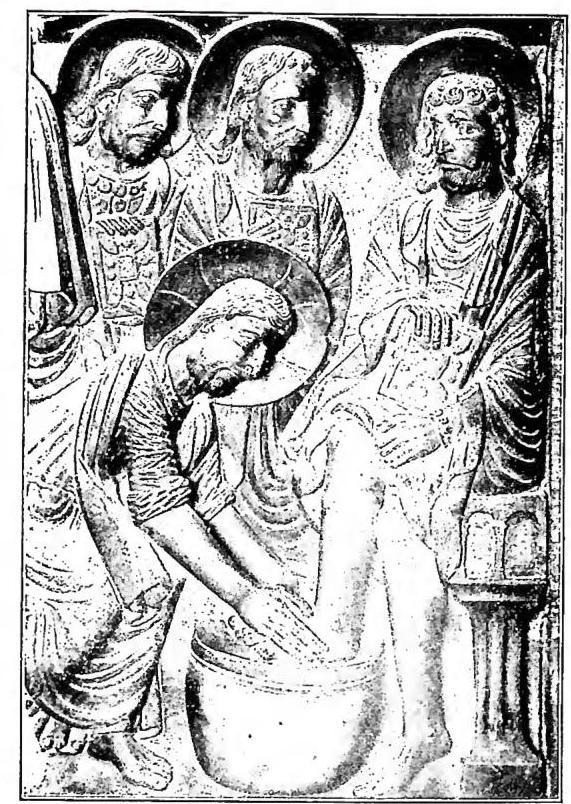
It is subsequently represented in the Purple Codex of Rossano, to the right of the Last Supper (A. Muñoz, Il codice purpureo di Rossano, Rome 1907, pl. 5); in ivories, as in a diptych in Milan (P. Garrucci, Storia dell'arte, VI, Prato 1881, pl. 450, 1), in the Kaiser-Friedrich Museum in Berlin and in the Museo civico of Bologna (Venturi, II, figs. 440 and 447), and later in the antependium of Salerno; later still in bas-reliefs, as at Selles-sur-Cher, Clermont, and in the Museum of Toulouse (from the cloister of La Daurade); in manuscripts, such as the Gospel of Patmos (10th cent.) and ms. lat. 17325 of the Bibliothèque nationale of Paris, in the Gospels of Otto III and Henry II in the Bavarian State Library in Munich, in a miniature of Corpus Christi College, Cambridge, and in the Chudorf Psalter. In mosaics, once present at Ravenna in the Orthodox Baptistery, from the time of Bishop Neone (449-59), traces remain in the lower tier, on the arches, of the illustrative inscription: ubi deposuit IHS vestimenta. Later, in frescoes, as at S. Urbano alla Caffarella and S. Maria in Pallara in Rome, and in the church of Saint-Martin-de-Vicq (Indre) in France;
in the East, in the mosaics of the churches of S. Luca in Phocis (early 11th cent.), of Nca-Moni on Chios, and of Daphni (mid-11th cent.); in frescoes of the rock-cut churches of Cappadocia and in the paintings of the church of SS. Pietro e Paolo at Turnovo in Bulgaria, damaged in 1913 (14th cent.).
The Rossano type is found again in S. Angelo in Formis, in Salerno, and in the oldest scenes of Cappadocia, that is, together with the Last Supper. — Vedi tav. LX.