Machine translation of the 1948–1954 Italian original. The original text is authoritative.
LAMPADA. — The use of the lamp for worship is found in every time and place, answering the need to illuminate sacred buildings; and since beeswax was always very costly, people readily resorted to oil collected in lamps of the most varied shapes and decorations, because in the Church it became customary to make even symbolic that which had arisen from necessity. The nocturnal vigils and vespers required the lighting of numerous lamps; indeed, their use every evening suggested the offering of light to God, accompanied by the singing of the lucernary (v.).
The illumination of a cathedral required considerable equipment: for this reason we find at every church several «cicendelari» (from «cicindela», a metal tube filled with oil and a wick, with which the lamps were lit), one of whom always had to be in the sacristy, ready for his duties. The lamps were either isolated or grouped on the «corona pharalis», or «gabata». Their use is already attested and specified by the inventory of Cirto (Algeria) of 303 (cf. DACL, Inventaires, VII, 1, col. 1396 ff.), by the canons of Hippolytus (no. 4), by many scattered notices in the Liber Pontificalis, and, in a curious manner, by Beroldus, in the Ordo of the Milanese Church of the 12th century. Following a practice very common among the pagans, the first Christians already placed lamps on tombs; but, unlike the pagans, they lit them to emphasize the symbolism of another life contained therein. This occurred more frequently at the tombs of martyrs. A most interesting document of this is the collection of ampullae preserved in the basilica of Monza, brought from Rome by the abbot Giovanni to Queen Teodolinda, containing the oils which, with the Pope’s permission, he collected from the lamps burning in the suburban cemeteries before the various tombs of the martyrs. In the liturgy of Holy Saturday there is preserved the blessing of the new fire, struck from the stone and gathered from a lamp, which in some churches is carried in the Easter processions and usually suspended beside the altar, so that fire may be taken from it with which to light the candles.
The CIC, can. 1271, establishes: «Before the tabernacle in which the Most Blessed Sacrament is reserved, at least one lamp shall burn day and night, fueled by olive oil or beeswax; where, however, olive oil cannot be obtained, it is left to the prudence of the local bishop to permit another oil, if possible, of vegetable origin.» The canon reflects the synodal legislation of the West from the 13th century, when, owing to the flourishing of Eucharistic worship, the custom became established
(phot. Alinari)
LAMPADA - Glass l. with fish and shells in classical style (11th cent.) - Venezia, basilica of S. Marco, Treasury.
of reserving the Eucharist in a public place. By a decree of the S. Congregazione dei Riti of 23 February 1916 (no. 4334), because of the difficulties created by the war, electric light was permitted; likewise during the Second World War and still today in places where such difficulties persist.
BIBL.: H. Leclercq, Lampes, in DACL, VIII, 1, cols. 1086-1221 with extensive bibl.; L. Köster, De custodia sanctissimae Eucharistiae, Roma 1940, pp. 172-80; F. Cumont, Cierges et lampes sur les tombeaux, in Miscellanea Giou. Mercati, V (Studi e testi, 125), Città del Vaticano 1946, pp. 41-47. Enrico Cattaneo
ART. - With the changed artistic tendencies of the late Middle Ages, the form of lamps also gradually changed, as is suggested above all by their representations in frescoes and miniatures. Throughout the Romanesque and Gothic periods precious materials were frequently used, and lamps became highly refined objects of the applied arts. For the most part they were suspended: in the East there were lamps of coloured glass, alabaster, ivory (a splendid example with silver mounting and precious stones is in the Treasury of the basilica of S. Marco in Venezia), and wrought iron (especially at Siena in the 13th-14th centuries). Portable lamps also, however, were widely produced; to the common type with two or three spouts for a double or triple flame, with a ring at the top through which to insert the index finger, were added more complex and elaborate examples, at times true works of art (fine examples are in the Louvre, the British Museum, the Ashmolean Museum in Oxford, and the Bargello). In Venezia, in the 15th century, the use of lamps in blown glass became established. Worth recalling are those beautiful ones painted by Carpaccio in the Presentazione and in the Sogno di s. Orsola, and that by Basaiti in the Vergine of the Accademia.
There were also lamps of unusual form, and many in bronze, in which the imagination of the Renaissance artist was variously given free rein. A curious example of a Venetian lamp, representing a horse’s skull bearing a child astride it, is in the Museo nazionale in Firenze; another, with a dragon emitting flame from its tongue, is in the Museo di Kensington. In the Baroque period lamps were chiefly made of glass, with a metal suspension system artistically ornamented according to the canons of that style. They were much used for the decoration of churches, but were often replaced by chandeliers with several lights and greater decorative effect. As for the form of the latter, these range from circular ones, very common in the Middle Ages (sanctuary at Fuente del Guarrozar
(phot. Anderson)
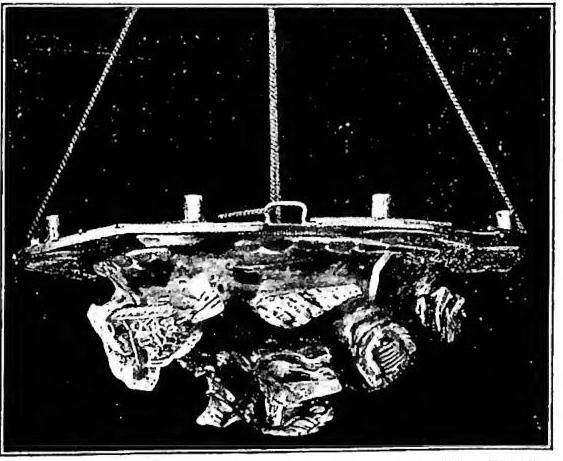
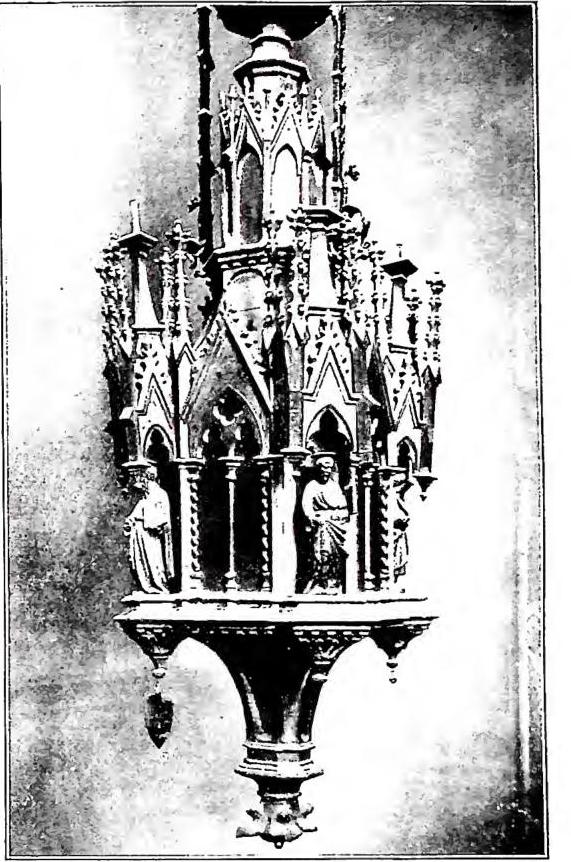
LAMPADA - Gilded wooden chandelier. Work by a Sienese artist of the second half of the 14th century - Siena, chapel of the Palazzo Pubblico.
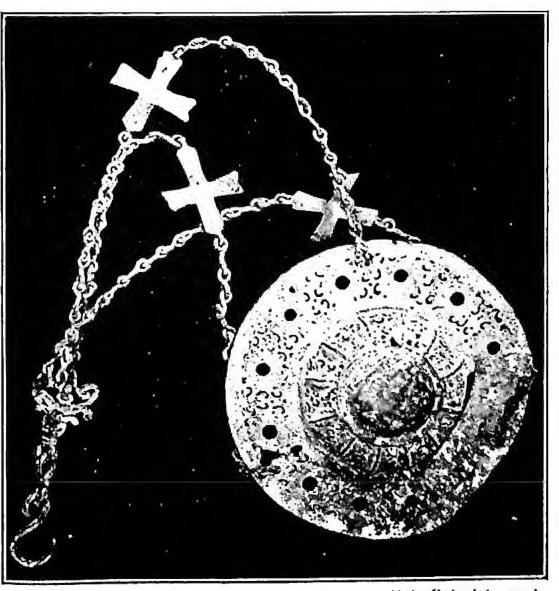
(phot. Gab. fot. naz.) LAMPADA - Lead chandelier with openwork (11th century) - Barletta, Cathedral.from Toledo (12th century) and Aachen (12th century) to those of Gothic taste with spires, pinnacles, and statuettes (Siena, Palazzo Pubblico, 14th century), and to the Renaissance examples composed of plastic or architectural elements, frequently depicted in paintings and frescoes of the 15th and 16th centuries. During the Baroque period, chandeliers decorated with crystal or blown glass, respectively produced in Bohemia and Murano, became increasingly fashionable.
In more recent times, the l. adapted to changes in the lighting system, and the ancient forms fell into disuse. - Vedi tavv. LII-LIII.
BIBL.: E.-E. Viollet-le Duc, Dictionnaire du mobilier français, Paris 1858 ff.; I. Labarte, Histoire des arts industriels au moyen-âge et à l'époque de la Renaissance, there 1887 (v. index); H. R. D'Allemagne, Histoire du luminaire depuis l'époque romaine jusqu'au XIXe siècle, there 1891; A. Melani, L'arte nell'industria, 2 vols., Milan n.d., passim; A. Pettorelli, Il bronzo e il rame nell'arte decorativa italiana, there 1926, passim; P. Toesca, Il medioevo, Turin 1927, passim; S. Aurigemma-M. Accascina, s. V. in Enc. Ital., XX, pp. 439–42. Giovanni Carandente
Cite this article
“LAMPADA.” Enciclopedia Cattolica, vol. VII (1951), p. 534. Azione Romana digital edition, https://azioneromana.com/article/lampada.