
AMPOLLA. — A small vessel with a narrow neck and a body of varied shape, intended to contain the wine and water for Holy Mass, the holy oils, aromatic essences, and similar substances.
1. LITURGY
In the first centuries of the Church, when the faithful supplied by their offerings the matter of the Eucharist, and Communion was administered under both kinds, the vessels (amae or amulae) intended for collecting the wine were fairly large: usually of silver, or sometimes of gold, at times finely chased and adorned with precious stones. In the Liber Pontificalis we have a list of these vessels which Constantine donated to the variousbasilicas. Today two glass or crystal a. are prescribed, so that their contents may be easily checked. Those made of metal are tolerated if they are precious, provided that they are clearly distinguished from one another.
For the holy oils and chrism, small ampullae or vessels with a wide opening, usually of metal, are still used.
The ampulla of Reims (the holy ampulla par excellence) is famous; according to Incmaro, it contained the chrism used for the baptism and consecration of Clodoveo, the first king of the Franks. Kept near the tomb of s. Remigio, it was destroyed during the French Revolution. Enrico Dante
2. ARCHAEOLOGY
Various types of glass, terracotta, and ivory ampullae are known, very often discovered either affixed to the sealing mortar of tombs in cemeteries(propr. Civiltà Cattolica)
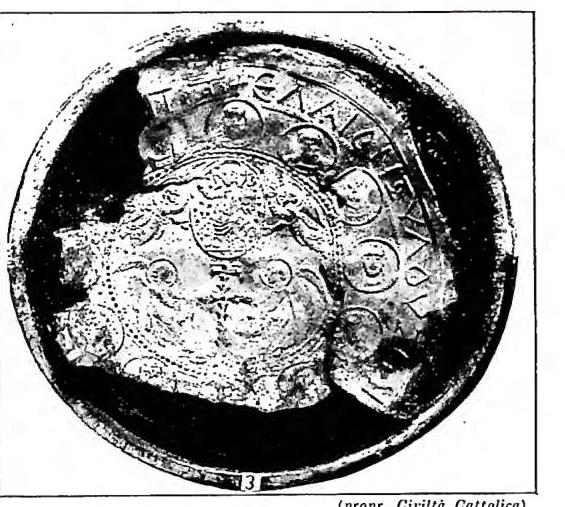
AMPOLLA - A. di stagno - Bobbio (sec. vi). Below: flowering Cross between two angels; above: the Redeemer in a mandorla against a starry background; around it: busts of the twelve apostles and the inscription: Oil of the Wood of Life, from the holy places of Christ.
underground or placed inside near the head of the deceased. The ancient scholars of subterranean Rome, such as Bosio, Boldetti, Lupi, and Marangoni, held that they had contained the blood of the martyrs (v. SANGUE), holy water, consecrated wine, and perfumes. All the a. discovered in the excavations recently conducted by the Pontifical Commission of Sacred Archaeology in the cemeteries of Commodilla, Panfilo, Pretestato, Novaziano, and the Via Latina show that they had contained oily liquid substances, the liquida odores recalled by Prudentius (PL 13, 888). In a single gallery of the cemetery of Panfilo, ten of them were found, some with the opening inclined to facilitate filling (E. Josi, Il Cimitero di Panfilo, in Riv. arch. crist., 3 [1926], p. 138).
A. of terracotta, glass, and metal were used by the faithful to carry home the oil that burned in the sanctuaries of the Holy Places and of the martyrs, or a little earth taken from those same places. The practice is attested as early as s. Giovanni Crisostomo (In Martyres homilia: PG 50, 664) and Gregorio di Tours (Miracula s. Martini: PL 71, 914 sgg., 955). In such cases the a. is called εὐλογία.
The best-known a. of this category are the following: at Bobbio, in the crypt of s. Colombano, a series of tin a. was found in 1910, decorated with designs inspired by the monumental subjects, mosaics, and frescoes that adorned the basilicas of Jerusalem, Bethlehem, and Nazareth, such as the Annunciation, the Visitation, the Nativity, the shepherds at Bethlehem, the Magi, the baptism of the Lord, Calvary, the women at the tomb, Christ appearing at the tomb, and Christ in glory.
In the cathedral treasury of Monza, 28 glass vials from Rome are preserved, containing oil collected by a certain Giovanni from the tombs of the Roman Martyrs and brought to Queen Teodolinda in the time of s. Gregorio Magno (590–604); as well as 16 metal a. for oil collected in the holy places of Palestine, likewise bearing scenes of the type found at Bobbio and dating no later than the beginning of the 7th century.
From the sanctuary of the martyr s. Menna come the numerous yellowish terracotta a. now scattered among various museums. There the martyr is depicted in military dress and with a halo, between two camels prostrate at his feet. Many bear the inscription ETÀOTIA TOY ATTOY MHNA, or O ATIOC MHNAC, or equivalent forms. In the Benedictine monastery of Farfa, a collection of 28 glass vials has been preserved since the 11th century; each is contained in a silk pouch and provided with its corresponding parchment label bearing an inscription indicating the sanctuary to which the earth collected in the various holy places of Palestine relates.