
AMPOLLA DI SANGUE. — Since the beginning of the seventeenth century, this expression and others like it have commonly been used to designate those small flasks or glass vessels, sometimes also made of terracotta, stained a reddish colour, found in ancient tombs or, more often, embedded in the mortar used to seal the loculi in the catacombs. For the excavators of the bodies of saints, and also for many learned men of the seventeenth to nineteenth centuries, they constituted the most authentic sign by which to distinguish whether a tomb belonged to a martyr or to an ordinary member of the faithful.
Yet flasks and vessels—this is now an established point among archaeologists—embedded in the walls or in the mortar of the loculi could have had many other meanings, and in particular could have served as ornaments, or to contain perfumes, or as a sign of recognition when the tomb bore no inscription. Likewise, the reddish colour could ordinarily have been produced by the oxidation of the material of the vessel itself, or of its contents—perfumes, oily substances, etc. It is certain that in antiquity the faithful sometimes boldly collected the blood of martyrs in order to preserve it among their possessions or to place it with the remains of the victims; but there is no evidence that they distinguished the tomb of a martyr from that of a member of the faithful by externally affixing to it a small flask or vessel containing their blood. Nor is there any record that the ancient investigators of the tombs of martyrs in the Roman cemeteries, from Damaso to the popes of the ninth century, ever identified a martyr’s tomb by means of such a distinguishing sign. It was created, albeit in good faith, by the seekers of the bodies of saints,
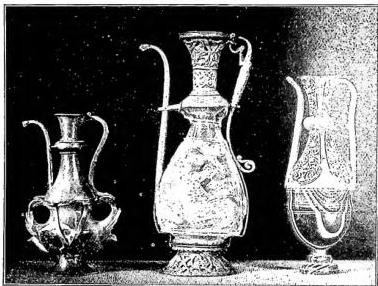
for their learning, came to establish the principle that the “blood glass” was to be regarded as the most authentic sign for recognizing the tomb of a martyr. This principle was immediately accepted in practice and then also officially sanctioned by the S. Congregation of Indulgences and Relics, on 10 April 1668, which established that « palmam et vas sanguine tinctum pro signis certissimis [martyrii] habenda esse » (cf. Decreta authentica S. R. Congregationis, II, Roma 1908, n. 3120).
The Protestants, naturally, were from the outset the most determined opponents of the a. d. s.; in Catholic circles, doubts about the contents of these a. and their probative value arose as early as the 17th century and continued to grow in the following centuries, especially after the repeated observation that the a. was very often found in tombs from the late 4th century, adorned with inscriptions that not only made no reference to martyrdom, but even seemed to exclude II. The most authoritative Catholic authors who expressed themselves in this sense are: Papebrock, Tillemont, Mabillon, Muratori, and Marini. In 1793 the abbot of S. Paolo, Giuseppe Giustino di Costanzo, put forward a new hypothesis, later taken up by Le Blant and partly also by De Rossi, according to which the a. would have contained not the blood of the Christian buried in the loculus, but that of some martyr, placed as if to guard the tomb of the faithful deceased.
Following the translation from Rome to Amiens of the alleged martyr Aurelia Teodosia (1853), the Bollandist Fr. Victor de Buck, at the suggestion of his superiors, published a study on the a. (De phialis rubricatis, quibus martyrum romanorum sepulcro dignosci dicuntur observationes V[ictoris] D[e] B[uck], Bruxelles 1855), printed in only a very few copies and not placed on the market. The author demonstrated therein that normally the a. could not in itself be a sign of martyrdom and, while granting to the a. that contained genuine human blood the value attributed to it by the S. Congregation in 1668, believed—an implausible hypothesis—that in general these a. contained remains of Eucharistic blood or, in any case, remains of the oblation. The first effect of the learned study was to bring about the suspension, through the intervention of De Rossi, who had obtained a copy, of the extraction of the holy bodies; the second was to provoke a new examination of the question by the S. Congregation of Rites. The studies collected in the ponenza published by the S. Congregation were all substantially opposed; nevertheless, apparently through the personal action of Msgr. Bartolini, secretary of the Congregation, the response given on 27 November 1863 was « non recedendum » from the decree of 1668 (Decreta authentica, II, Roma 1908, n. 3120). Characteristic was the vote of De Rossi, who, while in his writings he always deliberately refrained from entering into the heart of the question and expressed himself more freely only in private conversations, here developed at length the thesis that such a. cannot be a certain indication of the tomb of a martyr, all the more since it cannot even be said that, in general, they contained human blood. It was also through his intervention that, notwithstanding the aforesaid response of the S. Congregation of Rites, the ecclesiastical authorities of Rome continued thereafter to prohibit the extraction of the holy bodies from the catacombs (cf. Acta Sanctae Sedis, 14 [1881], p. 39); indeed, Dio X ordered one of these bodies, extracted in the 18th century with the usual a., to be returned there.
To decide the question, recourse has also several times been had, over the past century, to chemical analysis, with results sometimes positive and sometimes negative; vedi ultimamente G. De Sanctis, in Rivista di Archeologia Cristiana, 8 (1931), pp. 7–13. In any event, even if the presence of blood components, and not merely of an organic substance, in an a. were proved, this would not constitute proof of the martyrdom of the person buried there, unless other positive elements concurred in its support. Such blood, as di Costanzo thought, could at most be regarded as a relic of an unknown martyr, placed there to protect the remains of an ordinary deceased person.
Ampontes de sang, in DACL, I, coll. 1747–78, with a rich bibliography, and by G. Ferretto, Note Storico bibliografiche di Archeologia cristiana, Città del Vaticano 1942, pp. 248–68. A. Pietro Frutaz