
ANCORA. – G. B. De Rossi defined the a. as the solemn and fundamental symbol of Christian symbolism
(Bull. arch. crist., 2nd series, 2 [1871], p. 65). As a symbol of the sea, the sailor, navigation in general, and Neptune, the a. was also used on pagan monuments. On Christian monuments it expresses hope, according to the teaching of St. Paul: « fortissimum solatium habeamus [del regno dei cieli] qui confugimus ad tenendam propositam spem quam sicut anchoram habemus animae tutam ac firmam » (Hebr. 6:18–19). Vedi also St. John Chrysostom (Expos. in psal. 9: PG 55, 129; in psal. 123: PG 55, 355) and St. Augustine: « tolle spem... in Deo vivo. Ibi fige spem, ibi anchoram cordis tui, ut tempestas saeculi non te inde abrumpat » (Serm. 177: PL 33, 958).
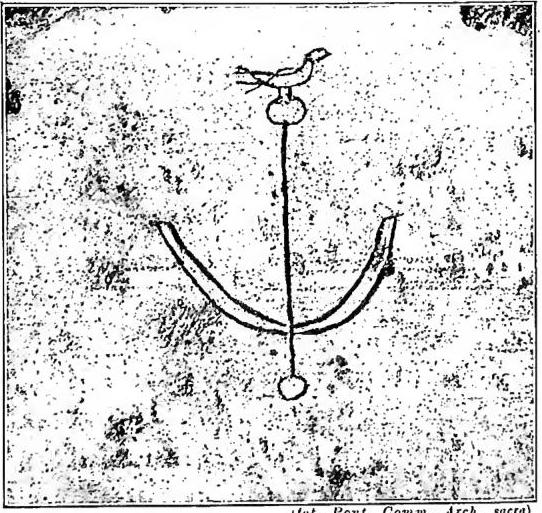
This symbol of Christian faith and hope appears on the cemetery monuments of the second half of the 2nd century and becomes frequent in the 3rd, while subsequently it rapidly disappears, remaining on objects for domestic use, especially rings and gems (Clem. Aless., Paedog., 3, 11, 59; O. Wulf, Kunst, pl. 56, 1135). The a. is used in epitaphs either alone or together with other symbols; it represents hope in Christ on a marble from Pretestato in which a P, arranged horizontally, is inserted into the a., cross (v.); it is also found together with the Good Shepherd or with the fish, the symbol of Christ. At times it seems, in its form, to display a concealed cross, precisely in accordance with St. Paul, who professes himself an apostle of Jesus Christ our hope (Tim. I, 1); in cases where the a. is between two fish, these must be recognized as the faithful, pisciculi according to Tertullian (de Bapt., 1: PL 1, 1306).
(photo Pont. Comm. Arch. secre)
ANCHOR — Tomb slab with anchor surmounted by a dove (3rd century).
Rome, Cemetery of Praetextatus.