
ANCONA and NUMANA, ARCHDIOCESE of. — The most important city of the Marches, situated on a bend of the Adriatic coast formed by Mount Conero, A. has approximately 95,000 inhabitants. It is the capital of the most populous province of the Marches (1,938 sq. km and 380,000 inhabitants) and the seat of the archdiocese, bordered to the north and east by the sea, to the southeast by the dioceses of Osimo and Cingoli, and to the west by those of Iesi and Senigallia. It has 44 parishes, 80 diocesan priests and 40 religious priests, and 118,000 Catholic inhabitants. The considerable body of Christian records, and especially their antiquity, lead one to believe that the Church of A. was the first to arise in the entire Picene region. The first historically certain bishop is St. Marcellinus (5th–6th century), since there is no similar historical testimony in favor of two martyrs venerated there and regarded as proto-bishops: St. Ciriacus, the principal patron of the city, and St. Primianus. An illustrious Anconetan bishop was Leopardo, legate of Pope Hadrian II to the Bulgarians (Liber Pontificalis, ed. L. Duchesne, II, p. 185). Martin V united the ancient Church of N. (Humana), in decline and ruinous, with that of A. (19 October 1422), and Benedict XIV granted the union in the title of both Churches. In 1907 Pius X raised A. to an archdiocese without suffragans. The territory formed part of the patrimony of the Roman Church (Liber Pontificalis, ed. L. Duchesne, I, p. 428); later, in the Constitutiones Marchiae Anconitanae of 1357, A. appears first among the Civitates maiores et magis nobiles. It experienced the rule of various lordships and, at intervals, autonomous government, until in the 16th century it was subjugated again and definitively annexed to the Papal States.
Abbeys. — Two abbeys, whose buildings partly remain, possess historical importance: S. Maria di Portonovo at the foot of Mount Conero, founded by Pietro Anconetano (1038), and the Camaldolese abbey of S. Pietro on the summit of the mountain, in the diocese of N.
Monuments. — The oldest and most impressive monument of Christian A., the basilica of the protomartyr S. Stefano, mentioned by St. Augustine (Sermo 323: PL 38, 1145–46), has completely disappeared. A highly interesting Christian hypogeum came to light in 1879: the cubiculum of Fl.
(photo Andersen)
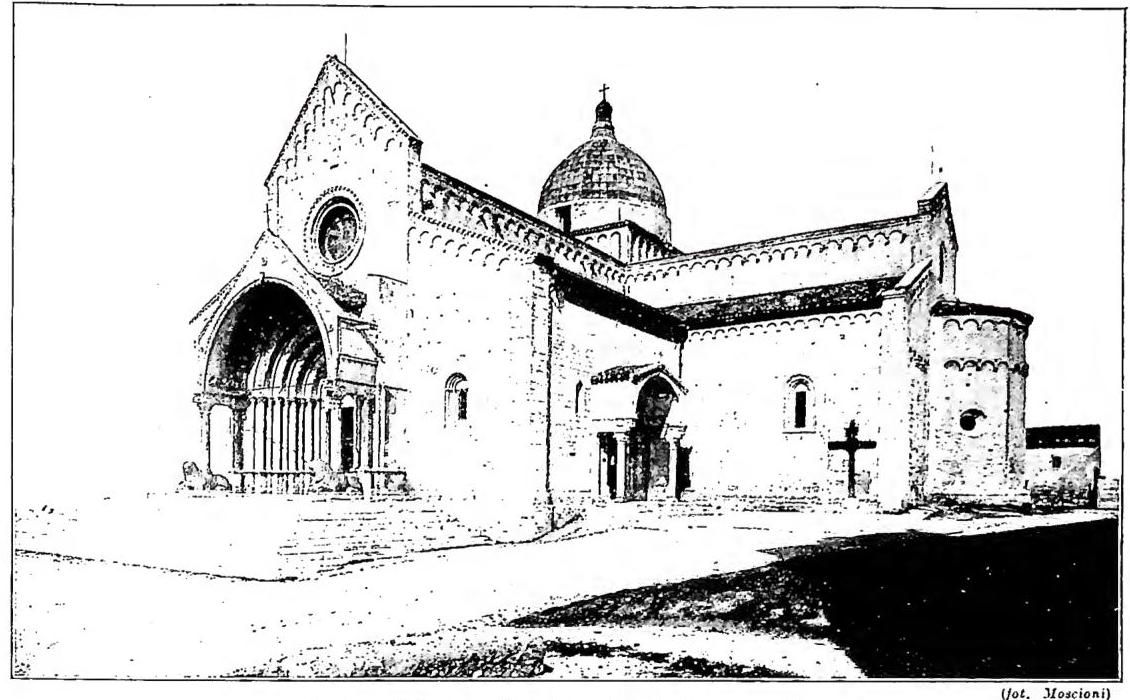
(photo Mosconi) ANCONA E NUMANA – Cathedral of A., dedicated to St Ciriaco.
Archives. – The episcopal archive has been dispersed. The chapter archive preserves, among other things, a precious Gospel book (7th–8th centuries) known as that of S. Marcellino.
Serafino Prete
A. IN CONTEMPORARY HISTORY. — The city of A., important for so many reasons, was, above all, also the first and busiest port of the Papal States, and as such was provided with well-designed fortifications, both by the Papal States and by others who subsequently came to occupy II. Ceded by the Holy See to Napoleon under the terms of the Armistice of Bologna (26 June 1796) and the Treaty of Tolentino (16 February 1797), which followed the not altogether inglorious clash at the Senio, it became part of the Roman Republic until, after a lengthy siege by the Russians, Turks, Austrians, and insurgents, it was restored to Pius VII on 5 July 1800; he had landed there on the preceding 21 June. After Marengo, the French returned (27 January 1801), and then, in July, the Pontiff returned under the concordat.
Reoccupied by Napoleon in 1805, three years later it was annexed to the Kingdom of Italy, because of the Pope’s refusal to join the Continental System. Between 1813 and 1815 Neapolitans, French, and Austrians contested A. in a succession of shifting fortunes, until Pius VII recovered it once and for all on 25 July of that year. The uprisings of 1831 were brought to an end in the Papal States by the entry of the Austrians into A.; in agreement with the government, they declared null the capitulation extorted by the insurgents from Cardinal Giovanni Antonio Benvenuti. In 1832, to counterbalance the Austrian intervention in Romagna and at Bologna, a French force landed unexpectedly at A.; it soon found itself in serious difficulties because of renewed disturbances by active innovators and because of the protests vigorously voiced by the Holy See. Gregory XVI, meanwhile, having excommunicated the revolutionaries, went so far as to send there, on 1 August, Monsignor Gaspare Grassellini as apostolic delegate; through prudent measures he restored order and was able to return the military works of the stronghold to an efficient condition.
As a result of the events that followed the reforms of Pius IX and his departure for Gaeta, A. became the scene of such and so unheard-of violence that the government of the Roman Republic was prompted to send Felice Orsini there to remedy the situation with some effectiveness. Livio Zambeccari subsequently contested the city with the Austrians, who besieged it by sea and land between 28 May and 18 June 1849, with the aim of restoring it to the Pontiff; afterward they maintained a garrison there for a decade, considerably improving its fortifications and striving, together with the governmental authorities, to thwart the plots promoted there, among others, by the Società Nazionale. Pius IX, acclaimed with great enthusiasm, stopped there during his triumphal journey through the provinces (22–25 May 1857), decreeing important public works, such as a new circuit of the city walls and further impetus toward completing a substantial arsenal, in addition to
After the Austrians departed from A. on 12 June 1859, following the progress of the Franco-Sardinian forces in Lombardy, the Papal government was able to maintain its position there, thanks to the cool-headedness of the apostolic delegate, Mons. Lorenzo Randi, the insight of General Allegrini, the firmness of Major Zappi, and the repressive action undertaken with a substantial force of troops by General Schmidt, who occupied Perugia (20 June), and by General De Kalbermatten, who marched from Pesaro with several thousand men towards Fano and Senigallia and arrived there on the 25th of the same month. Finally, on 25 March 1860, General Alfonso De Lamoricière landed in A., having been summoned by Pio IX to reorganize the Papal army; he remained there for a long time during the fervent and industrious months that followed, also intending, insofar as possible, to place it in a condition to offer effective resistance. Thus, after the battle of Castelfidardo (18 September 1860), Lamoricière, accompanied by a few courageous men, succeeded, not without skill, in withdrawing into the city and holding it tenaciously, coming to terms, after an honorable defense marked by valorous actions on both sides, only when, in addition to everything else, the powder magazine exploded on 29 September. A. was thus definitively united with the new kingdom. - Vedi Tavv. XCVIII-XCIX.