
OSIMO AND CINGOLI, DIOCESES of—United dioceses, the former in the province of Ancona, the latter in that of Macerata.
Osimo has an area of 150 sq. km. and a population of 44,515 inhabitants, all Catholics; it has 28 parishes served by 67 diocesan priests and 27 regular priests; it has 5 male and 15 female religious communities.
Cingoli has an area of 105 sq. km. and a population of 13,000 inhabitants, all Catholics; it has 11 parishes served by 24 diocesan priests and 14 regular priests; it has 2 male and 3 female religious communities. (Ann. Pont., 1952, p. 304).
In the Acts of s. Antimo (BHL, 361), the Osiman martyrs Sisinnio the deacon, Diocleziano, and Fiorenzo are mentioned; but, on the more reliable testimony of the Hieronymian Martyrology and of the later local cult, Fiorenzo and Diocleziano are regarded as authentic martyrs of O. (L. Allevi, Origini cristiane delle Marche, in Atti e memorie di Deput. di St. patr., 5th series, 2-3 [1938], p. 257). The episcopal see is attested as having long been vacant, diu pastorali
Statuti comunali. Un documento osimano del sec. XIV, in Studia Picena, 1 [1925], p. 74); Vitaliano is mentioned in an epitaph set into the crypt of the Cathedral (8th century), and the urn of s. Benvenuto, bishop (1364-82), is preserved. The chronology of the bishops of O., full of major gaps for the more ancient period, becomes complete and reliable after the 10th century. During the struggle against Nicolaism and the investiture, the city was disturbed by popular uprisings, against which Pope Leo intervened with a letter addressed omnibus Auximianis clero et populo.
(photograph Allevi)
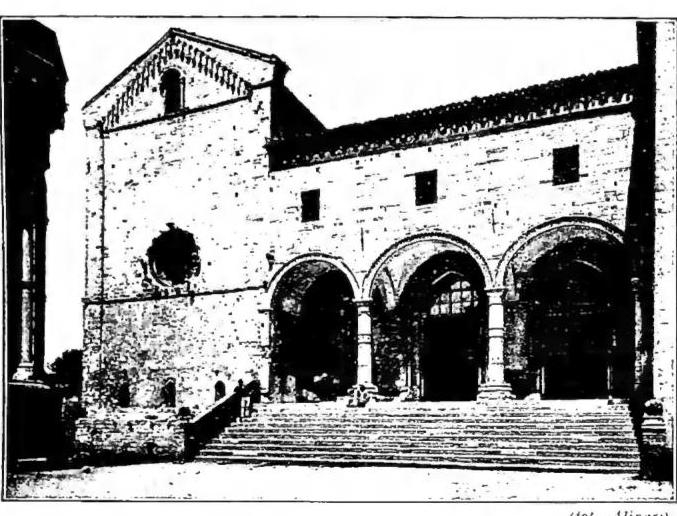
OSIMO AND CINGOLI, DIOCESES of—Entrance portico on the left side (early 13th century)—Osimo, Cathedral.
IX (cf. S. Prete, S. Pier Damiani, le chiese marchigiane, la riforma nel sec. XI, in Studia Picena, 19 [1949], pp. 123-24); to Bishop Gislerio (1022-57), who was said to be guilty of horrible crimes, Damiani wrote urging him to repent, and, when he had returned to better counsel, addressed one of his treatises to him (Epist., 4, 4: PL 144, 299; Opusc. 16: PL 145, 366-80). In the 12th century the best-known bishop was Gentile (1177-1205), who carried out pacifying work in the region, transferred the bodies of the martyrs Vittore, Filippo, and Corona to O., and undertook work on the Cathedral.
Under Bishop Rainaldo, in 1240, the episcopal see was suppressed by Pope Gregory, because the city had declared for Frederick II, and was subjected to Recanati; on 28 February 1264 Urban IV restored II. Bishop Bernardino de Cupis (1547-74) participated in the Council of Trent and supervised the implementation of its decrees in the diocese; this work was continued by his successor Cornelio Fermani (1574-88), who convened a synod and founded the Capuchin convent. Later, the following figures distinguished themselves: Agostino Galamini O. P., Master of the Sacred Palace and Minister General of the Order, made a cardinal in 1611, transferred from the Church of Recanati to this one of O., which he governed for 19 years (1620-39); he made several visitations and held three Synods (1624-27-30); and Cardinal A. Bichi, who summoned the Oratorian fathers to O. and invited the well-known quietist Fr. Giacomo Lambardi to direct the nascent oratory (1672). Benedict XIII, restoring the diocese of C., united it aeque principaliter with O. Among the holders of the two united churches, Pompeo Compagnoni (1740-74), author of erudite historical memoirs concerning the diocese and the region, and Cardinal G. A. Benvenuti (1828-38), papal-government legate during the uprisings of 1831, should be remembered.
The city of O., having offered itself to Pope Hadrian I (Lib. Pont., I, p. 496), belonged from the 8th century onward to the Papal States, but the fluctuating fortunes of the later struggles between Church and Empire pushed O. toward the Ghibelline side; during the siege of Ancona in 1172 it assisted the imperial forces of Cristiano of Mainz and, because it had sided with Manfred, was deprived of its episcopal see in 1240 until 1264. In the 14th century it submitted to an autonomous government by local lords (the Guzzolini and Sinibaldi), managing to attain peace only with Cardinal Albornoz (1368). Having fallen under the lordship of Francesco Sforza (1433), it freed itself and returned to the Holy See, to which it remained subject until the annexation of the Marches (1860).
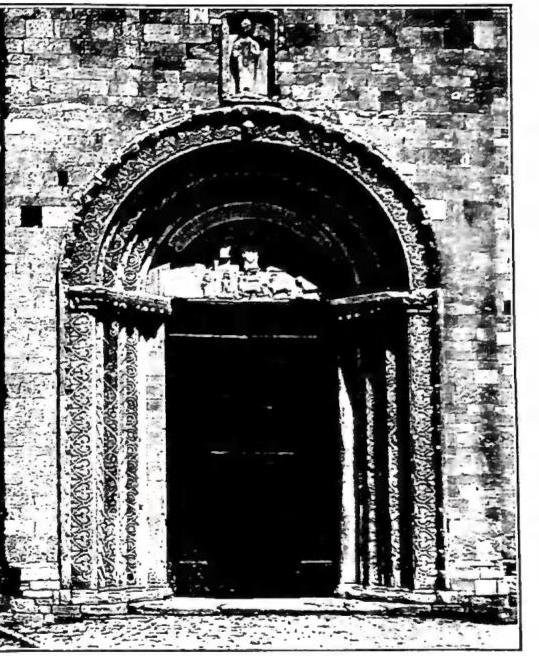
Monuments. – Cathedral: notable elements are attributed to a pre-Romanesque construction dating approximately from the eighth century, in the time of Bishop Vitaliano; but the present form of the entire building is Romanesque in structure. Pope Leone IX is said to have consecrated it in 1053 and dedicated it to s. Leopardo. The monument, in its present form, appears to be attributable to Bishop Giovanni (1295–1320). Characteristic is the entrance portico on the left side, with three arches and three portals; plastic decorative motifs are found in the apse and transept. The interior is Gothic, with vaults and a groined ceiling dating from the sixteenth century. The crypt is the most interesting part of the monument: formed by 3 transverse and 7 longitudinal little naves, it contains numerous examples of capitals and material of Roman origin. Bishop A. Ugolini Sinibaldi had the body of s. Leopardo, discovered in 1296 (incentio), entombed in an artistic altar in 1513, and also transferred to the crypt the remains of s. Vitaliano and of the martyrs of O.; the latter are preserved in a sarcophagus from the fourth century, with hunting scenes on the front and Christian figures on the upper section: the Adoration of the Magi, Noah in the ark, etc. (C. Costantini, Il duomo di O., in Rassegna marchigiana, 3 [1925], pp. 283–91; id., I restauri del duomo di O., ibid., 4 [1926], pp. 117–27). Attached to the episcopal residence is the Baptistery, where one may admire a bronze baptismal font by Tarquinio and P. Iacometti of Recanati (1627). Basilica of S. Giuseppe da Copertino: the church and convent of S. Francesco are securely attested in 1247, and some structures of the present church, such as the apse, tower, and right side, belong to that period. From 1657 s. Giuseppe da Copertino resided there; he died there, and, having been canonized by Clement XIII on 16 July 1767, he has continued to receive a cult in O. to the present day. The restored church was consecrated and dedicated to the new Saint on 27 May 1781 by Bishop Cardinal G. Calcagnini, and was declared a basilica by Pius VI on 20 January 1796 (anon., Convento di S. Francesco e basilica di S. Giuseppe da Copertino, in Picenum Seraphicum, 2 [1916], pp. 186–213, 439–48). S. Niccolò: former church, Romanesque, with a fine portal decorated in the Gothic style (thirteenth century); a Gothic aedicule preserves frescoes of the Bolognese school from the fourteenth century: eight Doctors on the vault, and on the walls the Crucifix and scenes from the life of the Virgin. In the territory of O. there is a Marian shrine at Campocavallo, a recent building in neo-Lombard style begun in 1892 by Bishop E. Mauri and completed by Bishop P. Fiorani (1916–24). Treasury: the Cathedral preserves a repoussé silver plaque (32 x 12 cm.) depicting the bishop standing with pallium and nimbus, together with the inscription SCS Leopardus, dating from the eighth or ninth century. The Curia Archive preserves documents dating from after the thirteenth century (1202); the Municipal Archive, rich in documents of monastic provenance, was reorganized by A. Zonghi (Relazione sull'ordinamento dell'antico Archivio comunale della città di O., Fano 1883).
C. – The episcopal see of C. has an ancient origin. Bishop Giuliano of C., who accompanied Pope Vigilius to Constantinople for the Council of 553 (Mansi, IX, 353–59), is the first mentioned in the documents, whereas Teodosio and Esuperanzio belong to an ancient period that cannot be determined because of the legendary character of the Vita s. Esuperantii (BHL, 2808). After the episcopal see had been extinguished at an unknown date, C. was placed under the diocese of O.; only in 1725 was it restored by Benedict XIII, who united it to that of O. aeque principaliter. It may be recalled that C. was the birthplace of F. Saverio Castiglioni, who became Pope Pius VIII (31 March 1829–30 November 1830).
Monuments. – C. contains a fine group of monumental churches from the Romanesque-Gothic period of the fourteenth century, among which the following may be noted: S. Esuperanzio, with an artistic portal (1295); S. Domenico, which preserves the Madonna del Rosario by L. Lotto (1539); S. Giacomo; S. Filippo; and S. Anastasia, where there are valuable frescoes (fifteenth–sixteenth centuries).
BHL: Lanzoni, I, 387, 389. P. F. Kehr, Italia Pontif., IV, Berlino 1909, pp. 206–211; Cappelletti, VII, 482; F. A. Zaccaria, Auximatium episcoporum Series, Osimo 1764; F. M. Rafaelli, Dissertazione dell'origine e de' progressi della chiesa vescovile di C., Pesaro 1769; P. Compagnoni, Memorie critiche della Chiesa e dei vescovi di O., opera postuma con note di F. Vecchietti, 5 voll., Roma 1782–83; L. Serra, L'arte nelle Marche, Pesaro 1929. Serafino Prete