
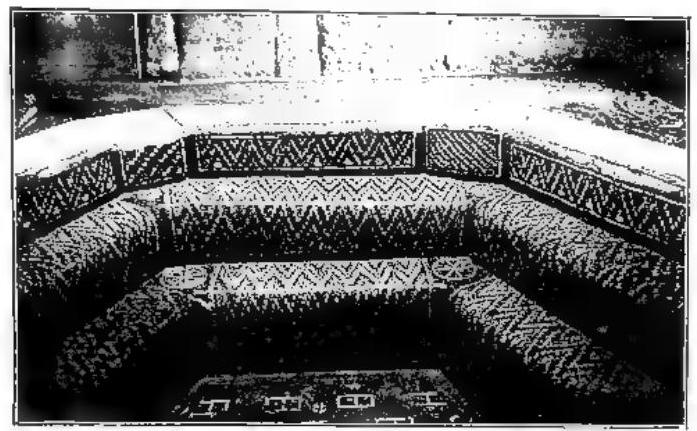
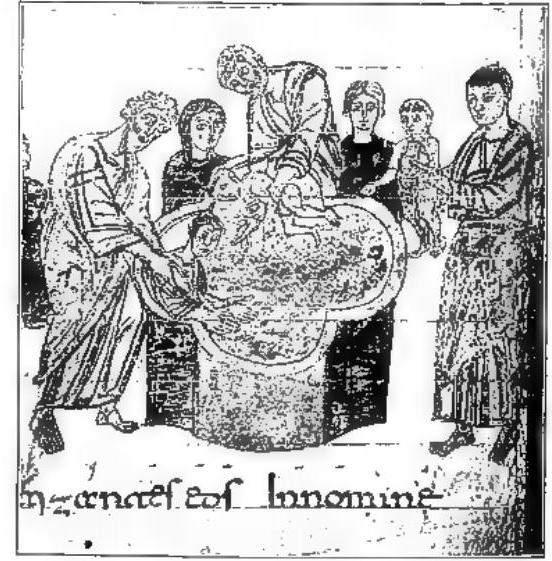
FONTE BATTESIMALE. – In Christian antiquity, when the Sacrament of Baptism was administered by immersion, the f. b., generally enclosed in baptistery (v.), consisted of a basin that assumed the most varied forms, namely: rectangular, hexagonal, octagonal, circular, cruciform, and even boat-shaped. It was usually constructed with its upper rim at floor level and had a depth of no more than 75 cm.; it was entered by means of two, or more commonly three, steps, and rarely four. The water generally did not exceed 30 cm. in depth; all of them have an outlet for the water, and some also an inlet, which in monumental baptisteries was supplied by deer, lambs, etc.
The walls of the basin were lined with marble slabs or mosaics. Such were the ancient baptismal basins found in Rome (S. Marcello and S. Crisogono), at Grado, at Burrinto in Albania, and the very numerous ones in Roman Africa, as well as the one recently found at el-Ma'mudijjeh, west of Hebron.
(for the portfolio of Prof. E. Joni)
FONTE BATTESIMALE – Baptismal font with changing ornamentation (5th–6th century) – Timend.
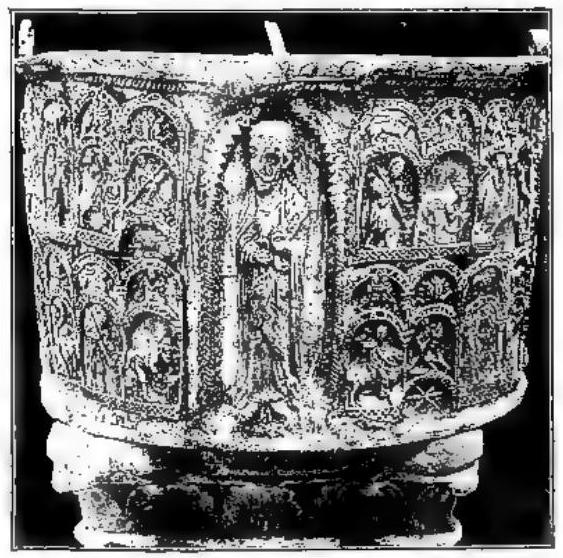
At whose centre there often rose a small pillar with a reservoir for the water and a statuette of the Baptist, and which could serve both for immersion and for baptism by infusion. Examples of this type are the font of S. Giovanni in Verona, datable to around 1200, decorated with eight scenes from the New Testament carved on the slabs of the polygonal basin and attributable, in part, to the art of Brioloto; and that of S. Frediano in Lucca (late 12th century), whose circular basin was adorned with stories of Moses by a master Roberto who recalls, « in plastic solidity and robust simplifications » (Toesca), Lombard sculpture. This proves that baptismal fonts too had, from that time onward, become a genuine sculptural object, comparable to the most famous ambons and pulpits. That the practice of baptism by immersion continued also during this period is attested by Dante’s verses referring to the font of the Florentine Baptistery (destroyed by Bernardo Buontalenti in 1577 and recently reassembled), consisting of an octagonal parapet, at the centre of which was a square enclosure adorned with Romanesque panels, with a basin-like well at each corner, one of which Dante is said to have broken, as he relates (Inf., XIX, 16–21), in order to save « un che dentro v'annegava ». In the same Baptistery of Florence, on the second side to the right, there is instead the beautiful marble baptismal font (1370), a work of the 14th century, with six bas-reliefs relating to baptism and probably executed by Venetian sculptors. A characteristic example of the Gothic period is also that of the cathedral of Orvieto, octagonal and with the large red-marble basin supported by eight crouching lions, while above it the cover is surmounted by the statuette of the Baptist. It is well known that the construction of a special building, the baptistery, for the administration of Baptism definitively ceased in the 14th century; in some baptisteries, however, baptismal fonts placed there during the Renaissance period are also found, such as that of the baptistery of Siena, with a hexagonal basin and scenes carved by Ghiberti, Donatello and Jacopo della Quercia, at whose centre rises Jacopo’s beautiful tabernacle, with statuettes of prophets within niches and crowned, as usual, by the statue of the Baptist. In the Renaissance font of the cathedral of Pienza, the basin, raised above the ground, has by then taken on the proportions of a large cup, to which the square tabernacle crowned by a cusp, upon which rests the statuette of the Precursor, is joined by means of a double motif of acanthus leaves. Once the rite had changed and the proportions of the font had diminished, it was natural that, no longer requiring a separate building, it should find a place in the church—as has been seen in some of the examples mentioned above—in a secluded location, generally near the entrance. With the spread of the use of side chapels, the baptismal font eventually came to occupy one of these chapels, which was often adapted and transformed in accordance with its new purpose. This transformation is especially noteworthy
in the Baroque period, during which the sculptural ensemble of the font becomes an integral part of the chapel’s architecture: a typical example is that of the basilica of S. Pietro in Rome which, placed in a chapel designed by Carlo Fontana, consists of a large block of porphyry covered with figured and gilded metalwork based on a design by Fontana himself. Another fine example of a Baroque font is the bronze one in the cathedral of Osimo, executed in 1610 by P. P. Jacometti, with the massive tabernacle supported by the sturdy haunches of four « tori romani ». For the modern period, one may mention the font of the basilica of S. Maria Maggiore in Rome, the work of Giuseppe Valadier, who completed it in 1826.
(Int. Enc. Catt.)
BAPTISMAL FONT - Baptism by immersion in a cruciform basin. Detail of a miniature in the Pontificale of Landolfo I of Benevento (057-84) - Rome, Biblioteca Casamantea 724. B - I - 13.
It was subsequently fused with the preceding one so as to serve two purposes. The Coptic ritual begins with a very ancient prayer for the consecration of the water and oil, followed by another, an expansion of that preserved in the «Testamentum Domini». In addition to the Coptic formulary (excluding the Trisagion, interpolated at a later date), introduced after the thirteenth century, the Ethiopian ritual also contains the two aforementioned formulas, antecedent to 381 (though with the pneumatological expansion), together with a prayer proper for the blessing of the baptismal water and oil. 2) In the West there are the Roman and Ambrosian formularies. According to Scheidt, these would be two independent translations of a text in another language, perhaps Syriac. Milan, however, may have received it directly from the East on account of their mutual relations, including in the liturgical sphere: the formula is in fact more complete, with mention of the Syrian Naaman and the pool of Siloam, absent from the Roman formulary because they were unfamiliar to the Latins. Rome, although a derivation from Milan cannot be excluded, seems more probably to have received it from North Africa.
After an introductory collect, the consecratory anaphora of the sacred baptismal waters follows (there is no doubt that, in its structure, the anaphora was intended to imitate the Eucharistic anaphora). After its first section, the priest divides the water in the form of a Cross, as though to fecundate it through contact with his consecrated hands, just as the Spirit of God (Gen. 1) once hovered over the waters of chaos. After another passage, the priest lays his hand upon the water as if to exorcise it; three signs of the Cross in the water then follow, recalling the river that flowed from Eden and was subsequently divided into four branches. Then comes another passage of the anaphora, after which the priest breathes three times, always in the form of a cross, upon the water, to purify it; finally (according to a rite that appeared at Rome around the eighth century), he immerses the previously blessed Paschal candle three times in the baptismal font, concluding the anaphora with the words: «May the power of the Holy Spirit fill this font and confer upon the water the efficacy of regeneration (for souls). Here let every stain of sin be effaced; here may nature, created in your image and thereby restored to the glory of its Creator, cast off its former squalor, so that all who enter this font of sacramental regeneration may be reborn to a new and truly innocent childhood».
(phot. Anderson)
BAPTISMAL FONT - F. b. in the Liberian Basilica. Work of L. Valadier (1821) - Rome, basilica of S. Maria Maggiore.
and the chrism (a non-ancient rite, introduced when, with the disappearance of adult catechumens, the special significance of the oil intended for them also became somewhat confused), to express the Grace of the Holy Spirit that makes fruitful those waters now ready for Baptism.
The Roman Ritual, in giving prescriptions for the baptistery, does not have the ancient building in mind but almost exclusively the f. b., for which it gives special regulations. It is customary today to place it in the first chapel on the left, where tradition locates darkness and sin; against these, therefore, the f. b. rises, from which light and Grace spring forth. S. Carlo (Instruct. fabricae ecclesiae, 18) makes this obligatory. Already in ancient times, a dove was placed above the f. b. (cf. Lib. Pont.: Pope Hilary, who died in 468, concerning the Lateran baptistery; Manai, VIII, 1037, for Antioch in 518), symbolizing the Holy Spirit who appeared during the baptism of Jesus and who is mystically present to make fruitful the waters of the sacred f. b. In the Middle Ages it was prescribed that the f. b. be covered with a red silk covering, later predominantly white, which is still used although the Ritual contains no such prescription.
The Ordo Romanus of S. Amand (L. Duchesne, Origines du culte chrétien, Paris 1925, p. 492), the Gregorian and Gelasian Sacramentaries, and Amalarius (PL 105, 1295) note that, once Vespers of Easter and of the Octave had ended, everyone made a procession ad fontes, undoubtedly with the purpose of meditating on the greatness of the Sacrament received there. In Rome this ceremony continued until the thirteenth century, but in Germany, in many places, until the last century, and it is still practised in Paris. The Ambrosian rite prescribed this procession after Lauds and Vespers each day; the relevant formulas have been preserved, but the procession takes place only at Easter and Pentecost and on the two days following each solemnity.