
FONTE AVELLANA. - The hermitage of S. Croce di F. A., beneath Monte Carria (Marche), is described by Dante (Par., XXI).
The date of its foundation is uncertain: Grandi favors the year 979; Mittarelli, 977.
The first papal document in favor of F. A. dates from Sylvester II in 1003. The original construction was eremitical: some cells with the small church and other rooms indispensable to the life of hermits. S. Pier Damiano was responsible for the construction of the small cloister, part of which has survived, from the primitive cenobium, and of the church, enlarged in 1171 and in the 13th century, in the Romanesque style with slightly Gothic arches, consisting of a single nave, with a raised presbytery where three altars from the 12th and 13th centuries are still preserved. In 1795 it was covered with stucco and plaster, and in 1940 restored to its original state, with some reconstruction in local stone.
The Chapter house, also Romanesque, dates from the 12th century, and the guest hall from the 13th century. The latter, of original architectural design, with two tiers of windows, awaits liberation from the superstructures added in the 1700s.
The library was begun through the work of S. Pier Damiano, who in Op. XIV gives a list of the books he himself purchased. The legal collection that took the name of the “Avellana Collection” has remained famous. The exceedingly rich archive is almost entirely preserved in the Vatican Library. Only a few documents, together with some valuable codices, have remained at F. A. The treasury was largely constituted by the offerings of Emperor Frederick (1177). The inventory of precious objects from 1425 is imposing, but they gradually perished through the action of the commendatory abbots. Worthy of note is the Byzantine staurotheca brought to F. A. from Venice by Cardinal Zurla in 1833.
From the beginning F. A. enjoyed exemption. S. Gregory VII, out of regard for his friend S. Pier Damiano, placed it under the protection of the Holy See. It grew into a Congregation with him, eventually having under its authority more than 100 churches and monasteries. It declined in the 14th century, and in 1325 the hermitage was transformed into an abbey. In 1569 it was subjected to the Prior General of Camaldoli. Despite the suppressions of the last century, it is now being reborn to new life.
F. A. originated as a hermitage according to the direction of S. Romualdo, bearing the personal imprint of S. Pier Damiano. Its life was one of almost uninterrupted prayer, penance, fasts, vigils, hair shirts, disciplines, metanoias, solitude in the hermit cells situated at a distance from one another, and apostolic zeal.
More than the other Romualdine hermitages, F. A. constituted a reaction against the ecclesiastical and monastic decadence of the time. Without renouncing the Benedictine Rule, it accepted its spirit and integrated its practice with the principles of Eastern monasticism in a cenobitic-eremitical synthesis in which the individual’s personality found its full spiritual expression.
Its organization therefore aimed at forming hermits and establishing independent hermitages, detaching them from the monasteries or making the latter serve the former within a congregational system or one of simple mixed communities, according to circumstances. The influence exerted by F. A. was enormous: on the Gregorian reform, on moral conduct, on the education of the clergy, on the use of property, which was accepted and then granted to the poor in emphyteusis for a nominal sum, and on the spiritual life, restored to its heights in the fundamental concepts of expiation for sin and contemplation of the mysteries of Christ, of spiritual fraternal charity (years of penance) for the dead and bodily charity for the living. It prepared and helped construct the rebirth of the 13th and 14th centuries, including the spirituality of the mendicant Orders.
Guido Monaco (1050), in all probability, lived and died at F. A.; S. Ubaldo frequently resided there. Fifty-four bishops and approximately seventy-six men renowned for holiness emerged from F. A., among them S. Giovanni da Lodi (1105), S. Raniero (1180), S. Rinaldo (1225), and S. Albertino (1294).
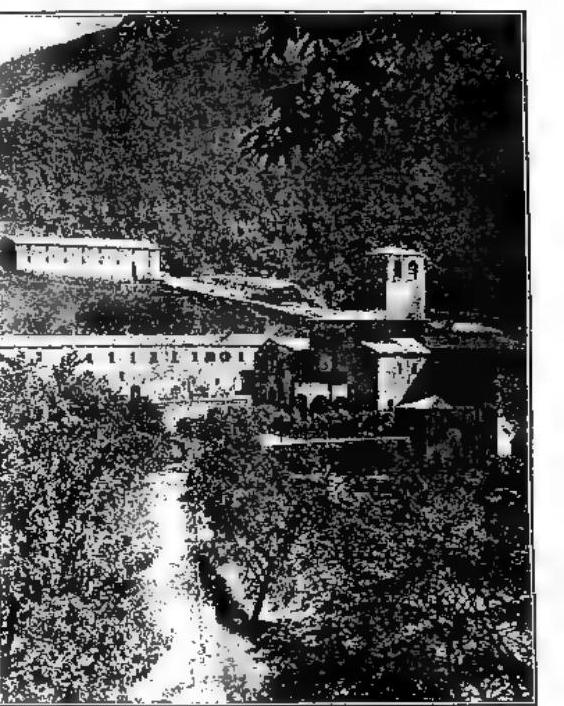
(fol. Marconi - Genova)
FONTE AVELLANA - Panorama - Serra S. Abbondio (Pesaro).
PL. 144, 17-88; Joannes a Laude, Vita s. Petri Damiani, ibid., 114-46; G. B. Mittarelli and A. Comodoni, Annales Camaldolensis, 9 vols., Venezia 1755-75; A. Capecchi, Storia di s. P. Damiano e del suo tempo, 2 vols., Firenze 1862; F. Tarducci, Dante e la badia di F. A., Perugia 1921; G. Vitaletti, La biblioteca di F. A., Roma 1925; Cortineau, I, cols. 1170-80; A. Giabbani, L'Eremo, Brescia 1945; id., Camaldolesi, Camaldoli 1944 (with extensive bibliography); id., Menologio camaldolesi, Roma 1950.