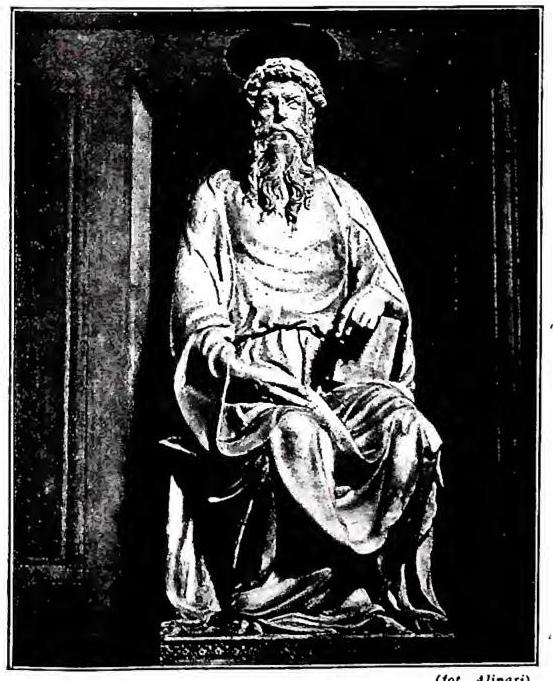
DONATELLO (DONATO di NICCOLÒ de' BARDI). — Sculptor, born in Florence in 1386, died there in 1466. Alongside Brunelleschi, the architect, and Masaccio, the painter, he was the creator of the new artistic humanity of the early Renaissance. An apprentice in Ghiberti’s workshop from 1403 to 1407, and subsequently Nanni di Banco’s fellow worker, D. was formed in a profoundly Gothic environment, although one rich in talent and already stirred by tremors of renewal. His earliest works (Prophet on the right of the “mandorla” doorway in Florence Cathedral and its “pendant” in Paris [1406–1408], David in marble at the Bargello [1409], St. Mark of Orsanmichele [1411], St. John the Evangelist in the Cathedral [1413–15], etc.) clearly show the signs of a prodigious effort to free the vision of a heroic humanity from traditional Gothic stylistic formulas
and feverishly alive: occasional references to antiquity do not signify a humanistic nostalgia, but a return to the sources of the freshest expressive immediacy. This formative phase concludes with the St. George of Orsanmichele (now at the Bargello), where the Gothic meandering of the line has been translated into the utterly new language of that sweeping spiral of the cloak which, imparting an intense energy of sudden movement to the figure, arrests its motion by anchoring it to a clear spatial volume. But this is a momentary equilibrium, attained almost on a razor’s edge; immediately afterward, in the statues for the campanile (from 1415 to 1430 and beyond) and in other contemporary works, D. achieved effects of great dramatic power, excavating and corroding the surfaces in a vision of intense human depth.
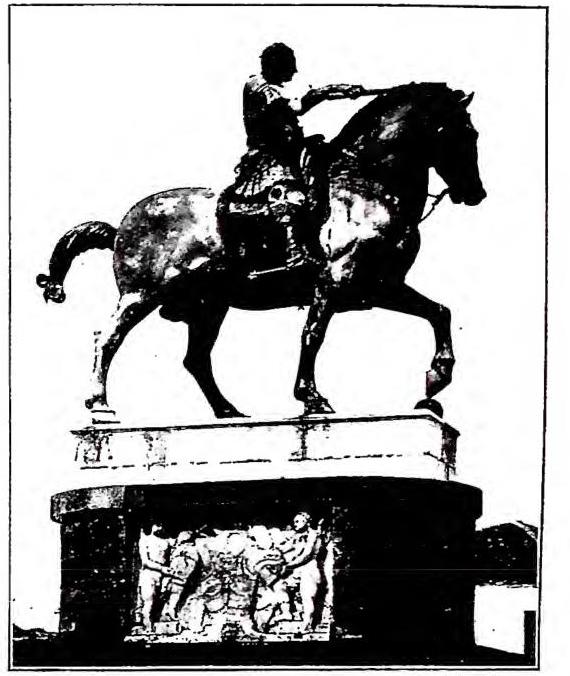
Meanwhile, in the statuettes and relief executed for the baptismal font of Siena (1423–29), in the Assumption of the Brancacci monument in Naples (1427), in the bronze statues of the David and the Amore-Atys at the Bargello, in the pulpit of Prato (1428–38), and in the singers’ gallery of Florence Cathedral (1433–39), light became the protagonist of the style, at times articulating perspective with its gleams, at times modelling the plastic form of the nude, and always transfiguring naturalistic or classicizing elements (D.’s journey to Rome in 1433 is documented) into an expression of great spiritual depth, variously accentuated: now toward the melancholy and contemplative, now toward the dramatic, now toward the exaltation of an unrestrained vitality (occasionally somewhat obscured by the collaboration of Michelozzo). The bronze doors and terracotta roundels of the old sacristy of S. Lorenzo are among the highest achievements of this Donatellian “expressionism,” which dissolves all corporeality into a harmonious vibration of lines and light, and every spatial definition into the hyperbole of a marvelous perspectival illusionism. From 1443 D. was in Padua, where in the statues and especially the bas-reliefs of the altar of the Saint he achieved, through an exceptionally fluid and impassioned treatment of light, accents of intense tragedy. The equestrian monument to Gattamelata (1447–53),
DONATELLO — S. Giovanni Evangelista — Florence, Church of S. Maria del Fiore.
DONATELLO - Monument to Gattamelata - Padua.
Although apparently serene and inspired by the Roman Marcus Aurelius, it rests stylistically upon an extremely precarious equilibrium; it is a structure of pressing rhythms, of surfaces quivering in the light, eroded and hollowed out, held together by a line entirely under tension.
In the works executed by D. after his return to Florence in 1453—the Magdalene in the Baptistery, the group Judith and Holofernes in the Palazzo Vecchio, the St John the Baptist of Siena Cathedral, and the two wooden pulpits, executed with extensive assistance from pupils, in S. Lorenzo—the dramatic luminism established in the Paduan works is still present, but more concentrated and turned inward. Thus, as has been said, Florentine society, which was by then developing the serenely humanistic ideals of what would become the age of Lorenzo il Magnifico, had to read in these final works of the great master a stern admonition, almost a “memento mori.”
D.’s artistic trajectory is among the most complex and most difficult to define in a single formula: and in conclusion it can only be said that the exceptional fervor of his genius, anxious for continual transcendence, ultimately destroyed its own achievements, presenting itself at once as the founder and, at least potentially, the subverter of one and the same great civilization: that of the fifteenth-century Renaissance. - Vedi tavv. CXIII-CXIV.