
Gioteschi

GIOTTESCHI. — Up to the beginning of this century, this term designated more or less all the Florentine painters of the fourteenth century. Today, with the progress of scholarship, the term has become restricted to the collaborators and followers of Giotto active between the end of the thirteenth century and the middle of the fourteenth.

Among the painters of the older generation, who graft Giottesque elements onto archaizing experiences and are sometimes called “paragiotteschi,” apart from the almost legendary Buffalmacco, the MAESTRO DELLA S. CECILIA (named after the eponymous panel in the Uffizi) stands out for his freshness. He collaborated on the Assisi cycle, executing the last three scenes and, from a design by Giotto, the first. Inferior to him is PACINO DI BUONAGUIDA, whose style is meticulous and miniature-like.

The exquisite MAESTRO DI FIGLINE is partly dependent on the Maestro della S. Cecilia; among other works, he painted the Assunta in S. Croce, often attributed to Giotto. In the lower church at Assisi, during the first decade of the fourteenth century, worked the MAESTRO DELLE VELE, whose mediocre Franciscan allegories long usurped Giotto’s name, and other anonymous artists, among whom the supposed STEFANO excels, the author of the Storie di S. Stanislao, already wholly imbued with Sienese colourism. From Stefano descend, on the one hand, the great MASO DI BANCO, and on the other, the probable GIOTTINO (Stefano’s son), that is, the author of the splendid Pietà of S. Remigio in the Uffizi and perhaps of an Assunta (destroyed in the last war) in the camposanto of Pisa and of frescoes
Article illustration
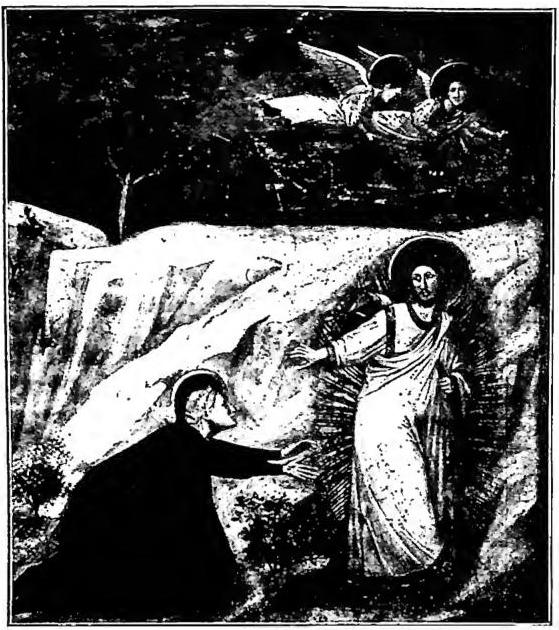
(photo: Gab. fot. nac.) GIOTTESCHI — Noli me tangere. Master of the Magdalene Chapel — Assisi, lower church of S. Francesco.
at Milanese Chiaravalle (from which, in the second half of the century, Giovanni da Milano would descend). In the same lower church of Assisi, the most faithful, though not ignoble, Giottesco is the MASTER OF THE MAGDALENE CHAPEL. Among the painters known by name, DADDI (v.) belong to the ranks of the Giotteschi, although the former is archaizing and the latter strongly influenced by Siena; and, by virtue of his documented discipleship under the master and honest fidelity as a follower, GADDI (v.) also belongs to them. — Vedi tav. XXXVII.

BIBL.: Venturi, V, 453 ff.; P. Toesca, La pittura fiorentina del Trecento, Bologna 1929, V. indice; M. Salmi, R. Offner, Studies of Florentine Painting (review), in Rivista d'arte, 2nd series, 1 (1929), p. 133; R. Offner, Corpus of Florentine Painting, 5 vols., Nuova York 1931 (the work continues), V. indice; A. Parronchi, Il Maestro della S. Cecilia, in Rivista d'arte, 2nd series, 2 (1939), pp. 193-228; R. Longhi, Fatti di Masolino e Masaccio, in Critica d'arte, 5 (1940), p. 180; G. Sinibaldi-L. Brunetti, Pittura toscana del Duecento e Trecento, Firenze 1943; A. Graziani, Affreschi del Maestro di Figline, in Proporzioni, 1 (1943), pp. 65-79; L. Coletti, I primitivi, II, Novara 1946; R. Longhi, Giudizio sul Duecento, in Proporzioni, 2 (1948), p. 50; L. Coletti, Gli affreschi della basilica di Assisi, Bergamo 1949.

Roberto Salvini

Cite this article

“GIOTTESCHI.” Enciclopedia Cattolica, vol. VI (1951), p. 305. Azione Romana digital edition, https://azioneromana.com/article/giotteschi.