
MEDICI, LORENZO de', known as il MAGNIFICO. — Born in Florence on 1 January 1449, died at Careggi (Florence) on 8 April 1492. Still very young, he effectively assisted his father Piero in thwarting the plots of his opponents, and in 1466, in derogation of the age limits established by the Statutes, he was admitted to the Council of One Hundred. In 1469 he married Clarice Orsini. Upon Piero’s death, in December of that year, L. and his brother Giuliano were recognized as the city’s leading citizens; but Giuliano completely withdrew from public affairs.
The internal conflicts that had troubled Piero’s government convinced L. of the need to reorganize the State and strengthen the regime; but the constitutional reforms were implemented with prudent slowness and at lengthy intervals: in 1470–71 and in 1480. Only in the final years were foreign affairs almost entirely centralized in L.’s personal Chancellery; yet he never went so far as to assume formally absolute power.
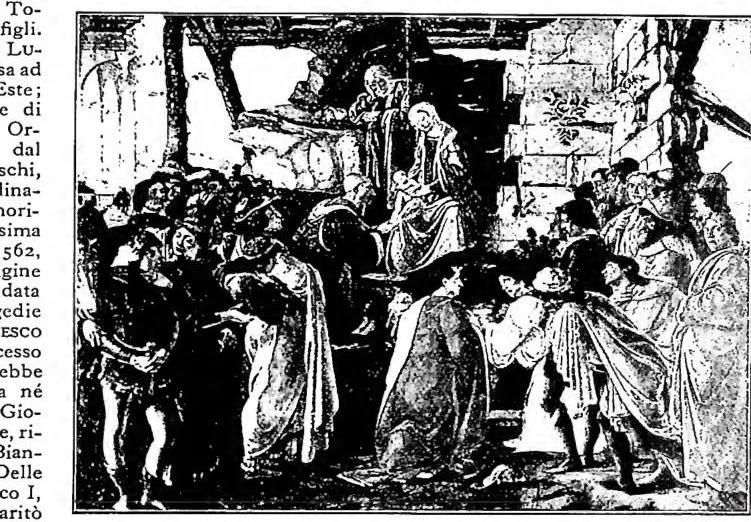
(Alinari photograph)
MEDICI, FAMIGLIA - Adoration of the Magi, impersonated by Cosimo (at the feet of Jesus), Pietro il Gottoso, and Giuliano (kneeling in the center), surrounded by other members of the family and of the Court. S. Botticelli (1467) - Florence, Uffizi.
in which Sisto IV allowed himself to be led by his ambitious nephew Girolamo Riario, eager to establish a lordship in central Italy. The first clash took place in 1473, when the Pope, with the help of the Pazzi, rivals of the Medici, forestalled Florence in the purchase of Imola. The dissension, which grew ever more bitter, had its tragic epilogue in the conspiracy of 1478. On April 26, during a Mass in S. Maria del Fiore, the two Medici were treacherously attacked: Giuliano was killed, but L. managed to save himself. The atrocity of the deed unleashed a furious popular reaction, and several of the leaders of the conspiracy, among them Archbishop Salviati, were put to death. This was followed by L.’s excommunication, the interdict pronounced against the city, and a general war. Ferdinando of Naples took up arms for the Pope, and military operations turned to Florence’s disadvantage, while her allies, Milan and Venice, gave her only scant assistance. L. found himself in serious difficulties, also because the adversaries skillfully declared that they were waging war against him and not against the city. Therefore, in December 1479, he made the bold decision to go to the court of his most powerful enemy, Ferdinando d’Aragona, in an attempt to reach an agreement. In Naples he succeeded in convincing the King, and departed having concluded peace: a success for which he “returned to Florence a very great man, if he had left it a great one” (Machiavelli).
In L.’s policies there now emerged the so-called policy of equilibrium. Here, however, two phases must be distinguished. During the War of Ferrara and until the Peace of Bagnolo (1484), L. pursued the same objective that had been pursued by Cosimo il Vecchio: to keep the forces of the Italian states in balance, preventing, through a prudent play of alliances, hegemonic ambitions from endangering peace. But when, in 1485, the Neapolitan barons, supported by the new Pope Innocenzo VIII, rebelled against the King, giving rise to a new general war, and L., overcoming the reluctance of his fellow citizens, insisted that Florence side with Milan and Naples against the Holy See, this intervention had a very different character from that of 1482. L. knew that any Italian ruler, once he found himself losing, would not hesitate to invoke foreign assistance; he knew that the new France, unified under a powerful monarchy, constituted the gravest threat to the freedom of the peninsula, a threat against which the Italian states could hope to defend themselves only by joining all their forces together. Therefore, while urging the allies to act with the greatest energy, he avoided having Florence formally declare war on the Church, and throughout the conflict he initiated and continued secret negotiations with the Pope, with the aim of preparing a “true peace.” L.’s correspondence now reveals his immediate and more distant aims. Since a weak and discordant Italy would be easy prey for the transalpine powers,
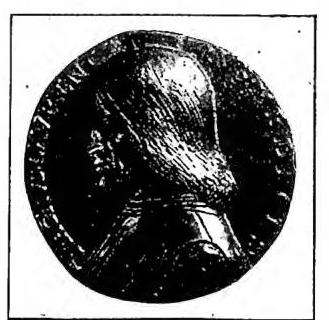
(phot. Alinari)
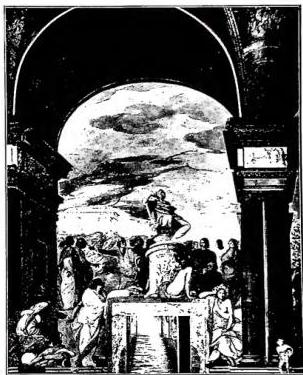
MEDICI, LORENZO de', detto il MAGNIFICO - L. il M. among poets and philosophers beside the statue of Plato. Painting by F. Furini - Florence, Palazzo Pitti, Museo degli Argenti.
(phot. Alinari)
No less original than his political action was the imprint L. left on our literature.
His poetic work consists of a collection of Rime; a Comento sopra alcuni de' suoi sonetti; two Selve d'amore; three short poems: l'Ambra, gli Amori di Venere e Marte, La caccia col falcone; two eclogues: il Corinto and l'Apollo e Pan; nine unfinished chapters: Simposio ovvero I beoni; Canzoni a ballo and Canti carnascialeschi; six philosophical chapters: l'Alterazione; Rime spirituali and Laudi; and a Rappresentazione de' ss. Giovanni e Paolo. The attribution of an idyll, La Nencia da Barberino, is disputed. More recently, he has been recognized as the author of a prose novella: the Novella di Giacoppo. The greater part of his extensive correspondence is still unpublished.
Unlike the humanists of his time, who for the most part preferred to use Latin, L. always wrote in the vernacular, and in the Comento sopra alcuni de' suoi sonetti he composed the finest apology, after that of Dante, for the traditional virtues, the magnificent possibilities, and the national value of our language. After a brief period of Stilnovistic and Petrarchan imitation, L. was among the first to introduce a vigorous popular vein into literature. His realism is not mere reproduction of nature: he does not limit himself to observing it with an attentive eye, but relives its spirit and interprets and renders it through universally human expressions.
As a man, although L. did not escape contradictions and faults, he nevertheless showed, in the seriousness of his family affections and in his way of life, free from all ostentation, that he had remained faithful to the plebeian simplicity of his lineage and to the solid moral and religious education received from his mother, Lucrezia Tornabuoni. Although he indulged the customs of his time by writing licentious songs, he nonetheless gave expression to the deepest aspirations of his soul by composing religious verses, whose very lack of stylistic refinement attests to their absolute sincerity, and by expressing in the Rappresentazione de' ss. Giovanni e Paolo, which may be regarded as his spiritual testament, a sadness inspired by a sense of the vanity of human pomp and pleasures. He faced death with Christian serenity, and before his passing asked for and received Savonarola’s blessing.
In L. are joined and fused the characteristic virtues of the Italian people: aversion to abstraction and a taste for the concrete and practical; a cautious acceptance of the new insofar as it does not destroy the spiritual heritage handed down by the fathers; and fundamental moral soundness. In politics as in art, L.’s life represents a continuous ascent from Florentine identity to Italian identity. He was the first statesman who, freeing himself from the municipal conception of the Middle Ages, rose to the broader vision of the common interests of the entire nation.
zione complessiva delle opere è quella a cura di A. Simioni, Bari 1914. Studi recenti sono citati in E. Bizzarri, Il Magnifico L., Milano 1950, e I. Marchetti, Stato Civile e lineamenti della Nenzia da Barberino, in Aevum, 33 (1951), p. 415 segg.; cf. inoltre Arch. stor. ital., 107 (1949), tutto il fasc. II, pp. 105-242. Roberto Palmarocchi