
MARCELLO II, PAPA. – Born at Montepulciano on 6 May 1501, died at Rome on 1 May 1555. Son of Ricciardo Cervini, a writer in the Apostolic Penitentiary under Innocent VIII, he pursued his studies at Siena.
He was then sent to Rome to complete them, and Clement VII entrusted him with carrying out the calendar reform that his father Ricciardo had begun under Leo X; the work was completed in 1525. The plague of 1526 caused M. to be recalled to his family, and the War of the League of Cognac prevented him, for the time being, from returning to Rome. A fervent student of the humanities, M. translated Cicero’s De amicitia into Italian, and Euclid and other Greek authors into Latin; already during that first Roman sojourn he had made many friends among the scholars and scientists of the time, with whom he maintained cordial relations throughout his life. Having moved to Rome again in 1531, he remained there for a year, received with particular benevolence by Cardinal Farnese. After his election to the papacy, the latter summoned him to his side and entrusted him with the education of his nephew, the young Cardinal Alessandro.
During his very brief pontificate, M. demonstrated his firm intention of rigorously implementing those reforming principles that had guided his activity as a prelate. He prohibited the costly festivities customarily held on the occasion of papal elections, postponed the examination of all petitions for privileges and graces, limited the number of members of his household and reduced their emoluments, established extremely strict rules for the conferral of ecclesiastical offices, and ordered that justice be administered impartially and without outside interference. To eliminate any suspicion of nepotism, he forbade his relatives to go to Rome or reside there; he also resolved to promulgate a bull imposing severe penalties on anyone who alienated ecclesiastical property in favor of relatives. During the War of Siena he attempted to carry out peacemaking efforts, refusing military aid to the besieged and advising them to cease their useless resistance, while urging Cosimo I to treat them with leniency. His sudden death prevented M. from continuing that reforming action which he regarded as an indispensable obligation for any pontiff.
During the ceremonies of Holy Week, M., who since the time of the Council had been convinced of the need to reform sacred music, had indignantly deplored the character of the chants that had accompanied the celebration of Good Friday. Palestrina, who was one of the singers, was thereby prompted to compose a Mass which the Pope’s death prevented him from presenting to him and which, because of these circumstances, was later entitled Missa papae Marcelli.
(phot. Alinari)
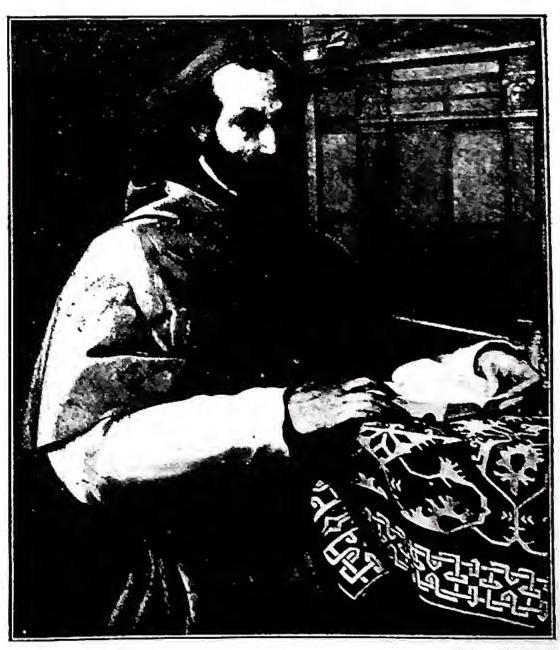
MARCELLO II, papa – Portrait of Cardinal Cervini, later M. II, attributed to Pontormo – Rome, Galleria Borghese.