
MONTEPULCIANO, DIOCESI di. — City and diocese in the province of Siena, on the Mons Politianus, which divides the Val di Chiana from the Val d'Orcia. It has an area of 163.85 sq km and a population of 20,000 inhabitants, all Catholics. It has 19 parishes served by 34 diocesan priests and 7 religious priests; it has a seminary, 3 male and 8 female religious communities (Ann. Pont., 1951, p. 276).
M. was inhabited from the Etruscan period onward. The designation Castellum Policianum appears in a document of 715. M. was long disputed by Arezzo, Siena, and Florence. Ecclesiastically, it was dependent on the diocese of Arezzo until 1476; at that time Sixtus IV exempted it from that jurisdiction, elevating it to a collegiate church. Pius IV, with the bull Ecclesiarum utilitati of 4 November 1561, created the diocese of M., immediately subject to the Holy See. Its first administrator was Cardinal Giovanni Ricci of M., who resigned the following year, when the first bishop, Mons. Spinello Benci (d. in 1569), was appointed; other bishops were Sinolfo Benci (1597–99), S. Tarugi (1600–1607), R. Ubaldini (1607–15), later a cardinal, A. Stufa (1622–40), the learned T. de Talenti (1646), A. Cervini (1663), P. Francesi (1737), P. Magnoni (1747), P. Franzesi (1757), P. Coletti (1802), I. Nicolai (1829), and C. Samuelli (1843). Born in M. AGNESE, SANTA (v.), Angelo Brogini, Poliziano (v.), Marcello II (v.), and St. Roberto Bellarmino (v.).
The most flourishing period of M. was that from the fourteenth to the eighteenth century; an academy founded by Niccolò IV flourished there and later took the name of the Intriganti. Churches and monumental palaces were built during that period.
The Cathedral, dedicated to Maria S.ma Assunta, was built to a design by Ippolito Scalza from 1532 to 1617; it has three naves divided by pillars; on the high altar is the
(Int. Alinari)
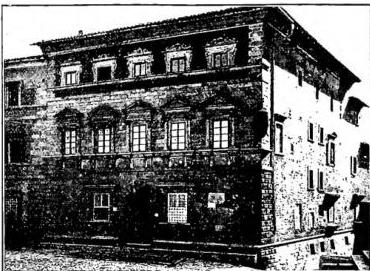
MONTEPULCIANO, DIOCESI di — Palazzo Contucci già Del Monte, di Antonio da S. Gallo (sec. XVI) — Montepulciano.
triptych with the Assumption by Taddeo di Bartolo (1401). Michelozzo erected there the monument to Mons. B. Aragazzi, secretary to Martino V, now, however, dismantled. The unfinished bell tower dates from the fifteenth century.
a Jesuit college, now the episcopal seminary; outside Porta al Prato stands the Church of S. Agnese da M., from the fourteenth century; S. Biagio, built by Antonio da Sangallo il Vecchio in 1518, is in the form of a Greek cross with a dome and recalls S. Maria della Consolazione in Todi.
Magnificent palaces include: the Gothic Palazzo Neri Orselli; the Mazzi del Monte, later Cantucci, Paolini, and Corvini palaces by Antonio Sangallo il vecchio; Palazzo Tarugi by Vignola; Palazzo Ricci by Baldassarre Peruzzi; the municipal palace, dating from the end of the fourteenth century, contains the civic museum, rich in works by Spinello Aretino, Girolamo di Benvenuto, Margaritone, Sodoma, etc.; among the small terracottas are an altar by Luca della Robbia and works by Andrea della Robbia; in addition, a series of precious illuminated choir books. — Vedi tav. XCV.