
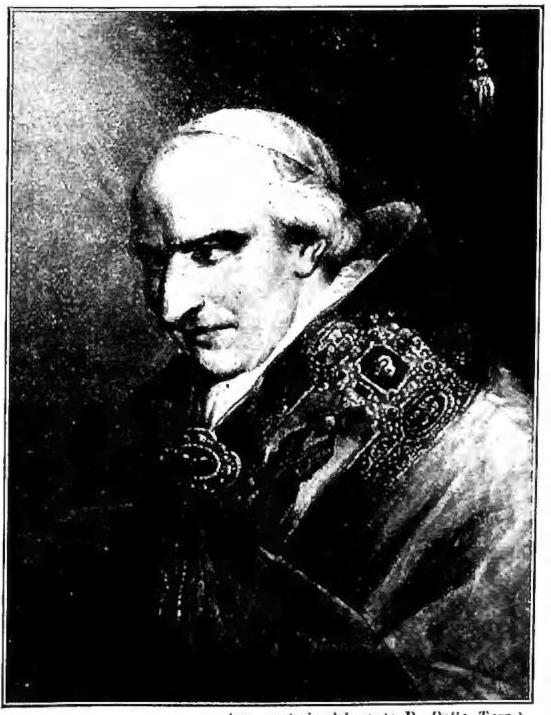
PIO VIII, POPE. — Francesco Saverio Castiglioni, b. at Cingoli on 20 Nov. 1761, d. at Rome on 30 Nov. 1830. He studied at the Campana College of Osimo and then at the Montalto College of Bologna. Having graduated in theology on 2 July 1785, he was ordained a priest at Rome on 17 Dec. of the same year. A collaborator of Msgr. Devoti in compiling the Institutiones Iuris Canonici and secretary of the commission that examined the decisions of the Council of Pistoia, he was successively vicar general at Anagni, Fano, Ascoli Piceno, and Cingoli. On 10 Aug. 1800 he was consecrated bishop of Montalto Marche, where he revealed his zeal and his austere conception of episcopal dignity. In July 1808, having refused to swear allegiance to Napoleon, he was imprisoned at Mantua, Pavia, and Milan. On 8 March 1816 he was created cardinal priest of the title of S. Maria in Traspontina and bishop of Cesena, where he arrived on 27 Apr. of that year. On 13 Aug. 1821 he became major penitentiary and bishop of Frascati. He enjoyed the favor of Cardinal Consalvi and of Pius VII, whom he came close to succeeding.
At the Conclave of 1829, the two parties of the «zelanti» and the «politici» again stood opposed, the latter faithful to Consalvi’s moderate tradition. The former, still numerically strong, were weakened by conflicting judgments concerning the pontificate of Leo XII. The representatives of the powers expressed conservative and authoritarian tendencies through the Spaniard Labrador, but above all calls for moderation through the Austrian Lutzow and, more emphatically, through the Frenchman Chateaubriand, who called for a pontiff who was well acquainted with «the needs of the present and of the future». Cardinal Castiglioni, the candidate of the moderates and well regarded in Paris, answered him on behalf of the Sacred College. Despite the opposition of the «zelanti», who supported De Gregorio and then Cappellari, he was elected on 31 March 1829 and consecrated on 5 Apr. Immediately, in order to reassure Austria, he appointed Cardinal Albani, head of the Consalvian party and acceptable to the Habsburgs, as Secretary of State.
From his first encyclical, Traditi humilitati nostrae, he wished to show that moderation and modernity of method did not signify renunciation of the uncompromising defense of Catholic principles and papal authority; and indeed he once again condemned religious indifferentism and the sects, reaffirming the authority of the Roman Pontiff over the bishops.
The condemnation of the Piedmontese Jansenists, the favor granted to the Jesuits, and the canonization of s. Alfonso de' Liguori (16 May 1830) likewise had a clear significance.
Through his efforts the Church advanced in the Anglo-Saxon countries following the Catholic Emancipation Bill of 23 Apr. 1829, which enabled English Catholics to sit in Parliament and hold public office, and also thanks to the first American Council held at Baltimore. He obtained from the Sultan civil rights and religious freedom for the Armenians and, on 6 July 1830, established an Armenian-rite archiepiscopal see at Constantinople.
Serious difficulties, however, arose on the European continent. P. VIII indeed came into conflict with Prussia over the question of mixed marriages, concerning which, in the brief Litteris altero abhine of 25 March 1830, he reaffirmed the doctrine that tolerates them, provided that the children receive a Catholic education. Just as he had wisely refrained from taking a position in the conflict between Lamennais and the legitimist and Gallican clergy, so, in the face of the July Revolution, which had also brought extremely violent anticlerical disturbances at Reims, Besançon, and Nancy, he knew how to act tactfully and succeeded in establishing friendly relations with the new regime, granting it his recognition, recommending submission to the constituted authorities, ordering the bishops not to abandon their sees, and allowing them to swear allegiance to the new King, to whom he recognized the title of «most Christian». Similar and different problems arose in Belgium, where what Albani regarded as a «monstrous alliance» between liberals and Catholics against the absolutism of the Protestant William I had taken shape, as well as in Poland and Ireland. In his own State, disturbed by some Carbonari unrest in Rome and Cesena, he adopted various administrative and social measures, reducing taxes, providing work for unemployed laborers, regulating the administration of the postal service and customs tariffs, suppressing the Congregation for the Supervision of Officials, and extending Leo XII’s provision «which prohibited landlords from evicting workers and increasing the rent»; he also awarded prizes to cultivators and prohibited the export of grain harmful to the lower classes. In Oct. 1830 he opposed an Austrian occupation of the Legations, which Cardinal Albani had already agreed upon with Vienna.