
ALFONSO MARIA DE' LIGUORI, saint – Profession of faith
with autograph signature (1762) – Vatican Secret Archives. Fondo
Processi Concettoriali.
Tommaso Falcoia, bishop of Castellammare di Stabia,
led him, on 9 November 1732, to found the
Congregation of the Most Holy Savior, later called
that of the Most Holy Redeemer (v. REDENTORISTI). His
first attempts to give the institute a stable form met
with the firm opposition of the chief chaplain
Celestino Galiani, Minister Tanucci, and
other government officials, who did not want to hear
of new religious Orders when they were considering
suppressing those already in existence. On 25 February
1749 he obtained ecclesiastical approval from
Pope Benedict XIV. After the most strenuous efforts,
in 1752 he succeeded in securing a royal decree
that granted the Congregation an existence precarious
but sufficient, at that time, to protect it
from further attacks. The founder took advantage
of this to organize the work with an unmistakable
character and to extend the apostolate of his disciples and himself,
opening colleges in the Papal States and in Sicily. And
the results of his missionary method were splendid,
with God contributing singular miracles.
In 1762 he was elected bishop of Sant'Agata dei Goti.
Around this period his already eminent holiness
shone more brightly, with repercussions even beyond Italy.
The popular and energetic apostle, who for thirty years
had evangelized the multitudes without affectation, indeed
combating the florid style of Fathers Giacchi and Ban-
diera, brought the same ardor to the diocese in uprooting
deep-rooted abuses, restoring crumbling churches,
and attending to the liturgical decorum of the services.
He took the greatest care of the seminary, raising its
moral and scholarly level, and became famous during the period
of the famine of 1763–64 for regulations against hoarding
and for wise measures to alleviate hardship.
In 1775, having relinquished the episcopate, he retired to Pagani, where,
although very ill, he continued to write and to encourage
the apostolate against the Enlightenment, faithful to his
vow never to waste time.
He was canonized by Gregory XVI in 1839, and
proclaimed a Doctor of the universal Church by Pius IX
in 1871.
2. HIS WORK
All his activity as a missionary, bishop, writer, and artist always had a single aim: to continue the work of the Redeemer, which is to save souls. For him, the supreme means of this redemption is the “internal mission,” which he organizes so that it first shakes souls from spiritual torpor througha clear preaching of the great truths concerning man’s destiny
and then launches them onto the path of salvation, rooting
in them love for Jesus crucified, who alone guarantees
a life of true virtue. He directs this mission to the souls
most abandoned spiritually; and in order to make it
continuous, he founded the missionary Congregation
of the Redemptorists.
3. LITERARY ACTIVITY
His literary activity arises from his apostolate, of which it is an integral and expanded expression, and consistently assumes a pastoral character. This pastoral sensitivity sharpens in him the search for immediacy, leading him to omit every subject not directly assimilable by the conscience, and to adopt a psychological conceptualization. Knowledge deepens into pastoral wisdom, and concepts and words become spirit and truth. This pastoral literary activity extends throughout his entire priestly life.A.’s first writings are works of asceticism: the Mas-
sime eterne (1728), the Canzoncine spirituali (1732), and the booklet
Visite al S.mo Suveamento (1745), whose success astonished
the author himself (Lettere di sant'A., III, Desclée,
Roma 1890, pp. 34, 65–68, 101). In 1746
his first work on moral theology appeared: Dissertazione sopra l'abuso di
maledire i morti, followed two years later by the first edi-
tion of the Theologia moralis, a quarto volume that, through
the nine editions published during the author’s lifetime
(the last in 1785), became three substantial folio volumes. The first
edition contained the text of the Medulla theol. moralis
by the Jesuit H. Busembaum, enriched with notes and six ap-
pendices. Among these was one on papal infallibility and another
on the Immaculate Conception, which followed the bitter controversy
provoked by Muratori’s De ingeniorum moderatione. In the second
edition (1753–55), an Eluchus quaestionum reformatarum (91) appeared
at the end of the two volumes; these questions were leading
the probabilism then professed by the author toward the reform
to which he had already been tending at that time. The text and
Busembaum’s name disappeared from the sixth edition onward
(1767). Of this work, recommended by ever-increasing success,
A. produced two abridgments: Pratica del confessore
(1755), Istruzione e pratica per un confessore novello (1755),
both translated into Latin and printed respectively under
the titles Praxis confessarii and Homo apostolicus, in
1757 and 1759.
In 1749 he published anonymously a Disse-
tatio scholastico-moralis pro usu moderato opinionis proba-
bilii, followed in 1755 by another work with the same title,
also anonymous. He soon abandoned them, and they were
suppressed from the Theologia moralis (Remondini, through
an error for which the Saint reproached him, reprinted them in the fifth edition,
1763), because they did not correspond to the new moral
conception to which he gave definitive expression in 1762.
In 1750 he published the Glorie di Maria, thereby entering
into controversy with Muratori’s Regolata disozione.
These were followed, at short intervals, by Av-
visi spettanti alla vocazione religiosa (1750), l'Amore delle
anime (1751), Modo di conversare continuamente ed alla
familiare con Dio (1754), Uniformità alla volontà di Dio
(1755), Avvertimenti ai confessori novelli (1756), Ap-
parecchio alla morte (1758), Discorsi da farsi in tempo
di flagelli (1758), Novena del S. Natale (1758), No-
vena del S. Cuore di Gesù (1758), Del gran mezzo della
preghiera (1759), intended to give a new direction to
discussions on grace, La vera sposa di Gesù Cristo (1760),
and Selva di materie predicabili (1760). A short work of apolo-
getics against deism appeared in 1756 under the title Breve
dissertazione contro gli errori dei moderni increduli. Almost
simultaneously with the printing of Mésenguy’s Jansenist cate-
chism, ordered by Tanucci, A. published, under the minister’s
eyes, the brief Diss. de iusta prohi-
bitione et abolition librorum nocuae lectionis (1759), in order to
assert the Church’s exclusive right to censor and prohibit books
dealing with religious matters. The pamphlet’s rapid success
earned exile for the royal censor, the Dominican
P. Sacco, and enormous popularity for the author
of the audacious little book.
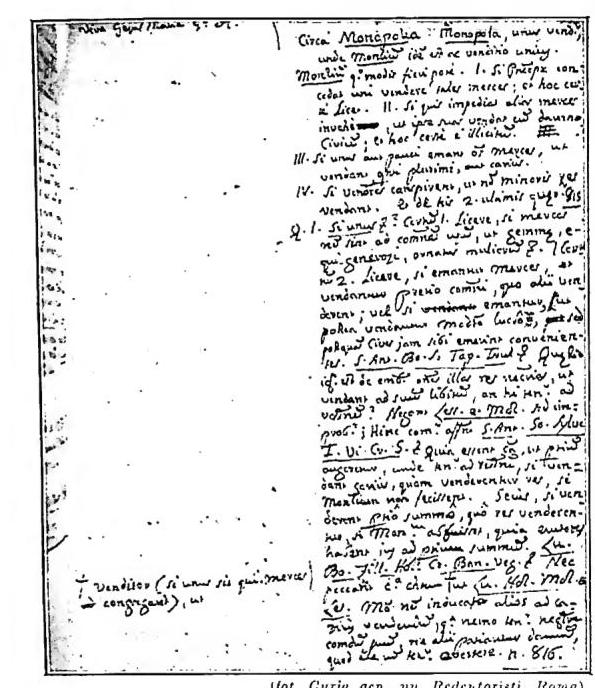
28. CATHOLIC ENCYCLOPEDIA
I.
ALFONSO MARIA DE' LIGUORI, saint – Autograph page from the Theologia moralis – Rome, Archive of the General Curia of the Redemptorist Fathers.
From 1767 to 1776 he published, in addition to ascetical writings, the volumes of controversy: Truth of the Faith against the Materialists and Deists (1767), Instruction to the People concerning the Precepts of the Decalogue (1767), in opposition to the catechism of Mésenguy; The Practice of Loving Jesus Christ (1768), Vindiciae pro suprema Rom. Pontificis potestate (1768), an energetic defense of papal infallibility against Nicola von Hontheim’s (Febronius’s) De Statu Ecclesiae; Dogmatic Works against the Supposedly Reformed Heretics (1769), placing Baio, Giansenio, Arnauld, Quesnel, and their followers among the ordinary heretics; Triumph of the Church (1772), Reflections on the Passion of Jesus Christ (1773), Reflections on the Truth of the
divine Revolution (1773), Translation of the Psalms and Canticles (1774), Victories of the Martyrs (1775), The Admirable Governance of Divine Providence (1775), and Theological-Moral Dissertations Concerning Eternal Life (1776).
We are far from having a complete list of his works, which comprises no fewer than 111 items, without counting revisions, additions, and unpublished writings.
29. THE MORALIST
His thought moves within the field of casuistic morality (v. CASISTICA); that is, the morality that directs the immediate application of general principles and positive laws to individual cases. Its historical background is the great struggle between the two interpretations of evangelical morality in contact with modern life: the interpretation that adopts a negative attitude and is consequently characterized by rigor; and the interpretation that tends toward a sound understanding of modern life. The exaggerations of the one and the other tendency are laxism and rigorism, condemned by the Church.In this struggle A., grounding himself on s. Tommaso and on the classical moralists of the 16th and 17th centuries, chooses the balance that lies between them.
As a student of theology, he adhered to a moral doctrine tending toward rigor. As a young missionary, he began an experimental verification of this morality, and, recognizing it as harmful to souls, courageously undertook the defense of probabilistic morality, which, at least in the schools, had lost considerable ground. He nevertheless subjected this morality to severe criticism, guided by his pastoral prudence, which on the one hand rests upon the loyal search for and adherence to objective truth, and on the other is sensitive to the subjective data of conscience. He thus decisively separated himself from current probabilism, which, in its decline, appeared as a technical calculation of extrinsic probability.
He himself describes his method as follows: «In reading the authors, I have found some who are too indulgent and who, without concern for the truth, write in order to please the world. Always ready to place cushions beneath the heads of sinners, they lull them to sleep in vice. There can be no doubt that these theologians cause immense harm to the Church, because those who love the easy way hasten to follow their maxims. I have found others who, in their excessive rigidity, confuse counsels with precepts and burden consciences with new weights, taking no account of human frailty. The former lead souls to perdition through laxity, and the latter through discouragement.
In composing the present book, I have proposed to myself to remain midway between laxism and rigorism. To enlighten myself on doubtful questions, I have shrunk from no labor. I have consulted the classical authors, both ancient and modern, those of the lenient opinion and those of the strict one. I have taken particular pains to examine at their sources all the texts of canon law relating to the matters treated: I have carefully noted the passages of the holy Fathers, adding reflections to them; I have transcribed and cited the judgments of s. Tommaso, drawn from their source. In intricate controversies, when it was impossible for me to resolve doubts by reading the authors, I discussed them with learned persons in order to derive benefit from their counsel. In evaluating opinions, I have always given greater consideration to reason than to authority: before pronouncing a judgment, I have sought to preserve the fullest possible indifference, so as not to be swayed either by prejudice or by passion. Having thus determined, insofar as I was able, the precise respective value of the opinions, I assigned them the characteristic designation of «less probable», «equally probable», «more probable». Finally, so as not to leave readers perplexed, I have endeavored in most cases to indicate the opinion I have adopted, unlike so many authors who are content to report the opinions of others without making their own known, to the great disappointment of those who read their books» (Adnotationes in «Medullam Theologiae moralis» Busembaum, 1753).
With this method and in this spirit he elaborated the whole of the Theologia moralis, especially the treatise De Poenitentia.
In the field of theoretical morality, the question of the “moral system” presented itself to him as an obligatory theme, specifically concerning the formation of the conscience that must act and yet does not possess certainty regarding the objective truth that ought to guide II. He adopts without qualification the probabilistic principle: «Lex dubia non obligat», and his little-known apologias document his dialectical vigor in the controversy with Fr. Patuzzi, a probabiliorist. This principle, however, is limited to the case of genuine doubt. For A., when a firmly decided opinion has formed in the conscience, it is not honest to reject II. And in order for this decided opinion to be formed, A. insists upon the sincere search for every light that may emanate from objective truth. Consistently with this spirit, the cases he resolved by means of the system are very few; in this respect his Theologia moralis differs from many others of its time. This spirit of interiority and pastoral sensitivity determined the adherence of almost the whole of the nineteenth century to the thought of the Saint.
30. THE DOGMATIC THEOLOGIAN
His positive character oriented him toward the problems most immediately relevant to the life of the believer, threatened by Voltairean Enlightenment and Jansenism in its final practical developments. His dogmatic work therefore has a more controversial than systematic character. With his complete adherence to Revelation, he possessed an unfailing sense of the Church’s intimate life which, together with his understanding of the needs of souls, makes his theology a «theologia salutis».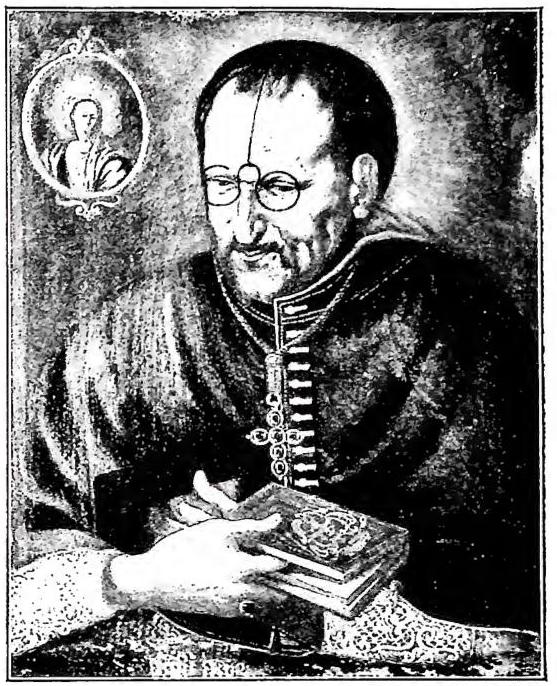
(phot. pp. Redemptorists)
ALFONSO MARIA DE' LIGUORI, saint — Portrait by an unknown author (1768) — Pagani, College of the Redemptorist Fathers.
our history, whose offensive power is subject to the economy of Redemption.
The conclusion developed in the book Gran mezzo della preghiera concerns our attitude before grace: it is always an attitude of free and therefore responsible cooperation. Yet A. could not delude himself about our weakness in relation to salvation. A law of beggary, he says, governs our relations with God. But what is weakness is also strength: one might say that we are rich in our indigence. God has made prayer a law; but more than prayer, it is the humble awareness of our misery and of God’s sovereign, paternal dominion that is law. It is incredible, he writes against Jansen, that an unobservable law should have been imposed upon us. Rather, the economy of Providence is different: God commands nature to do what it could not do by itself, because it lacks the means, precisely in order to make us experience the need to ask for them and thus live in the essential dependence existing between us and him.
Is it not he himself who, with paternal insistence, urges us to this «great means», which is psychologically experienced as easy and is easy for everyone?
Granted, then, on the one hand, that without God’s help we can do nothing, and, on the other, that God answers whoever prays to him, who does not see that prayer is absolutely necessary for salvation?
For A., the efficacy of grace is conditioned by the efficacy of prayer. Although prayer is initially a divine work, it is in our hands as an interior responsibility. This resolves itself into a new and most beautiful truth: prayer is not only a universal law, but is within us as a possibility, «the great means» of equally universal salvation: prayer is grace!
Sufficient grace, which according to the common teaching is given to all, thus coincides with prayer, which is grace and law, God’s supreme gift and our highest duty. Prayer is ours as the beginning of the salvation given us by sufficient grace, which thereby reveals itself as effective and operative; it is not only the possibility of acting, but actual action, a beginning toward the observance of the most difficult precepts, which we attain through efficacious grace, which God does not refuse to those who pray to him. But all this is also of God, because it is grace, divinely implanted assistance in the fibers of our soul.
A complete knowledge of A.’s dogmatic thought must take account of what he wrote and defended in the Glorie di Maria concerning the Immaculate Conception, a doctrine much disputed in the eighteenth century, but which A. declared «proxime definibilis», and concerning the patronage of the Virgin. The doctrine that increasingly dominates Catholic theology—that of Mary’s universal mediation in the distribution of graces—goes back to him; at the very least, the theological formula under discussion in the schools is his. He was therefore accused of innovation, although he had done nothing more than defend a truth that had lived in the Church since the most remote antiquity.
31. THE TEACHER OF ASCETICS
A.’s ascetical theology is Christocentric. The Pratica di amar G. C., a fundamental work, begins with this affirmation: «All the holiness and perfection of a soul consists in loving Jesus Christ, our God, our supreme good, and our Savior». The reason is evident, because if holiness comes from the Father, «the Eternal Father declares that he loves us insofar as we love Jesus Christ. Moreover, he gives us graces insofar as we ask him for them in the name of the Son; and he admits us to eternal beatitude insofar as he finds us conformed to the life of Jesus Christ» (Novena del Cuore di G.).To love Jesus Christ is to follow him. For A., the program proclaimed by Jesus is fundamental: «Qui vult venire post me abnegat semetipsum, tollat crucem suam et sequatur me» (Breve pratica per la perfezione...). It is volitional love, consisting of great desires and works: «One must love him (God) with all one’s heart, resolutely desiring to attain the greatest perfection in order to please God. But desires must then be joined to action, with fortitude in every circumstance» (ibid.).
This strong love brings about an interior change which for A. is fundamental and without which all ascetical practice would be fruitless: detachment («abnegat semetipsum, tollat crucem suam»). «In a heart that is full of earth, there is no room for the love of God; and the more earth there is in it, the less divine love reigns there. Therefore, whoever desires to have a heart full of divine love must strive to remove all the earth from it» (Opuscoli sull'amore divino, no. 8). Love produces this detachment, and detachment makes love more perfect: «Whoever truly loves Jesus Christ loses affection for all earthly goods and seeks to strip himself of everything in order to remain united only to Jesus Christ. All his desires are directed toward Jesus; he always thinks of Jesus, always sighs for Jesus, and seeks to please Jesus alone everywhere, at all times, and in every circumstance. But to reach this point one must continually strive to empty the heart of every affection that is not for God» (Pratica di amar G. C., chap. 2, no. 24).
In a soul where love of Jesus and detachment from creatures triumph, union with God is brought about. «God desires that the soul be stripped of everything so that he may unite it to himself and fill it with his divine love» (ibid., no. 23). For A., this union is perfect conformity to the will of God, and here he places the summit of...
of perfection. «All our perfection consists in loving our most lovable God. But the perfection of God consists in uniting our will to his most holy will; and not merely in conforming ourselves to whatever God ordains, but in making ourselves one with II. Conformity means that we join our will to the will of God; but uniformity means more: that we make of the divine will and our own a single will, so that we desire nothing other than what God desires, and the will of God alone is ours. This is the summit of perfection» (Opuscoli sull'amore divino: Uniformità alla volontà di Dio).
The means of sanctification arise from its nature. Love for Jesus calls for knowledge of Jesus, hence the continual contemplation of the Crucified. «Whoever considers the immense love that Jesus Christ has shown us throughout his life and especially in his death, in suffering so many pains for our salvation, cannot fail to remain wounded and inflamed with love for a God so enamored of our souls» (Saette di fuoco...).
Detachment is achieved through mortification, more interior than exterior. A.’s personal austerity is well known. Yet he wrote as follows to a religious community: «What hair shirts! I am sending you a good supply of books that may better help you to become holy... Love, rejoice: whoever loves a God so good must never admit thoughts of sadness into his heart.» Finally, union with God is achieved especially through mental prayer, Holy Communion, and continual remembrance of the presence of God (Breve pratica della perfezione; Pratica di amar G. C., chap. 8; Opuscoli sull'amore divino, no. 2).
But for A. the «great means» is prayer, because it alone obtains grace for us: «He who prays is saved; he who does not pray is damned.» Essentially connected with this is devotion to Mary Most Holy, which pervades the whole of Alfonsian asceticism: Mary is the Mediatrix of all graces; therefore it is vain to hope for sanctification without Mary.
A.’s asceticism opens onto mysticism: «The entire aim of a soul must be union with God; but it is not necessary for a soul, in order to become holy, to attain passive union; it is enough to attain active union: active union is perfect uniformity with the will of God» (Pratica del Confessore, chap. 9, no. 129).
32. THE FORTUNE OF THE WORKS
The writings of S. A. enjoyed a success such as is rarely encountered in the literary history of the Church. The Visite al S.mo Sacramento, the Glorie di Maria, the Apparecchio alla morte, and the Pratica di amar Gesù Cristo have by now become universal books, part of the devotional heritage of the people and also profitable reading for learned theology. During the author’s lifetime, they spread throughout Europe. We find them in every region of Italy, in Germany, France, Poland, and Spain. After his death, one may say that they became worldwide.It is difficult to provide a complete statistic of the various editions of his works. An attempt was made in the Acta doctoratus, now superseded by a more imposing bibliographical study in which the editions of his works in the various languages must be counted by the thousands. But what matters is the influence they exerted on the history of the Church from the eighteenth century to our own day, especially in the defeat of Jansenism in the various countries of Europe.
Theological studies: a) MORAL: B. Lanteri, Réflexions sur la sainteté et la doctrine du b. L., Lyon 1823, Italian trans., Reggio 1825; T. Gousset, Justification de la théologie morale du b. A. d. L., Besançon 1832; Vindicine alphonse, Brussels 1874; L. Gaudé, De morali systemate s. A., Rome 1894; L. Jansen, L'équiprobabilisme, in Revue thomiste 6 (1898), pp. 354, 420; id., La question hyacétique, Galoppe 1899; I. De Caigny, De genuins systemate s. A., Bruges 1901; L. Wouters, De minusprobabilisme, Freiburg 1905; S. Mondino, Studio storico-critico sul sistema morale di s. A., Monza 1911; E. Thamiry, La théol. morale de st. A., in Les questions ecclésiastiques, 2 (1912), pp. 55-57; F. Delarue, Le système moral de st. A., St-Etienne 1920. — Fr. L. Gaudé edited the critical edition of the Theologia moralis, in 4 vols., Rome 1905. — b) DOGMATIC: A. de Calonne, Système de st. A. sur la grâce, Paris 1868; H. Nimal, St. A. et la dogmatique, in Echo religieux de Belgique, 3 (1901), p. 176; C. Ryder, St. A. system of Grace According to his Teaching in his Treatise on Prayer, London 1903; L. De Ridder, St. A. et la théologie dogmatique, in Nouv. Revue Théol., 56 (1904), pp. 233-235; G. Van Rossum, S. A. et Immaculata Concepto B. M. V., Rome 1904; L. Jansen, S. A. doctrine de inflavus Dei in deliberatum voluntatis creatae activitutea, Aquisgrana 1920; E. Theyskens, St. A. et la médiation universelle de Marie, Brussels 1922; Cl. Dillenschneider, La Mariologie de st. A., 2 vols., Freiburg 1931-37; G. Cacciatore, S. A. et la guarnitisme, Florence 1944. — Fr. L. Walter collected and translated into Latin the theological treatises of s. A.: S. A. opera dogmatica, Rome 1903. — c) ASCETICAL: V. A. Dechamp, St. A. considère dans sa vie, ses vertus et sa doctrine spirituelle, Malines 1840; H. Manning, The mission of st. A., Dublin 1864; L. Gauthier, La miséricorde et la joie: Études littéraires pour la défense de l'Église, Paris 1865; M. De Meulemeester, Influences acctiques de st. A. en Belgique, Esschen 1923; C. Keusch, Die Aszetik des hl. A. M. V. L., Paderborn 1926; Italian trans., G. Di Fabio, La doctrine spirituale di s. A., Milan 1931; R. Garrigou-Lagrange, La testimonianza di s. A. paragonato a quelle di s. Tommaso e di s. Giovanni della Croce, in L'amore di Dio e la croce di Gesù, II, Turin 1936, pp. 101-223; G. Cacciatore, La spiritualità di s. A., in Le scuole cattoliche di spiritualità, Milan 1944; H. Manders, Liefde in de spiritualiteit van sint Alfonse, Brussels 1947. — In 1933 the Redemptorists began a critical collection of the ascetical writings of s. A.: Opere ascetiche, Rome 1933 ff.; 7 vols. have appeared so far.
Various studies: C. Romano, Delle opere di s. A. d. L., Rome 1866; J. Bogaerts, S. A. M. d. L., musicien et la réforme du chant sacré, Paris 1899; B. Bracchman, Étude sur l'éloquence apostolique de st. A. M. d. L., Houlers 1912; M. Palladino, S. A. poeta, Caserta 1917; A. Van Bervliet, La liturgie dans la piété alphonse, Esschen 1925; C. Keusch, Le vrai visage de st. A. M. d. L., Paris 1930; G. Gregorio, Canzoniere alfonse: Studio critico estetico col testo, Angri 1933; id., S. A. grammatico, Materdomini 1938; A. Santonicola, S. A. et l'azione cattolica, Pompeii 1939; G. de Luca, S. A. uomo grande, in Scritti su richiesto, Brescia 1944.
Anti-Alphonsian publications: The Moral Theology of s. A. was particularly vehemently attacked by Protestants, Old Catholics, and Orthodox: G. Maxwell, S. A. L. and the Redemptorists, Dublin 1859; G. Döllinger-G. Reusch, Geschichte der Moralstreitigkeiten... Nördlingen 1889; R. Grassmann, Auszüge aus der Moralthologie des h. A., Stettin 1901; id., Moralthologie des Liguori und die furchtbare Gefahr dieser für die Sittlichkeit der Völker, ibid. 1903 and 1909; A. Eisenhölz, Liguori oder Luther, Vienna 1901; G. Hoepel, S. Liguori und Christliche Moralt, in Christliche Welt, 16 (1902), cols. 670–84, 793–798; C. Dembion, Annales parlamentaires belges, Brussels 1903, p. 319; A. Anspach, A propos de st. A., Tournai 1903; M. Ludendorff, Ein Blick in die Moraltlehre der römischen Kirche, Munich 1930; A. Bruckner, Die Gebote im Lichte der Moralthologie des h. A. V. L., Schkeuditz 1930. The fierce attacks against s. A. led, twenty years ago in Norway, to an actual trial, with the establishment of a substantial prize for anyone who could prove the truth of the accusations; it ended with the Saint’s complete rehabilitation, which made a great impression in Protestant circles (Steinsvik-Riesterer Trial at Kristiansand, 1928; cf. Les Nouvelles Religieuses, 11 (1928), pp. 73–75).
For a more complete bibliography, V. M. De Meulemeester, Bibliographie générale des écrivains Rédemptoristes, Louvain 1933; the first volume is devoted entirely to s. A. Giuseppe Cacciatore