ALFONSO DI ZAMORA

ALFONSO OF ZAMORA. — A converted rabbi, b. in Zamora in 1474, baptized in 1506, d. in 1531. He was the first professor of Hebrew at the University of Salamanca. For 15 years he worked on the Complutensian Polyglot, entrusted by Cardinal Ximenes with the correction of the Hebrew text and the Latin translation of the Targum.

He elaborated the entire sixth volume of the Polyglot (1515), containing a Hebrew-Aramaic lexicon and a Hebrew grammar. He then published, also in Latin, a new Hebrew grammar with a lexicon (Alcalá, 1526), to which he added a Catalogus iudicum, regum et sacerdotum atque prophetarum Veteris Legis and an Epistola auctoris ad infideles Hebraeos urbis Romae (in which he demonstrates the coming of the Messiah). The Escorial preserves manuscripts in Castilian by A.: Libro de la Sabiduria de Dios (against the Jews), a third Hebrew grammar, and the translation of Kimchi’s commentary on the first 59 Psalms.

BIBL.: Hurter, II, col. 1134; F. Pérez Castro, El libro de la Sabiduria de Dios, de A. de Z., in Sefarad, 5 (1945), pp. 147-84. Antonino Romeo

ALPHONSUS MARIA DE’ LIGUORI, Saint, Doctor of the Church.

SUMMARY:

I. Biography

2. His work

3. Literary activity

4. The moralist

5. The dogmatic theologian

6. The master of ascetics

7. The influence of St. Alphonsus’s works.

I. BIOGRAPHY

He was born at Marianella, near Naples, on 27 Sept. 1696, son of Don Giuseppe de’ Liguori, captain of the royal galleys, and Donna Anna Cavalieri, of the marquises of Avenia; he died at Pagani on 1 Aug. 1787. He completed his studies in letters and sciences at home, which included music and the arts; in 1708 he enrolled at the University of Naples after having been examined in rhetoric by G. B. Vico. He studied civil and canon law there, graduating in law on 21 Jan. 1713, with a dispensation of about four years from the required age. He completed his precocious formation under the guidance of Perrone and Jovene, celebrated jurists, while at the same time attending the circle of the president of the High Council, Domenico Caravita, a kind of evening academy where historians and legal philosophers such as Costantino Grimaldi, Gaetano Argento, and Pietro Giannone gathered—principal architects of Neapolitan jurisdictionalism.

In 1715 he joined the pious union of the Doctors, directed by the Fathers of the Oratory, edifying young and old magistrates by his conduct. In the same year he began to practice law, and, as is evident from the Catalogue of Judgments, he was always successful in his defenses. In 1718, on account of his rare gifts, he was elected judge of the royal Portulano of Naples, and in 1722 ambassador of the new viceroy, Cardinal Altan. The following year the Duke of Gravina entrusted him with an extremely important case against the Grand Duke of Tuscany. Despite his rigorous diligence, sharpened by the exceptional nature of the feudal dispute, the brilliant advocate suffered a resounding defeat due to a clause that had not been duly considered. He believed his reputation and future were ruined and, renewing a resolution from his early youth—as indicated in his unpublished Diary—after a few months he decided to take up the ecclesiastical habit. Having overcome his father’s opposition and offered to the Madonna in the Church of the Mercede his sponsor as Knight of the Sedile of Portanova, he renounced his right of primogeniture and began the study of theology under the most learned Monsignor Giulio Torni, participating assiduously in dogmatic and moral discussions with Monsignor Guerriero and the Lazarist Fathers.

On 21 Dec. 1726, ordained a priest, he immediately began his ministry among the common people of the poorest districts, disregarding the prejudices of the patriciate from which he sprang. Assisted also by laypeople, he established the “Evening Chapels” mainly for street children (lazzarci), which became a school of civil and moral re-education. As a member of the Apostolic Missions, he traveled through the Vesuvian towns, the Apennines, and Apulia, announcing the eternal truths to the masses with simplicity. From that moment the thought of the salvation of the most abandoned souls acted in him as a predominant element.

A series of providential encounters followed, including those with the Venerable Sister M. CROSTAROSA, PIETRO (v.) and Monsignor

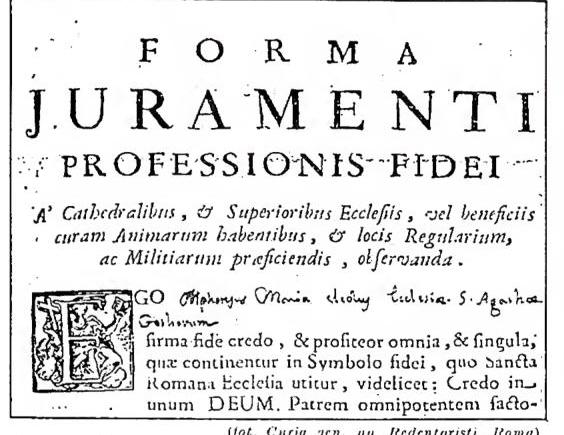
FORM
OATHS
OF THE
PROFESSION OF FAITH

To be observed by those who are to be promoted to cathedral and superior churches or benefices involving the care of souls, and to the places of regulars and military orders.

GIO. O. P. O. O. O. O. O. O. O. O. O. O. O. O. O. O. O. P. O. O. O. O. O. O. O. O. O. O. O. O. P. O. P. O. O. O. O. O. O. O. O. O. O. O. O. O. O. O. P. O. O. O. O. O. O. O. O. O. O. O. O. P. O. P. O. O. O. O. O. O. O. O. O. O. O. O. O. O. O. P. O. O. O. O. O. O. O. O. O. O. O. O. P. O. P. O. O. O. O. O. O. O. O. O. O. O. O. O. O. O. P. O. O. O. O. O. O. O. O. O. O. O. O. P. O. P. O. O. O. O. O. O. O. O. O. O. O. O. O. O. O. P. O. O. O. O. O. O. O. O. O. O. O. O. P. O. P. O. O. O. O. O. O. O. O. O. O. O. O. O. O. O. P. O. O. O. O. O. O. O. O. O. O. O. O. P. O. P. O. O. O. O. O. O. O. O. O. O. O. O. O. O. O. P. O. O. O. O. O. O. O. O. O. O. O. O. P. O. P. O. O. O. O. O. O. O. O. O. O. O. O. O. O. O. P. O. O. O. O. O. O. O. O. O. O. O. O. P. O. P. O. O. O. O. O. O. O. O. O. O. O. O. O. O. O. P. O. O. O. O. O. O. O. O. O. O. O. O. P. O. P. O. O. O. O. O. O. O. O. O. O. O. O. O. O. O. P. O. O. O. O. O. O. O. O. O. O. O. O. P. O. P. O. O. O. O. O. O. O. O. O. O. O. O. O. O. O. P. O. O. O. O. O. O. O. O. O. O. O. O. P. O. P. O. O. O. O. O. O. O. O. O. O. O. O. O. O. O. P. O. O. O. O. O. O. O. O. O. O. O. O. P. O. P. O. O. O. O. O. O. O. O. O. O. O. O. O. O. O. P. O. O. O. O. O. O. O. O. O. O. O. O. P. O. P. O. O. O. O. O. O. O. O. O. O. O. O. O. O. O. P. O. O. O. O. O. O. O. O. O. O. O. O. P. O. P. O. O. O. O. O. O. O. O. O. O. O. O. O. O. O. P. O. O. O. O. O. O. O. O. O. O. O. O. P. O. P. O. O. O. O. O. O. O. O. O. O. O. O. O. O. O. P. O. O. O. O. O. O. O. O. O. O. O. O. P. O. P. O. O. O. O. O. O. O. O. O. O. O. O. O. O. O. P. O. O. O. O. O. O. O. O. O. O. O. O. P. O. P. O. O. O. O. O. O. O. O. O. O. O. O. O. O. O. P. O. O. O. O. O. O. O. O. O. O. O. O. P. O. P. O. O. O. O. O. O. O. O. O. O. O. O. O. O. O. P. O. O. O. O. O. O. O. O. O. O. O. O. P. O. P. O. O. O. O. O. O. O. O. O. O. O. O. O. O. O. P. O. O. O. O. O. O. O. O. O. O. O. O. P. O. P. O. O. O. O. O. O. O. O. O. O. O. O. O. O. O. P. O. O. O. O. O. O. O. O. O. O. O. O. P. O. P. O. O. O. O. O. O. O. O. O. O. O. O. O. O. O. P. O. O. O. O. O. O. O. O. O. O. O. O. P. O. P. O. O. O. O. O. O. O. O. O. O. O. O. O. O. O. P. O. O. O. O. O. O. O. O. O. O. O. O. P. O. P. O. O. O. O. O. O. O. O. O. O. O. O. O. O. O. P. O. O. O. O. O. O. O. O. O. O. O. O. P. O. P. O. O. O. O. O. O. O. O. O. O. O. O. O. O. O. P. O. O. O. O. O. O. O. O. O. O. O. O. P. O. P. O. O. O. O. O. O. O. O. O. O. O. O. O. O. O. P. O. O. O. O. O. O. O. O. O. O. O. O. P. O. P. O. O. O. O. O. O. O. O. O. O. O. O. O. O. O. P. O. O. O. O. O. O. O. O. O. O. O. O. P. O. P. O. O. O. O. O. O. O. O. O. O. O. O. O. O. O. P. O. O. O. O. O. O. O. O. O. O. O. O. P. O. P. O. O. O. O. O. O. O. O. O. O. O. O. O. O. O. P. O. O. O. O. O. O. O. O. O. O. O. O. P. O. P. O. O. O. O. O. O. O. O. O. O. O. O. O. O. O. P. O. O. O. O. O. O. O. O. O. O. O. O. P. O. P. O. O. O. O. O. O. O. O. O. O. O. O. O. O. O. P. O. O. O. O. O. O. O. O. O. O. O. O. P. O. P. O. O. O. O. O. O. O. O. O. O. O. O. O. O. O. P. O. O. O. O. O. O. O. O. O. O. O. O. P. O. P. O. O. O. O. O. O. O. O. O. O. O. O. O. O. O. P. O. O. O. O. O. O. O. O. O. O. O. O. P. O. P. O. O. O. O. O. O. O. O. O. O. O. O. O. O. O. P. O. O. O. O. O. O. O. O. O. O. O. O. P. O. P. O. O. O. O. O. O. O. O. O. O. O. O. O. O. O. P. O. O. O. O. O. O. O. O. O. O. O. O. P. O. P. O. O. O. O. O. O. O. O. O. O. O. O. O. O. O. P. O. O. O. O. O. O. O. O. O. O. O. O. P. O. P. O. O. O. O. O. O. O. O. O. O. O. O. O. O. O. P. O. O. O. O. O. O. O. O. O. O. O. O. P. O. P. O. O. O. O. O. O. O. O. O. O. O. O. O. O. O. P. O. O. O. O. O. O. O. O. O. O. O. O. P. O. P. O. O. O. O. O. O. O. O. O. O. O. O. O. O. O. P. O. O. O. O. O. O. O. O. O. O. O. O. P. O. P. O. O. O. O. O. O. O. O. O. O. O. O. O. O. O. P. O. O. O. O. O. O. O. O. O. O. O. O. P. O. P. O. O. O. O. O. O. O. O. O. O. O. O. O. O. O. P. O. O. O. O. O. O. O. O. O. O. O. O. P. O. P. O. O. O. O. O. O. O. O. O. O. O. O. O. O. O. P. O. O. O. O. O. O. O. O. O. O. O. O. P. O. P. O. O. O. O. O. O. O. O. O. O. O. O. O. O. O. P. O. O. O. O. O. O. O. O. O. O. O. O. P. O. P. O. O. O. O. O. O. O. O. O. O. O. O. O. O. O. P. O. O. O. O. O. O. O. O. O. O. O. O. P. O. P. O. O. O. O. O. O. O. O. O. O. O. O. O. O. O. P. O. O. O. O. O. O. O. O. O. O. O. O. P. O. P. O. O. O. O. O. O. O. O. O. O. O. O. O. O. O. P. O. O. O. O. O. O. O. O. O. O. O. O. P. O. P. O. O. O. O. O. O. O. O. O. O. O. O. O. O. O. P. O. O. O. O. O. O. O. O. O. O. O. O. P. O. P. O. O. O. O. O. O. O. O. O. O. O. O. O. O. O. P. O. O. O. O. O. O. O. O. O. O. O. O. P. O. P. O. O. O. O. O. O. O. O. O. O. O. O. O. O. O. P. O. O. O. O. O. O. O. O. O. O. O. O. P. O. P. O. O. O. O. O. O. O. O. O. O. O. O. O. O. O. P. O. O. O. O. O. O. O. O. O. O. O. O. P. O. P. O. O. O. O. O. O. O. O. O. O. O. O. O. O. O. P. O. O. O. O. O. O. O. O. O. O. O. O. P. O. P. O. O. O. O. O. O. O. O. O. O. O. O. O. O. O. P. O. O. O. O. O. O. O. O. O. O. O. O. P. O. P. O. O. O. O. O. O. O. O. O. O. O. O. O. O. O. P. O. O. O. O. O. O. O. O. O. O. O. O. P. O. P. O. O. O. O. O. O. O. O. O. O. O. O. O. O. O. P. O. O. O. O. O. O. O. O. O. O. O. O. P. O. P. O. O. O. O. O. O. O. O. O. O. O. O. O. O. O. P. O. O. O. O. O. O. O. O. O. O. O. O. P. O. P. O. O. O. O. O. O. O. O. O. O. O. O. O. O. O. P. O. O. O. O. O. O. O. O. O. O. O. O. P. O. P. O. O. O. O. O. O. O. O. O. O. O. O. O. O. O. P. O. O. O. O. O. O. O. O. O. O. O. O. P. O. P. O. O. O. O. O. O. O. O. O. O. O. O. O. O. O. P. O. O. O. O. O. O. O. O. O. O. O. O. P. O. P. O. O. O. O. O. O. O. O. O. O. O. O. O. O. O. P. O. O. O. O. O. O. O. O. O. O. O. O. P. O. P. O. O. O. O. O. O. O. O. O. O. O. O. O. O. O. P. O. O. O. O. O. O. O. O. O. O. O. O. P. O. P. O. O. O. O. O. O. O. O. O. O. O. O. O. O. O. P. O. O. O. O. O. O. O. O. O. O. O. O. P. O. P. O. O. O. O. O. O. O. O. O. O. O. O. O. O. O. P. O. O. O. O. O. O. O. O. O. O. O. O. P. O. P. O. O. O. O. O. O. O. O. O. O. O. O. O. O. O. P. O. O. O. O. O. O. O. O. O. O. O. O. P. O. P. O. O. O. O. O. O. O. O. O. O. O. O. O. O. O. P. O. O. O. O. O. O. O. O. O. O. O. O. P. O. P. O. O. O. O. O. O. O. O. O. O. O. O. O. O. O. P. O. O. O. O. O. O. O. O. O. O. O. O. P. O. P. O. O. O. O. O. O. O. O. O. O. O. O. O. O. O. P. O. O. O. O. O. O. O. O. O. O. O. O. P. O. P. O. O. O. O. O. O. O. O. O. O. O. O. O. O. O. P. O. O. O. O. O. O. O. O. O. O. O. O. P. O. P. O. O. O. O. O. O. O. O. O. O. O. O. O. O. O. P. O. O. O. O. O. O. O. O. O. O. O. O. P. O. P. O. O. O. O. O. O. O. O. O. O. O. O. O. O. O. P. O. O. O. O. O. O. O. O. O. O. O. O. P. O. P. O. O. O. O. O. O. O. O. O. O. O. O. O. O. O. P. O. O. O. O. O. O. O. O. O. O. O. O. P. O. P. O. O. O. O. O. O. O. O. O. O. O. O. O. O. O. P. O. O. O. O. O. O. O. O. O. O. O. O. P. O. P. O. O. O. O. O. O. O. O. O. O. O. O. O. O. O. P. O. O. O. O. O. O. O. O. O. O. O. O. P. O. P. O. O. O. O. O. O. O. O. O. O. O. O. O. O. O. P. O. O. O. O. O. O. O. O. O. O. O. O. P. O. P. O. O. O. O. O. O. O. O. O. O. O. O. O. O. O. P. O. O. O. O. O. O. O. O. O. O. O. O. P. O. P. O. O. O. O. O. O. O. O. O. O. O. O. O. O. O. P. O. O. O. O. O. O. O. O. O. O. O. O. P. O. P. O. O. O. O. O. O. O. O. O. O. O. O. O. O. O. P. O. O. O. O. O. O. O. O. O. O. O. O. P. O. P. O. O. O. O. O. O. O. O. O. O. O. O. O. O. O. P. O. O. O. O. O. O. O. O. O. O. O. O. P. O. P. O. O. O. O. O. O. O. O. O. O. O. O. O. O. O. P. O. O. O. O. O. O. O. O. O. O. O. O. P. O. P. O. O. O. O. O. O. O. O. O. O. O. O. O. O. O. P. O. O. O. O. O. O. O. O. O. O. O. O. P. O. P. O. O. O. O. O. O. O. O. O. O. O. O. O. O. O. P. O. O. O. O. O. O. O. O. O. O. O. O. P. O. P. O. O. O. O. O. O. O. O. O. O. O. O. O. O. O. P. O. O. O. O. O. O. O. O. O. O. O. O. P. O. P. O. O. O. O. O. O. O. O. O. O. O. O. O. O. O. P. O. O. O. O. O. O. O. O. O. O. O. O. P. O. P. O. O. O. O. O. O. O. O. O. O. O. O. O. O. O. P. O. O. O. O. O. O. O. O. O. O. O. O. P. O. P. O. O. O. O. O. O. O. O. O. O. O. O. O. O. O. P. O. O. O. O. O. O. O. O. O. O. O. O. P. O. P. O. O. O. O. O. O. O. O. O. O. O. O. O. O. O. P. O. O. O. O. O. O. O. O. O. O. O. O. P. O. P. O. O. O. O. O. O. O. O. O. O. O. O. O. O. O. P. O. O. O. O. O. O. O. O. O. O. O. O. P. O. P. O. O. O. O. O. O. O. O. O. O. O. O. O. O. O. P. O. O. O. O. O. O. O. O. O. O. O. O. P. O. P. O. O. O. O. O. O. O. O. O. O. O. O. O. O. O. P. O. O. O. O. O. O. O. O. O. O. O. O. P. O. P. O. O. O. O. O. O. O. O. O. O. O. O. O. O. O. P. O. O. O. O. O. O. O. O. O. O. O. O. P. O. P. O. O. O. O. O. O. O. O. O. O. O. O. O. O. O. P. O. O. O. O. O. O. O. O. O. O. O. O. P. O. P. O. O. O. O. O. O. O. O. O. O. O. O. O. O. O. P. O. O. O. O. O. O. O. O. O. O. O. O. P. O. P. O. O. O. O. O. O. O. O. O. O. O. O. O. O. O. P. O. O. O. O. O. O. O. O. O. O. O. O. P. O. P. O. O. O. O. O. O. O. O. O. O. O. O. O. O. O. P. O. O. O. O. O. O. O. O. O. O. O. O. P. O. P. O. O. O. O. O. O. O. O. O. O. O. O. O. O. O. P. O. O. O. O. O. O. O. O. O. O. O. O. P. O. P. O. O. O. O. O. O. O. O. O. O. O. O. O. O. O. P. O. O. O. O. O. O. O. O. O. O. O. O. P. O. P. O. O. O. O. O. O. O. O. O. O. O. O. O. O. O. P. O. O. O. O. O. O. O. O. O. O. O. O. P. O. P. O. O. O. O. O. O. O. O. O. O. O. O. O. O. O. P. O. O. O. O. O. O. O. O. O. O. O. O. P. O. P. O. O. O. O. O. O. O. O. O. O. O. O. O. O. O. P. O. O. O. O. O. O. O. O. O. O. O. O. P. O. P. O. O. O. O. O. O. O. O. O. O. O. O. O. O. O. P. O. O. O. O. O. O. O. O. O. O. O. O. P. O. P. O. O. O. O. O. O. O. O. O. O. O. O. O. O. O. P. O. O. O. O. O. O. O. O. O. O. O. O. P. O. P. O. O. O. O. O. O. O. O. O. O. O. O. O. O. O. P. O. O. O. O. O. O. O. O. O. O. O. O. P. O. P. O. O. O. O. O. O. O. O. O. O. O. O. O. O. O. P. O. O. O. O. O. O. O. O. O. O. O. O. P. O. P. O. O. O. O. O. O. O. O. O. O. O. O. O. O. O. P. O. O. O. O. O. O. O. O. O. O. O. O. P. O. P. O. O. O. O. O. O. O. O. O. O. O. O. O. O. O. P. O. O. O. O. O. O. O. O. O. O. O. O. P. O. P. O. O. O. O. O. O. O. O. O. O. O. O. O. O. O. P. O. O. O. O. O. O. O. O. O. O. O. O. P. O. P. O. O. O. O. O. O. O. O. O. O. O. O. O. O. O. P. O. O. O. O. O. O. O. O. O. O. O. O. P. O. P. O. O. O. O. O. O. O. O. O. O. O. O. O. O. O. P. O. O. O. O. O. O. O. O. O. O. O. O. P. O. P. O. O. O. O. O. O. O. O. O. O. O. O. O. O. O. P. O. O. O. O. O. O. O. O. O. O. O. O. P. O. P. O. O. O. O. O. O. O. O. O. O. O. O. O. O. O. P. O. O. O. O. O. O. O. O. O. O. O. O. P. O. P. O. O. O. O. O. O. O. O. O. O. O. O. O. O. O. P. O. O. O. O. O. O. O. O. O. O. O. O. P. O. P. O. O. O. O. O. O. O. O. O. O. O. O. O. O. O. P. O. O. O. O. O. O. O. O. O. O. O. O. P. O. P. O. O. O. O. O. O. O. O. O. O. O. O. O. O. O. P. O. O. O. O. O. O. O. O. O. O. O. O. P. O. P. O. O. O. O. O. O. O. O. O. O. O. O. O. O. O. P. O. O. O. O. O. O. O. O. O. O. O. O. P. O. P. O. O. O. O. O. O. O. O. O. O. O. O. O. O. O. P. O. O. O. O. O. O. O. O. O. O. O. O. P. O. P. O. O. O. O. O. O. O. O. O. O. O. O. O. O. O. P. O. O. O. O. O. O. O. O. O. O. O. O. P. O. P. O. O. O. O. O. O. O. O. O. O. O. O. O. O. O. P. O. O. O. O. O. O. O. O. O. O. O. O. P. O. P. O. O. O. O. O. O. O. O.

Article illustration

divine Revelation (1773), Translation of the Psalms and Canticles (1774), Victories of the Martyrs (1775), Admirable Conduct of Divine Providence (1775), and Theological-Moral Dissertations Pertaining to Eternal Life (1776).

We are far from having a complete list of his works, which number no less than 111 titles, not counting revisions, additions, and unpublished writings.

7. THE MORALIST

His thought operates within the field of casuistic morality (v. CASUISTRY); that is, the morality that directs the immediate application of general principles and positive laws to individual cases. The historical backdrop is the great struggle between the two interpretations of evangelical morality in contact with modern life: the interpretation that adopts a negative stance and is consequently characterized by rigor; and the interpretation that seeks a healthy understanding of modern life. The exaggerations of these two tendencies are the laxism and rigorism condemned by the Church.

In this struggle, A. [Alfonso Maria de’ Liguori], basing himself on St. Thomas and the classical moralists of the 16th and 17th centuries, chooses the middle path of equilibrium.

As a theology student, he adhered to a moral doctrine inclined toward rigor. As a young missionary, he began a process of experimental verification of this morality, and recognizing its inadequacy for souls, he courageously took up the defense of probabilistic morality, which had lost much ground, at least in the lecture halls. However, he subjected this morality to severe criticism, guided by his pastoral prudence, which was founded on one hand upon loyal research and adherence to objective truth, and on the other hand was sensitive to the subjective data of conscience. Thus he decisively distanced himself from the prevailing probabilism, which, in its decline, appeared as a technical calculation of extrinsic probability.

He describes his method in the following terms: “In reading the authors, I have found some who are too indulgent, who, without concern for the truth, write to please the world. Always ready to place pillows under the heads of sinners, they lull them to sleep in vice. There is no doubt that these theologians cause immense harm to the Church, for whoever loves the easy path hastens to follow their maxims. I have found others who, in their excessive rigidity, confuse counsels with precepts and weigh down consciences with new burdens, disregarding human frailty. The former lead souls to perdition through laxity, and the latter through discouragement.

In composing the present book, I have set myself the goal of keeping to the just middle between laxism and rigorism. To enlighten myself in doubtful matters, I have not shirked any labor. I have consulted classical authors, both ancient and modern, those of the mild opinion as well as those of the strict. I have particularly endeavored to examine in their sources all the texts of canon law relating to the matters treated: I have carefully noted the passages of the holy Fathers, adding reflections; I have transcribed and reported the opinions of St. Thomas, drawn from their original sources. In intricate controversies, when it proved impossible to resolve doubts by reading the authors, I have discussed the matter with learned persons to derive benefit from them. In evaluating opinions, I have always given more weight to reason than to authority: before pronouncing judgment, I have sought to maintain complete indifference so as not to be swayed by prejudice or passion. Having thus determined, as far as I was able, the precise relative value of the opinions, I have assigned them the characteristic notes of ‘less probable,’ ‘equally probable,’ ‘more probable.’ Finally, to avoid leaving readers perplexed, I have endeavored in most cases to indicate the opinion I have adopted, in contrast to so many authors who are content to report the opinions of others without revealing their own, greatly disappointing those who peruse their books” (Adnotationes in “Medullam Theologiae moralis” Busembaum, 1753).

Article illustration
(letter, General Curia of the Redemptorists, Rome)
Alfonso Maria de’ Liguori, Saint — Autograph page from *Theologia moralis* — Rome, General Archives of the Redemptorist Fathers.

With this method and in this spirit, he elaborated his entire *Theologia moralis*, especially the treatise *De Poenitentia*.

In the field of theoretical morality, the question of the “moral system” presented itself to him as an obligatory theme, concerning the formation of conscience that must act yet lacks certainty regarding the objective truth that should guide II. He unreservedly adopts the probabilistic principle: “Lex dubia non obligat,” and his little-known apologies document his dialectical vigor in the controversy with Fr. Patuzzi, a probabiliorist. This principle is, however, limited to the case of true doubt. For A. [Alfonso], when a firm opinion forms in the conscience, it is not loyal to reject II. And in order for such a firm opinion to form, A. insists on the sincere search for every light that may emanate from objective truth. Consistent with this spirit, the cases resolved by him according to this system are few; in this respect, his *Theologia moralis* differs from many others of his time. This spirit of interiority and pastoral sensitivity determined the adherence of nearly the entire 19th century to the thought of the Saint.

8. THE DOGMATIC THEOLOGIAN

His positive character oriented him toward the problems most immediate to the life of the believer, threatened by Voltairean Enlightenment and Jansenism in its final practical developments. Thus his dogmatic work has a more controversial than systematic character. With full adherence to Revelation, he possessed an indefatigable sense of the inner life of the Church, which, together with an understanding of the needs of souls, makes of his theology a “theology of salvation.”

The Church, the unique means of salvation, is the term of the journey to truth and the sole depository of all the means to be saved. His apologetics, proceeding with a logical rigor uncommon in the 18th century, leads the unbeliever to the Church through a threefold stage: first, it demonstrates the existence of God; next, the existence of positive religion; and finally, it inspires a desire for the Catholic Church. In this ascent, he calls the whole person to truth, appealing not only to the intellect but also to moral and psychological factors. Proceeding further, once the divinity of the Catholic Church is accepted, A. emphasizes the absolute guarantee of the message entrusted to the Church, defending the infallibility of the ecclesiastical magisterium. The Vatican Council would later recognize A.’s contribution in this area. The message entrusted to the Church is a message of redemption. Jansenism, by limiting its scope, froze souls: A. reacts and makes his own the motto: *Copia pudet eum redemptio*. In his work *Admirable Conduct of Divine Providence*, he affirms, through history, the universality of redemption and the unchanging unity of the divine plan of salvation with regard to humanity. Creation and Redemption merge in his thought into a single divine design to make man blessed. The original plan of God, he writes, remains intact even after sin. The changes introduced by the fall of the first man pertain rather to the means by which God will achieve the realization of His plan of love. The starting point is the prayer of the Church: “gratias agimus tibi propter magnam gloriam tuam.” How can one give thanks to God for His glory if not by perceiving that glory reflected in men through the Incarnation and Redemption? Rather than a law inherent in human nature, he writes, sin is an external episode

Article illustration
Ulvi. pp. Redentoristi%
Alfonso Maria de' Liguori, santo - Portrait by unknown author (1768) - Pagani, Collegio dei pp. Redentoristi.

In our history, whose offensive power is subject to the economy of Redemption.

The conclusion developed in the book *Gran mezzo della preghiera* concerns our attitude toward grace: it is always an attitude of free and therefore responsible collaboration. But regarding our weakness in the order of salvation, A. could not delude himself. A law of beggary, he says, governs our relationship with God. Yet what is weakness is also strength: one might say we are rich in our indigence. God has made prayer a law; but more than prayer, the law is the humble awareness of our misery and of God’s sovereign, paternal dominion. It is incredible, he writes against Gianseño, that a law should be imposed that cannot be observed. Rather, the economy of Providence is different: God commands nature to do what it could not do by itself, because it is devoid of means, precisely to make us experience the necessity of asking, and thus to live in the essential dependence that exists between us and Him.

Is it not He Himself who insistently urges us to this “great means,” which is psychologically experienced as easy and is easy for everyone?

Having thus established on the one hand that without God’s help we can do nothing, and on the other that God answers those who pray to Him, who does not see that prayer is absolutely necessary for salvation?

For A., the efficacy of grace is conditioned by the efficacy of prayer. Yet while prayer is initially a divine work, it is placed in our hands as an interior responsibility. This resolves into this new and beautiful truth: that prayer is not only a universal law but is within us a possibility, “the great means” of equally universal salvation: prayer is grace!

The sufficient grace, which in common teaching is given to all, thus coincides with prayer that is both grace and law, the loftiest gift of God and our highest duty. Prayer is ours as the beginning of salvation granted by sufficient grace, which thus reveals itself as effective and operative, and is not only the possibility of acting but actual action, a step toward the observance of the most arduous precepts, which we attain through efficacious grace, which God does not refuse to those who pray to Him. Yet all this is also from God, for it is grace, a divine aid grafted into the fibers of our soul.

A complete understanding of A.’s dogmatic thought must take into account what he wrote in *Le Glorie di Maria* on the Immaculate Conception—doctrine much disputed in the 18th century but which A. declared “proxime definibili”—and on the patronage of the Virgin. The doctrine that increasingly dominates Catholic theology regarding Mary’s universal mediation in the distribution of graces goes back to him; at least, it is his theological formulation that was debated in the schools. For this he was accused of innovation, whereas he did no more than defend a truth that had lived in the Church from the most remote antiquity.

9. THE MASTER OF ASCETICS

A.’s ascetical teaching is Christocentric. The *Pratica di amar G. C.*, a fundamental work, begins with this assertion: “All the holiness and perfection of a soul consists in loving Jesus Christ, our God, our highest good, and our Savior.” And the reason is evident, because if holiness comes from the Father, “the Eternal Father protests that He loves us insofar as we love Jesus Christ. Moreover, He bestows graces insofar as we ask them of Him in the name of the Son; and He admits us to eternal beatitude insofar as He finds us conformed to the life of Jesus Christ” (*Novena del Cuore di G.*).

To love Jesus Christ is to follow Him. For A., the program enunciated by Jesus is fundamental: “Qui vult venire post me abnegat semetipsum, tollat crucem suam et sequatur me” (*Breve pratica per la perfezione...*). It is a volitional love, made of great desires and works: “We must love Him [God] with all our heart, resolutely desiring to attain the greatest perfection in order to please God. But to desires we must join action with fortitude in times of trial” (*ibid.*).

This strong love works an interior change that is fundamental for A. and without which every asceticism would be vain: detachment (“abneget semper, totum, tollat crucem suam”). “In a heart that is full of earth, there is no room for the love of God; and the more earth there is, the less divine love reigns there. Therefore, whoever desires to have a heart full of divine love must strive to remove all earth” (*Opuscoli sull’amore divino*, no. 8). It is love that accomplishes this detachment, and it is detachment that makes love more perfect: “Whoever truly loves Jesus Christ loses affection for all earthly goods and seeks to strip himself of everything in order to remain united only to Jesus Christ. All his desires are directed toward Jesus, he always thinks of Jesus, always sighs for Jesus, and seeks to please Jesus alone in every place, at every time, on every occasion” (*Pratica di amar G. C.*, ch. 2, no. 24).

In a soul where the love of Jesus and detachment from creatures triumph, union with God is established. “God wills that the soul be stripped of all in order to unite it to Himself and fill it with His divine love” (*ibid.*, no. 23). For A., this union is the perfect conformity to the will of God, and here he places the summit of perfection. “All our perfection consists in loving our most lovable God. But then the perfection of God consists in uniting our will to His most holy will; and not only in conforming to it but in making it one with it, so that we will nothing except what God wills, and the sole will of God is our will. This is the summit of perfection” (*Opuscoli sull’amore divino: Uniformità alla volontà di Dio*).

The means for sanctification arise from its nature. Love of Jesus demands knowledge of Jesus, hence the constant consideration of the Crucified. “Whoever considers the immense love that Jesus Christ has shown us in His life and especially in His death, in suffering so many pains for our salvation, cannot but be wounded and inflamed to love a God so enamored of our souls” (*Saette di fuoco...*).

Detachment is effected through mortification, more interior than exterior. A.’s personal austerity is well known. Yet he wrote thus to a religious community: “What hair shirts! I am sending you a good supply of books that may better help you to become holy... Love, laugh: whoever loves a God so good must never admit thoughts of sadness into his heart.” Finally, union with God is effected especially through mental prayer, the holy Eucharist, and the constant memory of God’s presence (*Breve pratica della perfezione; Pratica di amar G. C.*, ch. 8; *Opuscoli sull’amore divino*, no. 2).

Yet for A., the “great means” is prayer, because it alone obtains grace: “Whoever prays is saved; whoever does not pray is damned.” Here devotion to the Blessed Virgin Mary is essentially intertwined with A.’s asceticism: Mary is the Mediatrix of all graces; therefore it is vain to hope for sanctification without Mary.

A.’s asceticism opens onto mysticism: “The whole aim of a soul must be union with God; yet it is not necessary for a soul to become holy by attaining passive union; it suffices to attain active union: active union is the perfect conformity to the will of God” (*Pratica del Confessore*, ch. 9, no. 129).

10. THE FORTUNE OF HIS WORKS

The writings of St. ALPHONSUS had a success rarely matched in the history of the Church’s literature. *Visits to the Most Blessed Sacrament*, *The Glories of Mary*, *Preparation for Death*, and *The Practice of Loving Jesus Christ* have become universal books, part of the devotional heritage of the people and also profitable reading for learned theologians. During the author’s lifetime, they spread throughout Europe. They are found in all regions of Italy, in Germany, France, Poland, and Spain. After his death, they may be said to have become worldwide.

It is difficult to give a complete statistical account of the various editions of his works. An attempt was made in the *Acta doctoratus*, now superseded by a more extensive bibliographical study in which the editions of his works in different languages must be counted by the thousands. But what matters is the influence they exerted on the history of the Church from the eighteenth century to our own day, especially in the defeat of Jansenism in various countries of Europe.

BIBL.: Biographies: A. TANNONIA, *Della vita ed Istituto dei ven. Servo di Dio A. M. de’ L.*, 3 vols., Naples 1798–1802; new ed., Turin 1857; C. BERRUTI, *Lo spirito di S. A. de’ L.*, Naples 1857; Cl. VILLECOURT, *Vie et institut de s. A.*, Tournai 1863; C. DLUGSKRON, *Leben des h. Bischofs u. Kirchenlehrers A. V. L.*, Regensburg 1887; A. CAPECELATRO, *La vita di s. A. M. de L.*, Rome 1893; A. BERTHE, *St. A. de L.*, Paris 1896, Italian trans., Florence 1903; ANNOT DES NOTOURS, *St. A. de Liq.*, 4th ed., Paris 1913; A. PICHLER, *Der h. A. V. L.*, Regensburg 1922. On the youth of St. ALPHONSUS: [Various authors], *S. A.: contributi bibliografici*, Brescia 1940; G. GETTO, *S. A. de L.*, Milan 1946.

Theological studies: a) MORAL: B. LANTERI, *Reflexions sur la salute et la doctrine du b. L.*, Lyons 1823, Italian trans., Reggio 1825; T. GOUSSET, *Justification de la théologie morale du b. A. d. L.*, Besançon 1832; *Vindiciae alphonsianae*, Brussels 1874; L. GAUDÉ, *De morali systemate s. A.*, Rome 1894; L. JANSEN, *L’équiprobabilisme*, in *Revue thomiste*, 6 (1898), pp. 354, 420; id., *La question lugoïcisme*, Galoppe 1899; I. DE CAIGNY, *De genuino systemate s. A.*, Bruges 1901; L. WOUTERS, *De minusprobabilismo*, Freiburg 1905; S. MONDINO, *Studio storico-critico sul sistema morale di s. A.*, Monza 1911; E. THAMIRY, *La théol. morale de s. A.*, in *Les questions ecclésiastiques*, 2 (1912), p. 55–57; F. DELARUE, *Le système moral de s. A.*, St-Étienne 1929. — II. L. GAUDÉ edited the critical edition of *Theologia moralis* in 4 vols., Rome 1905. b) DOGMATIC: A. DE CALONNE, *Système de s. A. sur la grâce*, Paris 1886; H. NIMAL, *St. A. et la dogmatique*, in *Echo religieux de Belgique*, 3 (1901), p. 176; C. RYDER, *St. A. system of Grace According to his Teachings in his Treatise on Prayer*, London 1903; L. DE RIDDER, *St. A. et la théologie dogmatique*, in *Nouv. Revue Théol.*, 56 (1904), p. 233 sqq.; G. VAN ROSSUM, *S. A. et l’immaculée Conception B. M. V.*, Rome 1904; L. JANSEN, *S. A. doctrine de influxu Dei in deliberatum voluntatis creatae activitatem*, Augsburg 1920; E. THEYSKENS, *St. A. et la médiation universelle de Marie*, Brussels 1922; Cl. DILLENSCHNEIDER, *La Mariologie de s. A.*, 2 vols., Freiburg 1931–37; G. CACCIATORE, *S. A. et il razionalismo*, Florence 1944. — II. L. WALTER collected and translated into Latin the theological treatises of St. ALPHONSUS: *S. A. opera dogmatica*, Rome 1903. c) ASCETICAL: V. A. DECHANT, *St. A. considéré dans sa vie, ses vertus et sa doctrine spirituelle*, Malines 1840; H. MANNING, *The mission of s. A.*, Dublin 1864; L. GAUDET, *La miséricorde et la joie: Études littéraires pour la défense de l’Église*, Paris 1865; M. DE MEULEMEESTER, *Influences ascétiques de s. A. en Belgique*, Esschen 1923; C. KEUSCH, *Die Asketik des hl. A. M. V. L.*, Paderborn 1926; Italian trans., G. DI FABIO, *La dottrina spirituale di s. A.*, Milan 1931; R. GARRIGOU-LAGRANGE, *La testimonianza di s. A. parallela a quelle di s. Tommaso e di s. Giovanni della Croce*, in *L’amore di Dio e la croce di Gesù*, II, Turin 1936, pp. 191–223; G. CACCIATORE, *La spiritualità di s. A.*, in *Le scuole cattoliche di spiritualità*, Milan 1944; H. MANDERS, *Liefde in de spiritualiteit van sint Alfonsus*, Brussels 1947. — In 1933 the Redemptorists began a critical collection of the ascetical writings of St. ALPHONSUS: *Opere ascetiche*, Rome 1933 ff.; to date seven volumes have appeared.

Miscellaneous studies: C. ROMANO, *Delle opere di s. A. d. L.*, Rome 1896; J. BOGAERTS, *S. A. M. d. L., musicien et la réforme du chant sacré*, Paris 1890; B. BRACKMAN, *Etude sur l’éloquence apostolique de s. A. M. d. L.*, Roulers 1912; M. PALLADINO, *S. A. poeta*, Caserta 1917; A. VAN BIERVLIET, *La liturgie dans la piété alphonsienne*, Esschen 1925; C. KEUSCH, *Le vrai visage de s. A. M. d. L.*, Paris 1930; O. GREGORIO, *Canzoniere alfonsiano: Studio critico estetico col testo*, Angri 1933; id., *S. A. grammatico*, Materdomini 1938; A. SANTONICOLA, *S. A. e l’azione cattolica*, Pompei 1939; G. DE LUCA, *S. A. uomo grande*, in *Scritti su richiesta*, Brescia 1944.

Anti-Alphonsian publications: Especially the moral theology of St. ALPHONSUS was strongly attacked by Protestants, Old Catholics, and Orthodox: G. MAXWELL, *S. A. L. and the Redemptorists*, Dublin 1859; J. DÖLLINGER–J. REUSCH, *Geschichte der Moralstreitigkeiten...*, Nördlingen 1889; R. GRASSMANN, *Auszüge aus der Moraltheologie des h. A.*, Stettin 1901; id., *Moraltheologie des Ligouri und die furchtbare Gefahr dieser für die Sittlichkeit der Völker*, ibid. 1903 and 1909; A. EISENKOLB, *Ligouri oder Luther*, Vienna 1901; G. HOEPEL, *S. Ligouri und Christliche Moral*, in *Christliche Welt*, 16 (1902), cols. 679–84, 703–708; C. DEMBLON, *Annales parlementaires belges*, Brussels 1903, p. 319; A. ANSPACH, *A propos de s. A.*, Tournai 1903; M. LUDENDORFF, *Ein Blick in die Morallehre der römischen Kirche*, Munich 1930; A. BRUCKNER, *Die Gebote im Lichte der Moraltheologie des h. A. V. L.*, Schkeuditz 1930. The bitter invectives against St. ALPHONSUS led twenty years ago in Norway to an actual trial, with the establishment of a substantial prize for anyone who could prove the validity of the accusations; this ended in a complete rehabilitation of the Saint, an event that made a strong impression in Protestant circles (*Processo Steinsvik-Riesterer* at Kristiansand, 1928; cf. *Les Nouvelles Religieuses*, 11 [1928], pp. 73–75).

For a more complete bibliography, see M. DE MEULEMEESTER, *Bibliographie générale des écrivains Rédemptoristes*, Louvain 1933; the volume is entirely devoted to St. ALPHONSUS. GIUSEPPE CACCIATORE