
GIANNONE, PIETRO. – Born on 7 May 1676 at Ischitella to Scipione and Lucrezia Micaglia; died at Turin on 17 March 1748. He studied law at Naples, graduated there in 1698, and began to practise law successfully. At the same time, he devoted himself passionately to jurisdictional questions,
which he wished to reconsider in their historical antecedents and in their overall context. The result was a work of broad design, the Istoria civile del Regno di Napoli (published at Naples in 1723), in which the author set out to recount the history of southern Italy from the origins of Christianity to the end of the seventeenth century. These events, however, were reinterpreted by G., who, inspired by his political passion, viewed them in a single light: that of the conflict between State and Church, systematically placing all good on the side of the State and all evil on that of the Church. Hence a series of distortions and serious deficiencies, which make the work questionable and obsolete from the historical-scientific standpoint. It is instead fundamental to the history of political-ecclesiastical thought for its jurisdictionalism, intimately linked, in G.’s vision, to the alliance between monarchical absolutism and the middle class. The work had an immediate impact, received extravagant praise from the anti-curialists, became one of their most cherished texts, and was translated into many languages (placed on the Index on 1 July 1723).
G., excommunicated by the archbishop of Naples in 1723, went to Vienna, where he was received by Charles VI, who granted him an annual pension. In Vienna he wrote several polemical pamphlets, all intended to examine and clarify individual points of the earlier work; taken together, they also presented a concrete programme of political action, which in later times was put into practice at Naples and elsewhere (the full exercise of the regio exequatur, reduction of ecclesiastical jurisdiction, gradual suppression of mortmain, etc.). Also in Vienna he wrote another work of greater importance, known by the title Triregno: in it he developed the thesis that, in order to ensure the free and unchallenged exercise of state sovereignty, it was necessary to suppress the papacy and the ecclesiastical hierarchy, deprive the clergy of all temporal possessions, and subject it wholly to the State.
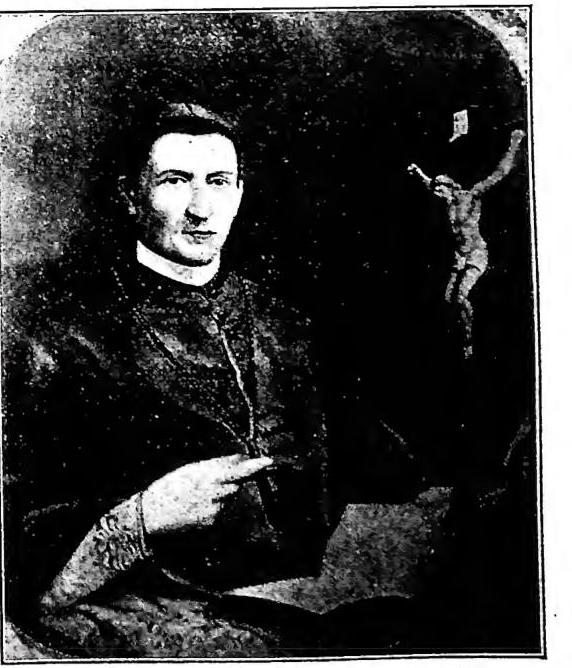
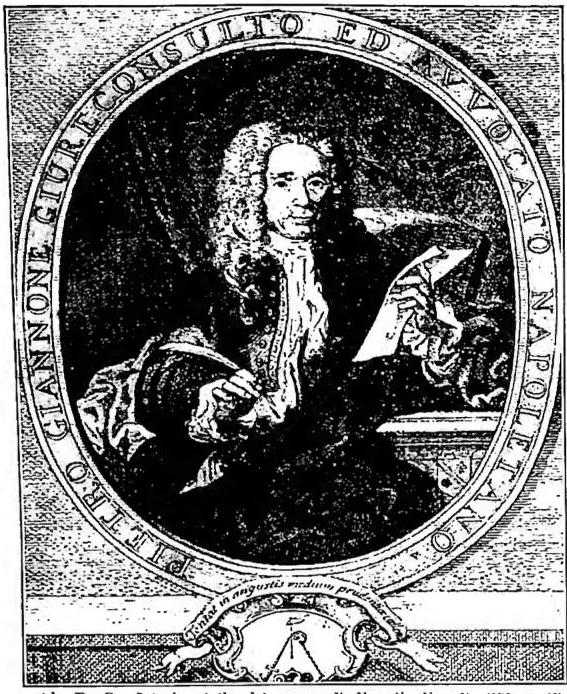
(from P. G., Istoria civile del regno di Napoli, Naples 1770, p. 12) GIANNONE, PIETRO - Portrait from an engraving by J. F. Sedelmeir.
G., in his major and minor works, in his initial sensationalism, his jurisdictionalism, and even his Socinianism, must be regarded as one of the writers who made an effective contribution to the affirmation of secular positions in the eighteenth century.