
FORTEZZA. — In its primary meaning it indicates robustness, vigor, energy, strength, both in the physical and in the moral sense. It may be considered: 1) as a natural moral virtue; 2) as an infused virtue; 3) as a gift of the Holy Spirit.
I. NATURAL MORAL VIRTUE. — Lessius defines it as: « the virtue that moderates the movements of the soul in enduring and regulating the terrible circumstances of existence, especially the dangers of life » (De iustitia et iure coeterisque virtutibus cardinalibus, Paris
1606, bk. III, chap. 1). More comprehensive is the definition of s. Tommaso, who calls it: « the virtue that removes the impediments and difficulties that turn the will away from accomplishing what is according to reason » (Sum. Theol., 2ᵃ-2ᵃᶜ, q. 123, a. 1).
In a broad sense, the term f. also denotes firmness of spirit in the fulfillment of one’s duty. Understood in this way, rather than as a special virtue, it may be considered the indispensable condition for the exercise of all the virtues. The same s. Tommaso calls it: « the condition of every virtue, because it entails, in an absolute sense, the firm determination of the will » (ibid., 1ᵃ-2ᵃᶜ, q. 61, a. 3). This virtue must not be confused with rashness, still less with ferocity, as sometimes happens in ordinary usage. Evidently, the object of a virtue can only be something honorable. Consequently, those who face even the gravest dangers for dishonorable reasons—for example, duelists, thieves, etc.—cannot be called courageous, but rather rash, ferocious, and so on.
II. INFUSED VIRTUE. — This is the supernatural strength that gives man the power to perform acts of f. meriting eternal life. Its material object is the same as that of the natural moral virtue of f. Its formal object, however, is no longer the natural goodness inherent in this virtue, but rather the moral goodness of an invincible fidelity to God. Whereas the former is directed according to the norms of natural prudence, the latter is directed according to the dictates of supernatural prudence. It is the virtue of the martyrs and of all those who suffer persecution for the faith. Indeed, the f. of the martyrs
(Int. Anderson)
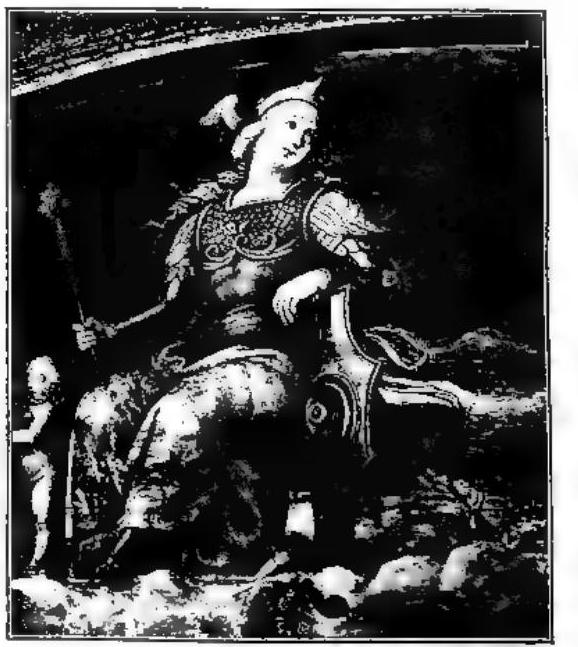
FORTEZZA — F. Fresco by Raffaello (1500) — Perugia, Collegio del Cambio.
is, moreover, a splendid argument for demonstrating the divinity of the Catholic religion. For this reason, nearly all those who discuss f. dwell at length on Christian martyrdom.
III. GIFT OF THE HOLY SPIRIT
It is the gift that perfects the virtue of fortitude by giving the will supernatural impulse and energy. It differs from the virtue in that it does not arise from our efforts, even when assisted by Grace, but solely from the action of the Holy Spirit. The virtue of fortitude does not remove a certain hesitation, a certain fear of obstacles and dangers; the gift of fortitude, on the other hand, replaces these with decisiveness and the sure hope of success, and thus leads to much greater results. A typical example is found in Act. 6:8, where St. Stefano is mentioned: “Stefano, full of grace and fortitude, performed wonders and great signs.” And further on: “Stefano, being filled with the Holy Spirit, fixed his eyes on heaven, saw the glory of God and Jesus standing at the right hand of God” (ibid., 7:55).IV. MEANS OF ACQUIRING II
To obtain it, in addition to prayer, the humble acknowledgment of our own helplessness is useful. Providence usually makes use of the weakest instruments, provided that they are conscious of their insufficiency, to accomplish the greatest undertakings (cf. I Cor. 1:27-29). Also helpful are patience in enduring the adverse circumstances of life and the small daily trials, perseverance in the effort to fulfill one’s duty precisely at all times, to bear with the faults of others, to overcome human respect, and to profess one’s faith openly. To do all this habitually is already heroism, that is, the virtue of fortitude carried to its highest peak.V. VIZI CHE SI OPPONGONO
Some oppose it by defect, for example, timidity; others by excess: foolhardiness and boldness.Timidity is an excessive fear in facing what one must do. Foolhardiness and boldness are contrary vices, occurring when someone, in order to overcome an imminent evil, does something inappropriate either in itself or with regard to the time or the manner.