Machine translation of the 1948–1954 Italian original. The original text is authoritative.
GENITORI. -
I. DEFINITION
Parents, from the Latin genitor, are those who have brought us forth into life. St. Thomas calls them: “the particular principle of our being, just as God is the universal principle” (Sum. Theol., 2ᵃ-2ᵃᶜ, q. 112, a. 5). For just as God created human beings, so parents procreated their children; just as God preserves creatures in their being and directs them to their end through his Providence, so parents guard their children with their care and govern and direct them to their end through their counsel and example. The relations of parents toward their children belong to natural law, since the domestic society is prior to every oth-
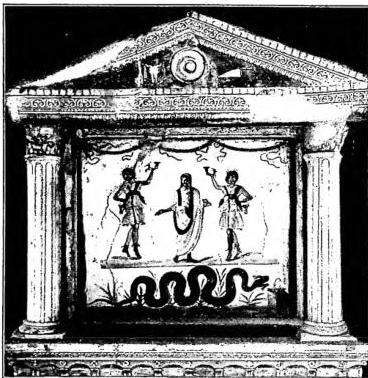
(phot. Anderson) GENIUS – Lararium with the G. flanked by two Lares. Below, the serpent, symbol of the ancestors – Pompeii, house of the Vettii.er form of society. It follows that any interference by the State aimed at arrogating to itself the task of educating children is illicit and arbitrary.
The principles of the advocates of this position are well known. Parents, they say, very rarely have the possibility of instilling in their children that education and those directives which are necessary for the common good of the society in which they will one day have to live and work. On the other hand, the State has requirements of unity and defence to which all must contribute their share. It is therefore the responsibility of the State to subject the various tendencies of parents to its own requirements, which are ultimately those of the community. Those who reason in this way forget that, although the State has the right and duty to intervene in and contribute to the education of citizens and even to replace parents when they are unable to do so, it cannot in any case modify or abrogate the dictates of natural law, since this has been inscribed in the heart of every human being by God himself. An opposite, but equally dangerous, error is that of those who, rejecting the authority of the State in the education of offspring, nevertheless maintain that parents too have no such right; since children are entirely independent of every authority, they alone have the right to choose the kind of education that most pleases them. Pius XI speaks at length of these and other errors concerning the rights and duties of parents in the encyclical Divini illius Magistri of 31 December 1929 and provides their refutation.
(phot. Andersen)
Cite this article
“GENITORI.” Enciclopedia Cattolica, vol. VI (1951), p. 28. Azione Romana digital edition, https://azioneromana.com/article/genitori.