
ACQUI, DIOCESE of. — City of Piedmont, on the Bormida, a tributary of the Po, in the upper Monferrato. It is the ancient Aquae Statiellae, center of the Ligurian Statielli, subjugated by the Romans around 163 B.C. It was a Roman municipium included in Regio IX, and its geographical position helped make it economically prosperous within a short time. Numerous monuments attest to the degree of civilization attained by A., among them the ruins of a grandiose aqueduct 14 km. long, which conveyed the waters of the Erro into the city. After the invasions of the Goths, A. was occupied by the Lombards in 568 and elevated to a duchy, subject to the more important duchy of Asti. Later, Charlemagne placed a count over it, as over the other cities. The establishment of the bishopric of Alessandria (1175), whose territorial expansion took place at the expense of A., caused wars between the two neighboring cities, and A. was often forced to seek the assistance of the marquis of Monferrato and even of Frederick II, who succeeded in having a peace treaty concluded between the two contenders in 1224. Plundered by Charles of Anjou (1273), it was retaken by the marquises of Monferrato and, after alternating vicissitudes and disputes, remained under their lordship. In 1533, when the last marquis of Monferrato (Giangiorgio Paleologo) died, the marquisate passed to the Gonzaga of Mantua. In the seventeenth century it was repeatedly occupied by the Spaniards and the French; in 1746 it passed to Carlo Emanuele III of Savoy. Devastated by the plague in 1630–31, it suffered further damage during the Napoleonic wars.
A., famous for its thermal waters, of which it is exceptionally rich, belongs to the province of Alessandria and has 16,553 inhabitants. It possesses fine palaces, including the episcopal palace, from the fifteenth century; the cathedral, begun by Bishop Primo, is attributed to s. Guido, who probably completed and inaugurated it in 1067, dedicating it to the Virgin Assumed into Heaven. Important vicissitudes have altered its original Lombard structure. On the portal stands out the lunette with bas-reliefs by Antonio Pilacorta da Lugano, depicting the Assumption of the Virgin. The apsidal part displays its original Romanesque character. The bell tower, in terracotta, is from the thirteenth century.
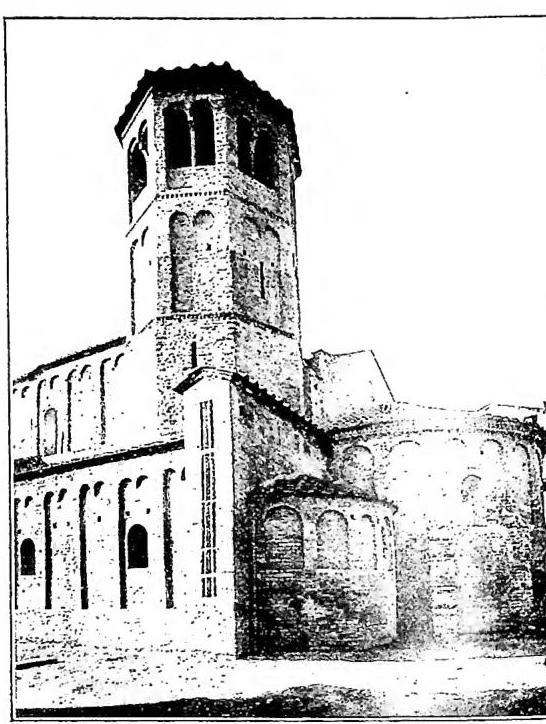
(Gab. Fateur, No. 1)
ACQUI – Exterior of the church of S. Pietro (12th century).
…were buried, recalls the name of Ditario, who died in 488. The reliable succession begins in 680 with Valentino. The cathedral was transferred by Bishop Dudone from the church of S. Pietro extra muros, built by the Lombard kings Ari- perto and Liutprando, to S. Maria. S. Pietro, burned by the Saracens and rebuilt by Bishop s. Guido, was granted by him to the Benedictine monks, who maintained a flourishing monastery there until the 15th century. The patron saint of the city is s. Guido, bishop from 1034 to 1070, whose feast is celebrated on the second Sunday of July; the ab immemorabili cult was approved by the S. Congregation of Rites in 1853. Son of the counts of Acquesana, he endowed the diocese with property and enriched the city with monuments and monasteries, including that of S. Maria, near the Cathedral, for Benedictine nuns.
A suffragan of Milan first, and from 1805 of Turin, the diocese of A. has 180,000 inhabitants, of whom 179,800 are Catholics; it comprises 90 municipalities in the province of Alessandria, 23 in that of Genova, 1 in that of Cuneo, 147 parishes, 267 diocesan priests, 46 religious priests, and 59 secular priests.