Machine translation of the 1948–1954 Italian original. The original text is authoritative.
WATERCOLOR. - A method of painting on a white or very light ground by means of transparent colors, prepared with gum arabic and glycerin and diluted with water, so that, without resorting to white pigments, the light tones are produced by leaving the ground uncovered or lightly veiled. Some obtain the purest whites by using a scraper. It is advisable to keep watercolors, since they are almost always small in size, under glass and not to leave them exposed to the rays of the sun (v. GUAZZO).
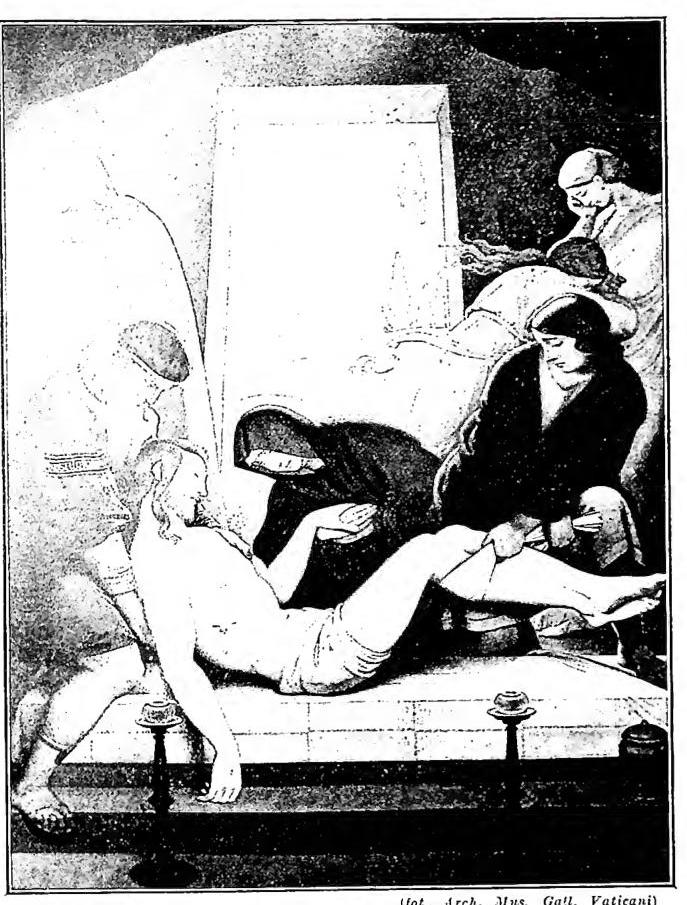
ACQUERELLO - Deposition, from F. Overbeck’s « Via Crucis ».This technique, which the Chinese employed on silk as early as the 3rd century B.C., has also been practised among us chiefly for sketches and studies or for colouring prints and drawings. Beginning in the 18th century, in Holland, England, Italy, and elsewhere, it was employed with subtle refinements by specialist artists who formed societies and organized exhibitions.
It has limited application in the field of sacred art, for which it can provide devotional stationery, ex-votos, and holy cards. Overbeck painted the stations of a Via Crucis in watercolour. - Vedi Tav. XXI.
BIBL.: C. Viguier, Nouveau manuel complet de miniature, de gouache, de lavis à la sépia, de l'aquarelle, et de peinture à la cire. Parigi 1845; H. M. Cundall, A History of British Water-colour painting, Londra 1929; S. Ricci, L'a. nella grande arte italiana, Milano s. a. Corrado Mezzana
Cite this article
“ACQUERELLO.” Enciclopedia Cattolica, vol. I (1948), p. 171. Azione Romana digital edition, https://azioneromana.com/article/acquerello.