
VIA CRUCIS. - It is customary to designate by this name the journey that Jesus, laden with the Cross, made from
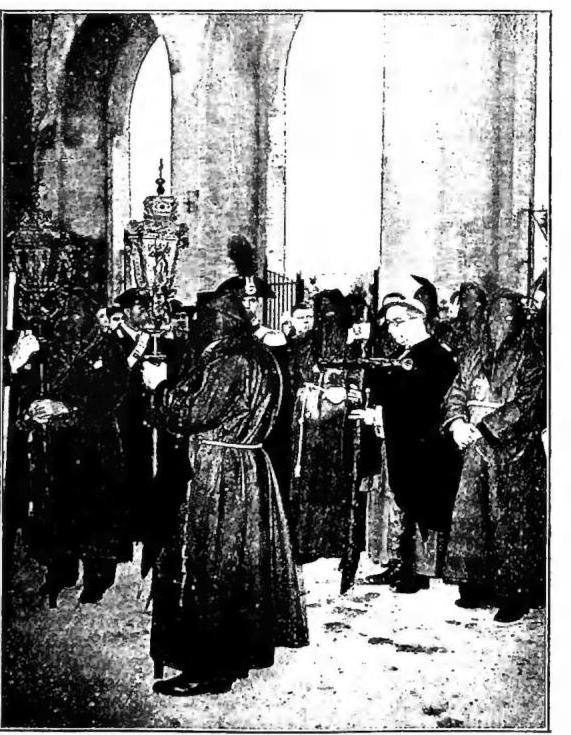
The origin of this devotion is unknown, but it undoubtedly received a strong impetus in the 12th-14th centuries at the time of the Crusades, when it became possible to reconstruct that journey ideally through the streets of the city. As the Crusaders and pilgrims returned to their own lands, they took care to erect in their countries memorials of Calvary, of the Holy Sepulchre, and of the other sites of the Passion in order to inspire the faithful and to kindle in them a greater devotion to the Passion of Christ.
The various stations were not fixed at the beginning and also varied in their subject matter, being the fruit of private devotion. It was only in the 18th century that the ecclesiastical authority intervened by fixing the number of stations of the V. C. at 14 and determining the episode commemorated at each individual station. Of these episodes, some are explicitly drawn from the Gospel, while others are a probable dramatization of it: the falls under the Cross, the meeting Veronica (v.). This gave rise in the 18th century to a literary controversy on the part of some scholars with Jansenist tendencies, such as Puiati and Ricci, of whom the former dared to propose a series of stations of his own invention.
In propagating this extraliturgical but soundly popular devotion, the Friars Minor distinguished themselves most, having already been entrusted since the 14th century with the custody of the Holy Places of Palestine. They spread this pious exercise everywhere, and in their churches and near their friaries they erected stations of the V. C., exhorting the faithful to remember the Passion of Christ and the Mysteries of the Redemption. Its principal promoter was St. Leonardo da Porto Maurizio, who in the course of his missions throughout Italy (1731-51) erected 572 V. Clement XII, on 3 Apr. 1731, through the Sacred Congregation of Indulgences, issued special Monita ad recte ordinandum devotum exercitium V. C., which still today, with some modifications made by the Apostolic Penitentiary on 13 March 1938, constitute the fundamental norm regulating the erection of the V. indulgences.
The provisions currently in force on the basis of the aforementioned decrees are: 1) the stations of the V. C. may be erected
in churches and in public and semipublic oratories, and also in private ones where Mass is celebrated by apostolic indult. For domestic oratories, special faculties are required, which are granted by the minister general of the Friars Minor. They may also be erected outside of churches, in cemeteries, along avenues, etc. - 2) The stations must be 14 in number, separated from one another, and above each there must be a clearly visible wooden cross, even if small. Stone or metal crosses are not permitted. That the individual stations be painted or sculpted is not strictly necessary, but it is recommended in order to impress the Mystery meditated upon more firmly on the minds of the faithful. - 3) In order that the faithful may gain the granted indulgences, it is necessary that the stations be canonically erected by a priest endowed with the proper faculty. The formula of blessing is found in the Roman Ritual. According to canons 239 and 349 of the CIC, cardinals, bishops, superiors of the Orders of Friars Minor, and priests of the same Orders delegated for this purpose by their respective superiors have the faculty to erect and bless the stations of the V. Apostolic Penitentiary. - 4) The faithful who perform the pious exercise of the V. time, provided they fulfill the conditions prescribed by the Church, and a partial indulgence of 10 years for each individual station, should they be unable to complete them all. To gain these indulgences, a bodily movement, even minimal, is required between one station and the next, as if to follow the path of Christ toward Calvary. However, when the crowd of faithful impedes their movement due to the narrowness of the place, it is sufficient that one person traverse the individual stations in the name of all, accompanied spiritually by the others. Special prayers are not prescribed for performing the V. C. fruitfully. It is only required to meditate during the visit of the stations on the Passion of the Savior according to each one's capacity.
Massimiliano Brandys
ART. - In the cyclical representations of the Passion of Christ that have come down to us from the late Middle Ages, the presentation
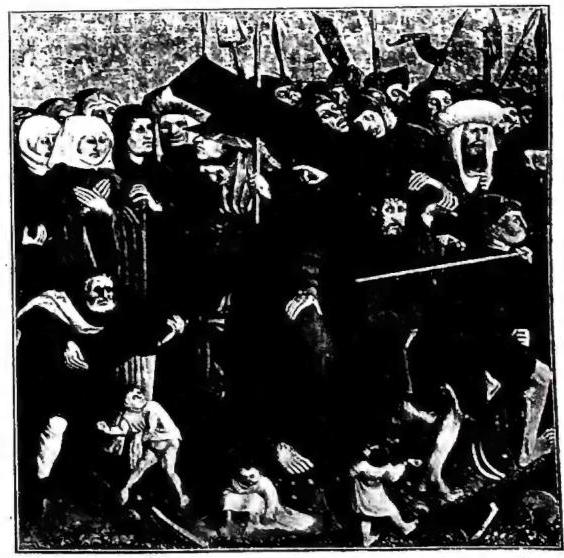
Series of depictions, presenting the unfolding of the Passion of Christ in an increasingly homogeneous manner, appear for the first time in the folk art of southern Germany around the middle of the 15th century. Initially they consisted of only seven scenes, and only in the 18th century did they reach the number of 14, by then called "stations."
The individual stations must depict, in the following order: 1) Jesus condemned to death; 2) Jesus laden with the Cross; 3) Jesus falling for the first time; 4) Jesus meeting his most holy Mother; 5) Jesus helped by Simon of Cyrene; 6) Jesus wiped by Veronica; 7) Jesus falling the second time; 8) Jesus consoling the pious women; 9) Jesus falling the third time; 10) Jesus stripped and given gall to drink; 11) Jesus nailed to the Cross; 12) Jesus dying on the Cross; 13) Jesus taken down from the Cross; 14) Jesus laid in the tomb.
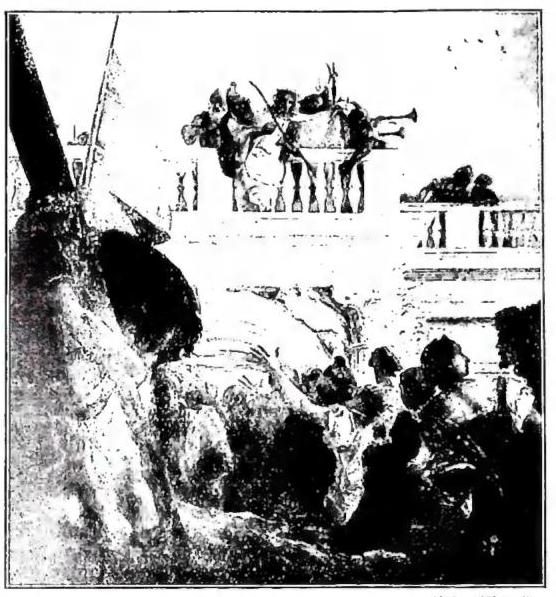
From the second half of the 18th century to the present day, the representations of the V. painting, prints, and sculpture are countless, though not many possess true artistic value. An exceedingly rare specimen of high value is the eighteenth-century V. S. Polo (Venezia), the work of Gian Domenico Tiepolo (v.). Truly good is the V. Treviso. Among those rendered in bronze, mention should be made in Roma of that in the church of Cristo Re and that in the church of S. Eugenio, executed by various sculptors. - Vedi t.V. CXL.