
PILATO, PONZIO. —
I. LIFE
Roman procurator of Judea at the time of Jesus.Descendant of the family of the Ponzi, of Samnite origin, already famous in the earliest days of the Roman Republic, P. is called a “knight” and must personally have been brave, as P.’s cognomen seems to indicate, deriving in all likelihood from pilum, javelin. He took pride in the title of “friend of Caesar” (Io. 19, 12), a sign of his nobility.
P. was the fifth Roman procurator of Judea. He succeeded Valerius Gratus in A.D. 26 and remained in office until 36. Appointed by Tiberius in the time of Sejanus, the sworn enemy of the Jews, he always showed great contempt for those under his rule. Herod Agrippa I, in a letter to Caligula, calls him “implacable, inconsiderate, and obstinate.” Such indeed he appears in the few episodes that history has preserved concerning him, transmitted by Philo and Josephus Flavius. His downfall was caused by the Samaritans, who denounced him to Vitellius, governor of Syria, following an act of cruelty committed against them. Vitellius deposed P. and sent him to Rome to answer for his conduct before the Emperor. P. arrived in Rome at the beginning of 37, Tiberius already dead: from that time onward he disappears from history.
Apart from the account of the trial of Jesus Christ, in which P. plays so great a part, he is mentioned six times in the New Testament, three times by his full name, in Lc. 3, 1; Act. 4, 27; I Tim. 6, 13; and three other times by his cognomen alone, P.: Lc. 13, 1; Act. 3, 13; 13, 28. In passing, St. Luke (13, 1) refers to an episode of cruelty in which P. had a group of Galileans killed in the Temple while they were offering sacrifices.
What made P. infamously famous was the trial and condemnation of Jesus Christ. Throughout the proceedings, P. conducted himself uncertainly. Toward Jesus Christ he showed himself respectful and almost favorable: he repeatedly declared him innocent (Mt. 27, 23; Mc. 15, 14; Lc. 23, 4. 14. 22; Io. 18, 38; 19, 4. 6), and for a long time refused to accept the request for condemnation submitted by the members of the Sanhedrin; indeed, he tried to free him: he sent him to Herod (Lc. 23, 6-15); he proposed inflicting a punishment on him in order to placate the people (ibid. 23, 16); he tried to exercise the right of pardon in his favor (Mt. 27, 15-21; Io. 18, 39 ff.); he displayed him to the people crowned with thorns, in order to move them to compassion (Io. 19, 4-6). Nevertheless, in addition to having him scourged, he finally pronounced the sentence of death on the cross, precisely as the members of the Sanhedrin demanded, to whom he did not wish to yield. From the outset he had realized that they had brought Jesus before him, moved by envy toward him (Mt. 27, 18),
and then he adapted himself to the change in the accusation, which became political instead of religious, and condemned the innocent man. St. John (18 and 19) reveals P.’s character: cynical, yet possessing the Romans’ innate sense of justice; insensitive to higher principles and superstitious; hostile to the Jews and extremely sensitive to his own advantage, for which he went so far as to sacrifice a man’s life. He decided to pronounce the condemnation when he heard them cry: “If you release him, you are not a friend of Caesar!” (Io. 19, 12).
Legend provides details concerning P.’s end. After his arrival in Rome, history ceases to speak of him. Legend, however, varies so greatly that it ranges from making him a suicide to proclaiming him a saint. According to Eusebius (Hist. eccl., II, 7: PG 20, 155), he was exiled to Vienne, in Gaul, where he committed suicide; according to Malalas (Chronographia, 10: PG 97, 390), he was beheaded by Nero. A violent death was probably P.’s miserable end.
II. APOCRYPHA OF P
A complex of mutually complementary apocryphal writings, composed of primitive parts and later additions. The primitive nucleus seems to have consisted of Christian writings of the 2nd century, recounting the Passion, death, descent into limbo, and Resurrection of Jesus, brought together under the general title of Acta Salvatoris or, as it is preserved in the Greek recension of the present Acta Pilati, Ἑκονήματα τοῦ Κυρίου ἡμῶν Ἰησοῦ Χριστοῦ πραχθέντα ἐπὶ Ποντίου Πλάτου. Other writings were subsequently added, containing P.’s notification of what had happened concerning Jesus, and the punishment inflicted upon him and the Jews for the condemnation of the divine Innocent. Seven works belonging to this collection may be distinguished.1. Acts of P
A writing that has come down in two Greek recensions, very different from one another (A and B), one Syriac, one Coptic, one Atmenian, and two Latin ones (A and B). It seems already to have been known to St. Justin (Ap., I, 35 and 48: PG 6, 384 and 400) and to Tertullian (Apol., 21: PL 1, 461). It consists of two parts, both subsequently completed, containing: the first, the trial of the Redeemer before P.; the second, the burial carried out by Joseph of Arimathea. The primitive part seems to have been written, shortly after the events, by a Jewish Christian; it was completed soon afterward. The original language was Aramaic. In 425 the apocryphon was found by a certain Aenia, who translated it into Greek and published it with a preface; the recension from which the other recensions known today derive dates from that time. It has an unmistakably apologetic purpose. If the author was not himself a witness of the events, he used the Gospel narrative as a background, adding a considerable amount of his own material, drawn from testimonies transmitted orally and well known to his contemporaries.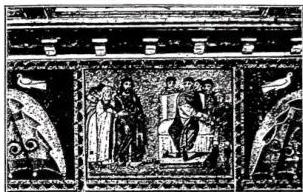
(phot. Alinari)
PILATO, PONZIO — P. washing his hands. Sixth-century mosaic. Ravenna, basilica of S. Apollinare Nuovo.
to his house. Summoned before the council, he recounts his own liberation. Then news arrives of the Savior’s Ascension: at that point faith in him begins to make its way into those hearts.
2. Descent of Christ into the Underworld
This apocryphal work is often found, especially in the Latin versions, following the preceding one; it is generally absent from the Greek codices, as well as from the Coptic version. It is preserved in a single Greek recension, whereas there are two Latin ones for this work as well. It too was written by a Jewish Christian. Nevertheless, it constitutes a distinct and independent work, only later added to the Acts of P., of which it is a confirmation and complement. C. Tischendorf dates it to the beginning of the second century or even to the end of the first century A.D.; L. Darley asserts that it belongs to the first years after the events narrated.It contains the account of Christ’s descent into limbo and of what took place there, written by the two sons of the old Simeon, Leucius and Carinus, raised from the dead by the risen Jesus.
Jesus takes Satan prisoner, brings out the just, and entrusts Adam to the Archangel Michael, who carries him to the Earthly Paradise, where Enoch, Elijah, and the good thief are found. At the end of the little book, many codices place a Letter of P. to Claudius, in which he recounts what occurred during his governorship: the Jews’ accusations against Jesus, his credulity toward their words, and Jesus’ condemnation. He nevertheless rises again; but since the Jews had sought to corrupt the witnesses, P. wishes to warn the Emperor against their lies.
3. Letter of P
It is preserved in some Latin codices, none of them Greek; its author and date are uncertain. It is also known as the Second Letter of P., addressed to Tiberius. It presupposes the first. In the codices it follows the account of the Descent into the Underworld, and seems to date from no more than a few decades after P.’s misfortune and his return to Rome.In it P. apologizes for having had to condemn Jesus, a most devout man, saying that he was compelled to do so by the Jews, all united in desiring his death, which was then accompanied by unprecedented prodigies. He also states that he wished to avoid seditions and preserve the Emperor’s authority.
4. Gospel of Nicodemus
This is not a new apocryphal book, but the combination of the Acts of P. with The Descent of Christ into the Underworld.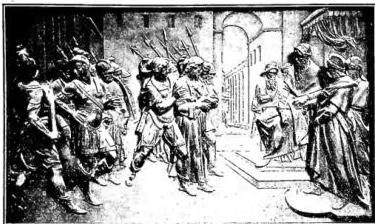
5. Anaphora Pilati
Also known by the name of Epistle of P. to Caesar, it is nevertheless completely different from the letter to Claudius. It is a report that P. makes to the emperor Tiberius concerning what happened in Palestine with regard to Jesus. It tooPILATO, PONZIO - Christ before P. Detail of the bronze altar by Giambologna (16th century) - Florence, church of the Most Holy Annunciation.
Very ancient, it is preserved in two Greek recensions, fairly similar to one another. It is not found in Latin codices.
P. writes that the Jews handed Jesus over to him, accusing him especially of having violated the Sabbath. Jesus, on the other hand, had always shown himself to be good and had benefited many, even through miracles. Provoked by the disturbances, he first had Jesus scourged, then condemned him to death. The Jews crucified him. When he was on the Cross, the sun was darkened, the earth quaked and split open, and many dead arose. On the night after the Sabbath, Jesus himself rose again and called back to life those who were in Limbo. Many Jews hostile to Jesus were swallowed up by the earth, and all the synagogues of Jerusalem were destroyed.
6. Paradosis Pilati
It is the continuation or, better, the consequence of the Anaphora, probably by the same, unknown author. Preserved only in a few Greek codices.After receiving P.’s report, the Emperor became furious and ordered him to be imprisoned. On arriving in Rome, he was subjected to a solemn trial and condemned to death. The Jews too were punished, some with death, others with slavery.
7. Vindicta Salvatoris
This too concerns the relations of the Romans with the Savior. Preserved only in some Latin codices, by an unknown author.It must date back to the time of Claudius, at least in the primitive recension, which is very brief and formed the original nucleus of the longer one. The Latin recension, as it has come down to us, is certainly composed of several writings, as is shown by the repetitions found in II. In the primitive part, the punishment of P. and the Jews, inflicted by Titus and Vespasian, is narrated. To this part there was subsequently added the account of a mission by Velusianus, who here is said to have been sent by Titus and Vespasian: he goes to Palestine, seeks an image of Jesus; he finds Veronica’s handkerchief and brings it to Rome, where it is venerated by Tiberius, who by this act merits healing from his infirmities and has himself baptized.
In conclusion: besides the Acts of P. and the Descent of Christ into Hell, it appears that the various Letters of P. and the Vindicta Salvatoris, preserved in Latin, correspond to the Anaphora and the Paradosis Pilati of the Greek codices: they have the same aims, but are independent of one another. Nevertheless, both derive from a common, official source, and seek to complete the cycle of the Acta Salvatoris. Later studies may clarify several points that are still obscure.
la Vindictes. Leurs origines et leurs transformations, ibid. 1919; P. Vannutelli, Aeterum Pilati textus synoptici, Rome 1938. Fedele Pasquero
III. ARCHAEOLOGY
The figure of P. in the judgment of the Lord also entered into representations of ancient Christian art, especially on sarcophagi. Garrucci, Le Blant, and others published nineteen examples of sculpture; Wilpert published a further nine, though fragmentary. The sarcophagi, which derive from a Roman prototype, are, with the exception of nine, of the type whose front is divided by columns: in these, generally, the scene of P.’s judgment is on the right; the tribunal is indicated by the suggestus, with the judge’s seat, the hourglass for determining the time allotted for the conduct of the trial, the judge’s assessors or counselors, the soldiers accompanying the accused, and P., beside whom is the servant preparing to wash his hands. The most noteworthy sarcophagi are: the Lateran 55, known as that of the “two brothers,” and the Lateran 174, now in the Vatican Grottoes, like that of JuniusBassus. The scene is also found on one of the front columns of the ciborium of the high altar of S. Marco in Venice (6th century); on the lid of the lipsanotheca in the Museo civico of Brescia (4th century); there Christ is held by two soldiers, while P. washes his hands; on the ivory diptych in the Treasury of the cathedral of Milan (5th century), where P. washes his hands while G. Christ is led away by a soldier, as in the ivory in the British Museum of London (early 5th century) and on the bronze door of the cathedral of Salerno (13th century). Of singular interest is the same episode in the mosaics (early 6th century) in S. Apollinare Nuovo at Ravenna: Christ, accompanied by a soldier, is to the right of P., who, seated on the judicial chair and flanked by several figures, washes his hands.
Finally, mention may be made of the so-called “basin of P.,” which is located in the courtyard bearing that name, amid those buildings—churches and oratories—that constitute the basilica of S. Stefano in Bologna. It is a small marble basin of archaic workmanship, a gift of the Lombard kings Liutprand and Ilprand. Discovered during an excavation, it was believed to be the basin in which P. washed his hands; it was placed on a base by Cardinal Giovanni de’ Medici, later Leo X.