Machine translation of the 1948–1954 Italian original. The original text is authoritative.
URBAN I, POPE, saint. - He succeeded Callistus (d. 222) and governed the Church for about 8 years until 230. The author of the Liber Pontificalis describes him as a Roman, son of Pontianus, who died on May 19 and was buried in the cemetery of Praetextatus.
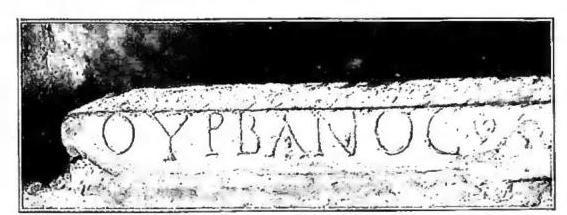
In fact, a certain Urban, described as a "confessor," was buried in this cemetery; he is mentioned in the Papyrus of Monza and in the 7th-century Itineraries (the Notitia ecclesiarum also adds "bishop," perhaps following the tradition of the Liber Pontificalis). The Pope was buried in the cemetery of Callistus; in the popes' crypt, De Rossi found a fragment of a sarcophagus lid with the letters OVPBANOC E (πέσκο-
URBAN I, POPE, saint - Greek inscription of Urban (3rd century). Rome, cemetery of St. Callistus. (courtesy of Prof. E. Jovi)205), and Urban's name was found in an inscription placed in the same crypt by Pope Sixtus III. The Urban buried in Praetextatus could be the confessor whom Pope Cornelius says adhered for a time to the schism of Novatian (Eusebius, Hist. eccl., VI, 43). The Martyrologium Hieronymianum commemorates the Pope in Callistus on May 19, the other Urban in Praetextatus on the 25th of the same month; the Gregorian Sacramentary, however, has the Pope's Mass on this latter date. The entry in the Roman Martyrology for May 25 is entirely incorrect.
Nothing is known about Urban's life, nor is there any evidence that he was a martyr. The author of the Passio s. Caeciliae (BHL, 1495) introduced him among the protagonists of his narrative, Tiburtius and Valerian, buried in the cemetery of Praetestatus; the Passio of Urban himself, written almost as a complement to the previous one, is entirely legendary.
BIBL.:Lib. Pont., I, pp. SCIII ff., 143 ff.; Acta SS. Mali, VI, Paris 1866, pp. 4-22; G. B. De Rossi, La Roma sotterranea cristiana, II, Rome 1867, pp. 33-54; G. Wilpert, La cripta dei papi, ibid. 1910, p. 17 ff.; Martyrologium Hieronymianum, pp. 262, 273; H. Delahaye, Étude sur le légendier romain, Brussels 1936, p. 80 ff.; Martyrologium Romanum, p. 207; R. Valentini-G. Zucchetti, Cod. topogr. della città di Roma, Rome 1942, p. 86.
Cite this article
“URBANO I, PAPA, SANTO.” Enciclopedia Cattolica, vol. XII (1954), p. 568. Azione Romana digital edition, https://azioneromana.com/article/urbano-i-papa-santo.