
VEZZOLANO. - Abbey of Canons Regular of St. Augustine, dedicated to the Most Holy Mary, in the diocese of Casale (Piedmont), in territory that formerly belonged to the diocese of Vercelli.
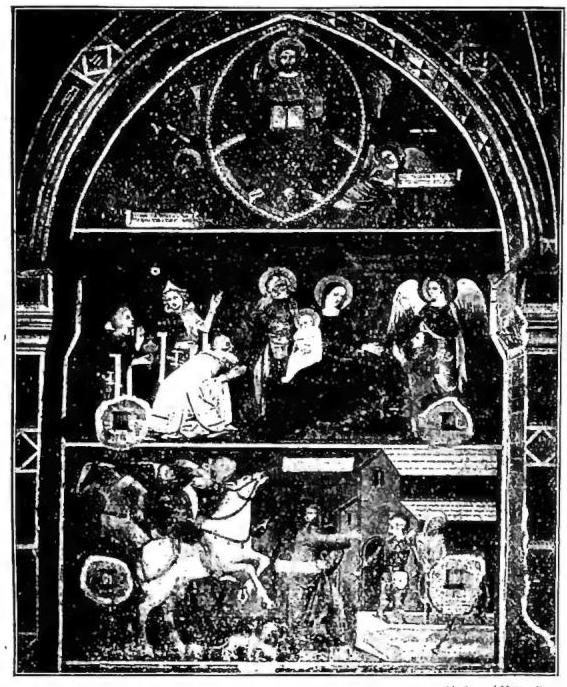
A legend attributes the founding of the abbey to the sudden appearance in that place of three skeletons to Charlemagne during a hunt. The abbey, founded in the 11th century, was completed in 1189, in the time of Frederick Barbarossa and of provost Vibone, as is indicated in an inscription in Leonine verses. The church, originally with three naves divided by pillars, was later reduced to two because the lesser southern nave was sacrificed for the construction of the cloister. At the height of the third pillar, across the entire width of the nave, a great lectorium was built with five decorated arches, with steps for climbing up onto it like a pulpit. The temple has in its Romanesque facade two portals: in the larger one are carved St. Gregory the Great, an angel and a deacon, and on the imposts of the arch the symbols of the Evangelists Mark and Luke. Above this portal are three galleries; in the second, in a bifora, are the statues of two angels and of St. Peter; at the top, the head of the Savior. At the high altar is a panel in relief representing the Madonna with the Child and a monk presenting the emperor Charlemagne to St. Augustine. To the right of the apse one enters the quadrangular cloister with octagonal pillars on two sides, on the third side with cylindrical pillars, on the fourth with biforas. On the walls are 14th-century frescoes, among them the Redeemer in majesty, the Madonna with the Child, the four doctors of the Church, the Epiphany, the episode of the apparition of the three skeletons to Charlemagne, with sculptures representing in the lower zone 35 patriarchs of the lineage of David and in the upper zone episodes from the life of the Madonna. The abbey was suppressed in 1797. Recently the monument was isolated, by removing the buildings that had been leaning against it on the south, and the church and cloister were restored.
Bibliography3 works
Enrico Josi