
MANNING, HENRY EDWARD. — Cardinal and archbishop of Westminster, born on 15 July 1808 at Totteridge, died at Westminster on 14 January 1892. Of a distinguished family particularly attached to the High Church, he grew up in an entirely anti-Catholic environment. Although at Garrow School (which had latitudinarian tendencies) he had shown a greater passion for horses than for books, at the age of 19, with the help of John Anderson, he entered Balliol College, Oxford, where he revealed the first signs of that strength of will which distinguished him throughout his life. The motto he then adopted, aut Caesar aut nihil, expressed the lofty aspirations of the twenty-year-old, whose political career was cut short by his father’s financial collapse (1831). Having entered ecclesiastical life, he immediately achieved success in it: ordained on 23 December 1832, he shortly afterwards became parish priest of Lavington, where he married the daughter of his predecessor, Carolina Sergent. Soon widowed and childless, he was recommended to the newly appointed bishop of Chichester, who named him his archdeacon (1841). In these offices he distinguished himself through his zeal on behalf of Anglican missions and, above all, through his oratorical gifts, which he displayed in the speeches of the decade 1840–50.
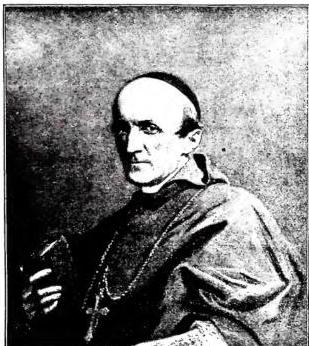
(from E. Soderini, Il pontificato di Leone XIII, I, Milan 1932, pl. 36)
MANNING, HENRY EDWARD — Portrait.
of the facts that Newman reviewed in his celebrated essay. M., who had then settled in London, refused the highly coveted appointment as the queen’s chaplain; an illness that confined him for several months accelerated his inner process (1847); a journey to Rome (1848), contact with distinguished Catholic personalities, and the Anglican scandal of Hampden and Gorham brought him to the threshold of the Church. The decisive event occurred when Pius IX, on 29 September 1850, restored the Catholic hierarchy in England (12 bishops headed by the archbishop of Westminster, Cardinal Wiseman). The cry “No popery” once again rang out in meetings and public squares; M., as archdeacon of Chichester, was obliged, at the order of his bishop, to convene an assembly of the clergy to protest against the brief of Pius IX; he obeyed, but at the end, to everyone’s astonishment, declared that he no longer belonged to the Anglican communion. On 6 April 1851 he made his abjuration and placed himself at the disposal of Cardinal Wiseman, who ordained him a priest (15 June 1851) and sent him to complete his studies in Rome, where he obtained a degree in theology on 25 January 1854. Returning to England, in 1856 he founded the Oblates of St. Charles, a congregation of priests destined to preach in working-class districts; the following year he was appointed provost of the Chapter of Westminster. From that moment disagreements arose with that part of the clergy headed by Msgr. Errington, coadjutor bishop with right of succession, who could not tolerate the superiority of a convert and an “ultramontane.” Incidents were not lacking, and Pius IX, called upon to judge, decided de iure in favor of Errington; de facto, upon Wiseman’s death (1865), he appointed M. archbishop, and M. was consecrated on 5 June 1865.
M.’s long episcopate (1865–92) bears the imprint of his strong personality: a man of action, sustained by a will ever ready and extraordinary courage, he transformed his archdiocese, providing it with docile and well-prepared priests, founding the Seminary of St. Thomas at Hammersmith, multiplying churches, missions, and schools, caring for the immigrant Irish, and obtaining favors for Ireland from the government.
Destined in his youth for a political career, as a bishop he knew how to deal skillfully and successfully with the great affairs of the Church: in the question of the Papal States, so vital when he was working alongside Cardinal Wiseman, he showed himself a rigid temporalist in the work The temporal power of Vicar of Jesus-Christ (London 1861). On this point his ideas were greatly moderated through contact with reality, as is apparent from his intimate notes. M. fought his greatest battle at the First Vatican Council, where he proved a fervent defender of papal prerogatives, especially infallibility; his public interventions in the Assembly were rare, but in the corridors of the Council he carried out important work of clarification and persuasion. He had prepared for this work through his learned pastoral letters on the subject, which, collected together, formed the volume Petri privilegium (London 1871). After the Council he dispelled Gladstone’s insinuations in the work The Vatican decrees in their bearing on civil allegiance. A political exposition (ibid. 1875) and outlined the events of the great assembly in The true story of the Vatican Council (2nd ed., ibid. 1878). Unfortunately, the enthusiasm for Rome that he displayed in 1870, and which led him to be called the prototype of English ultramontanism, diminished somewhat under the pontificate of Leo XIII, without this cooling affecting his faith as a Catholic or his loyalty as a bishop. After 1870 he had to confront the question of elementary education. The State subsidized secular schools for the benefit of a minority, leaving the independent schools of the majority (Anglicans, Methodists, Catholics) in an inferior position. M. strongly opposed this injustice and, although he did not obtain legislative changes, through his timely interventions he prepared the moral détente that led the English government to a better assessment of Catholic claims. As for university education, M., contrary to Newman’s opinion, never permitted Catholics to attend Oxford or Cambridge, considering the foundation of a Catholic university necessary; the undertaking failed, partly because, excluding Newman, he employed a man who possessed neither the genius nor the prestige of the person excluded. He fought his most glorious battle on the social front. Some even called him a socialist, but his campaign was inspired by the Gospel; the culmination of this activity was what has remained in history under the name of the “cardinal’s peace”: the strike of one hundred thousand dockers (unorganized and poorly paid workers) threatened civil war; all the authorities’ negotiations had proved fruitless when M. went to the employers’ headquarters and settled the difficult dispute amid universal rejoicing (1889).
M. was a man of action and subordinated his facile pen to it: his numerous works prepared for or followed the most important acts of his pastoral activity and, while they reveal neither profound thought nor new formulations, they possess a particular unction and unmistakable turns of phrase that make them acceptable to every kind of reader. Their dissemination and their many translations into French and Italian are therefore understandable. In addition to those already mentioned, the following should be noted: The grounds of faith (London 1852); The love of Jesus to penitents (ibid. 1863); The internal mission of the Holy Ghost (5th ed., ibid. 1875); The glories of the Sacred Heart (ibid. 1876); The eternal priesthood (ibid. 1883), his most popular work. M.’s life ended in an apotheosis: as early as 1875, at the time of his elevation to the cardinalate, all England expressed sincere admiration for him; the English government too, on various occasions, acknowledged the moral superiority of the eminent archbishop. He made the Roman purple popular in the land of Elizabeth: in 1850 Cardinal Wiseman was received with the cry of “No popery”; in 1875 Cardinal M. was greeted by the cheers of everyone; and in 1892 his coffin, adorned with the symbols of his dignity, was saluted by the great with reverence and followed by the people with affection and regret.